Sunlight as a Myth
Chasing SunlightSunlight as a Myth is the dominant cognitive state of the world before Jonathan Heights reaches Bright Defile: a conviction that the sun belongs to stories rather than experience. The belief makes the eternal darkness appear permanent, allows artificial illumination to stand in for nature, and turns Jonathan’s testimony into an object of ridicule. His expedition gains its decisive force by treating that shared disbelief not as settled truth but as a boundary that can be crossed.
Definition and Social Context
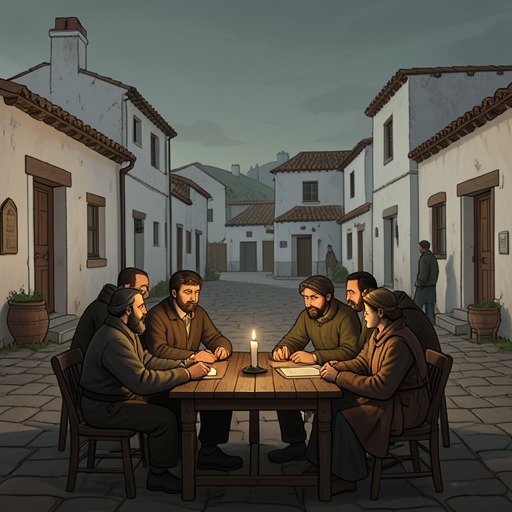
Sunlight is publicly dismissed in the opening exchange as a myth. Captain Montgomery’s blunt statement, “Sunlight is a myth,” expresses more than personal doubt: it voices the common understanding of a civilization living beneath lightless skies and sustained by manufactured illumination. The world’s human communities keep a vigil of light against the eternal darkness, and the available evidence of civilization is correspondingly technological and political rather than natural. The Illuminated King’s authority, the Reflected Council’s influence, and the zint-lit settlements all belong to a system that has learned to survive without the sun.
That belief also organizes the boundary between human civilization and everything beyond it. At Danby’s Point, the illuminated track reaches the easternmost terminus of human settlement beneath a tall zint-lit tower, while the plateau’s alien lights and constructions press against the straight lines of human architecture. A great metal gate divides the human quarter from darker forces, yet the architecture on either side visibly influences the other. The setting makes “light” a cultural category as much as a physical one: human order calls itself illuminated, while eastern peoples and nonhuman forms are pushed into the vocabulary of darkness, danger, and aberration.
Jonathan Heights and the Rejection of Disbelief
Jonathan Heights does not merely argue that sunlight exists; he claims direct sensory knowledge of it. When Captain Montgomery asks what it looks like, Jonathan describes it as the most beautiful thing he has ever seen and recalls a single ray descending from the heavens. Its clarity and purity have burned themselves into his soul, leaving the rest of the world faded by comparison while giving him strength and purpose. The myth therefore has two incompatible meanings in the narrative: to society it is a laughable fairy tale, but to Jonathan it is the most authoritative fact of his life.
His certainty becomes the stated reason for an expedition aboard the Endeavor, even though the airship is barely serviceable, with a damaged envelope, melted and dissolved sections, and superstructure cracked by luminiferous detonation. Jonathan presents the venture as a pursuit of something more compelling than ordinary exploration. He recruits Captain Montgomery partly because the captain brought the wrecked vessel back to port, has long flying experience, and is desperate enough to accept the risk. The ruined condition of the Endeavor contrasts with Jonathan’s confidence: the expedition begins from material failure, but is driven by an immaterial claim that he refuses to abandon.
Jonathan’s conviction is not softened when others mock it. Eleanor McAvey treats the claim as an old fairy tale and expects that, without gold, she may need to invent another explanation for the journey. Jonathan answers that anyone who had seen sunlight would understand. When questioned by Eleanor after a confrontation, he states that the expedition is “for keeps” because he has found sunlight, and he responds to her disbelief with the same insistence rather than supplying proof. André Ludwig likewise calls it a fairy tale, although his encounter with forbidden knowledge has already shown him that some things cannot be unlearned. Jonathan confirms that he was not lying about having seen sunlight, while refusing to disclose more than the pursuit itself.
Institutional Doubt and the Politics of Proof
The Illuminated King’s interest reveals that sunlight is not merely a private superstition. Information that Jonathan has found it reaches the throne, and the Illuminated King announces that the monarchy has a stake in the matter. A royal agent is assigned to safeguard those interests, while Jonathan receives the Illuminated King’s token, an inscribed white coin that glows faintly and appears in his hand without his understanding of how it arrived there. The supernatural manner of the token’s arrival deepens his distrust of the monarchy and gives the alleged myth a political value: the crown wants access to what Jonathan has encountered, even while its civilization depends on denying or controlling realities beyond its walls.
Antomine, the royal agent, embodies a more militant response to the same uncertainty. Trained chiefly as a chaplain but also skilled in languages and zint weaponry, he declares that humanity belongs to the light and that secrets drawing people away from it must be purged. His doctrine converts ignorance into a protective discipline. Alien materials are forbidden not because their practical value is unknown, but because their hostility to “good and honest light” is treated as sufficient evidence of moral contamination. At the eastern frontier, Antomine similarly argues that threats cannot be ignored merely because confronting them is inconvenient; civilization, in his view, is built by doing more than the minimum for those who come after.
This doctrine reaches its sharpest expression when Antomine confronts Ukari. He insists that the Illuminated King has no interest in adopting powers that dwell in the dark, while Ukari answers that the king hides behind walls and denies the darkness surrounding him. Antomine replies that humans do not bend to darkness but bend darkness to suit themselves, and that walls put borders on it. Sunlight as a Myth thus supports an ideology of containment: the absence of the sun can be endured so long as humanity can name its own artificial lights as civilization and keep the unknown beyond controlled thresholds.
From Legend to Encounter
The expedition repeatedly tests the practical consequences of rejecting the myth. Jonathan uses maps, reports, and negotiations to guide the party eastward, including dealings with Tiuni at Danby’s Point. Tiuni supplies information about shifting caravans, the Verdant Expanse, ancient ruins, and the movements of eastern forces and beasts. The knowledge is useful precisely because the region cannot be mastered by inherited human assumptions. Jonathan’s maps narrow the possible routes, while the party’s contact with fractured beings and other nonhuman inhabitants exposes how unstable the division between familiar humanity and supposed darkness really is.
Yet Jonathan’s goal remains distinct from ordinary imperial expansion or commercial exploration. He is willing to study unfamiliar lands and use their information, but he resists allowing the expedition to become an extension of the Inquisition. When Antomine urges a campaign against Umbraught in Angkor Leng, Jonathan argues that they are not a navy and lack the time and resources to cleanse a city of that size. His refusal is not a rejection of danger; it is a refusal to let the institutional meaning of light displace the expedition’s single purpose. The journey exists to reach sunlight, not to make every eastern threat conform to the western order.
The final movement overturns the belief decisively. At Bright Defile, sunlight does not remain a report, metaphor, or disputed memory. Its presence compels disclosure, and Antomine admits that a man like Jonathan mastering secrets beyond even the Illuminated King’s comprehension threatens everything the king has built. Jonathan crosses the final barrier by using his cane as a thin sword-blade and sacrificing it to bridge the last impossible stretch. The object that has accompanied his controlled, carefully presented identity is abandoned at the threshold, and the act converts conviction into physical passage.
Consequences and Narrative Significance
Inside Bright Defile, Jonathan encounters a green country, white clouds, a blue sky, and the sun itself, older and vaster than anything he had imagined. He feels its warmth on his face, freedom in the wind behind him, and the liberty of truth before him. His smile supplies the simplest resolution to the world’s longest denial: sunlight was not a myth, although nearly every institution and traveler had treated it as one.
The revelation does not restore the old order. A flash of light projects Jonathan’s enormous silhouette westward, stretching from the furthest east to Beacon, where the Illuminated King stands in his tower. For a moment Jonathan appears as a titan bestriding the world before the image disappears. The final image makes the discovery both personal and political. Sunlight frees Jonathan from the belief that confined humanity, but his passage also casts a shadow over the civilization that made disbelief into law, doctrine, and habit.
The state therefore functions as more than an early misunderstanding corrected by later evidence. It structures the book’s central opposition between inherited certainty and direct encounter, between artificial illumination and the sun, and between walls that contain darkness and truth that exceeds containment. The narrative ultimately leaves the category of myth behind: once Jonathan enters Bright Defile, sunlight becomes a fact, while the supposedly stable institutions built around its impossibility are exposed as the more fragile illusion.