Terminus Stay and Departure
Chasing SunlightTerminus Stay and Departure marks the point at which the Endeavor’s expedition confronts a new kind of danger: not a visible monster or hostile city, but a settlement so clean, welcoming, and orderly that its very harmlessness becomes suspicious. Found in the wilderness around a terrestrite vein, Terminus offers repair, supplies, books, food, and apparent safety. Yet its hospitality gradually separates the expedition from itself, as crew members abandon the ship and Jonathan Heights concludes that the town’s true weapon is temptation.
Discovery of an Impossible Settlement
The encounter begins when the Endeavor approaches what should have been an isolated terrestrite vein and instead finds rumbling machinery, a bright town, tall white walls, sturdy mooring towers, and busy streets. Human infrastructure appears to have been established far beyond the ordinary reach of Beacon, producing what Jonathan recognizes as an impossible flame of civilization in the wilderness. The mooring towers display inviting green lights, human figures move about the port, and the settlement is plainly preparing to receive the arriving airship.
Jonathan accepts that Terminus is physically real, but he refuses to regard it as genuine in any moral or political sense. A clean, well-supplied town could not have appeared in only a few years without a trace of the undertaking in Beacon, especially when every pound of metal and stone would have had to be transported by airship. Antomine reaches a similar conclusion from the perspective of the Inquisition, questioning where the inhabitants and their supplies came from. Their shared suspicion establishes the central tension of the stay: Terminus is not an illusion, but its existence seems to violate the expected order of the world.
The Port and Its Hospitality
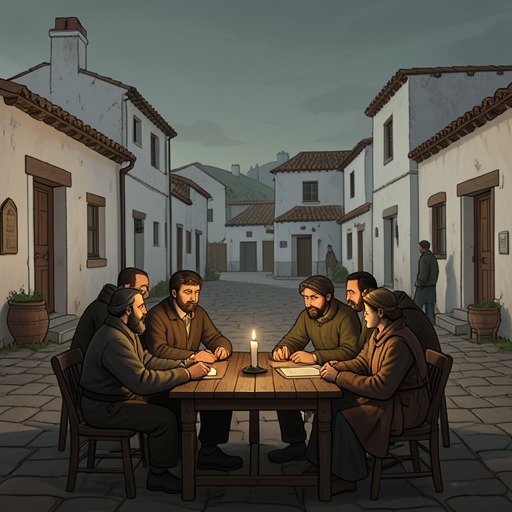
Jonathan and Antomine descend to the mooring towers in flight suits, with zint engines keeping them aloft. The people they pass appear clean, healthy, cheerful, and entirely ordinary; they wave to the visitors while continuing their maintenance and repair work. Carriages cross smooth flagstones, zint lamps illuminate tidy streets, and even the absence of the stench associated with less civilized settlements makes the town more disturbing to Jonathan. The portmaster, Connor Freeman, greets them with a firm handshake and enthusiastic friendliness, praises the Endeavor, and assures them that the ship may moor wherever convenient.
The town continues to behave like an ideal human settlement. Jonathan wanders its streets, visits shops, observes ordinary residents, and finds no open disorder or threatening shadow. He buys books containing lost-language scholarship, an experience that recalls his younger life as an explorer of forgotten histories. The purchase briefly reconnects him with the intellectual appetite that once defined him, but the sunlight within him makes that former attachment feel hollow by comparison. Terminus therefore offers not merely physical comfort but access to the past Jonathan has spent much of his life pursuing.
The apparent safety extends to the expedition’s daily life. Eleanor McAvey leaves to enjoy one of the town’s cafes, while Antomine also takes his leave. Jonathan spends several days studying his books as repairs are completed and new purchases are brought aboard. Airmen and passengers move through Terminus without incident, and the town offers taverns, inns, and other familiar pleasures. Each ordinary detail strengthens Jonathan’s conviction that the settlement’s danger is deliberate precisely because it refuses to reveal itself.
Suspicion, Temptation, and Defection
Jonathan repeatedly searches for the hidden mechanism behind Terminus but finds only friendly normalcy. He sees no dark secret, no dangerous wildlife, and no visible force enforcing the settlement’s peace. The clocks announce the end of the day in a ragged chorus, yet even this familiar marker of time offers no clue. Instead, the town seems constructed to prove Jonathan wrong about the nature of the world. His inability to identify a concrete threat makes his distrust more difficult to defend, while the settlement’s enforced friendliness steadily frays his patience.
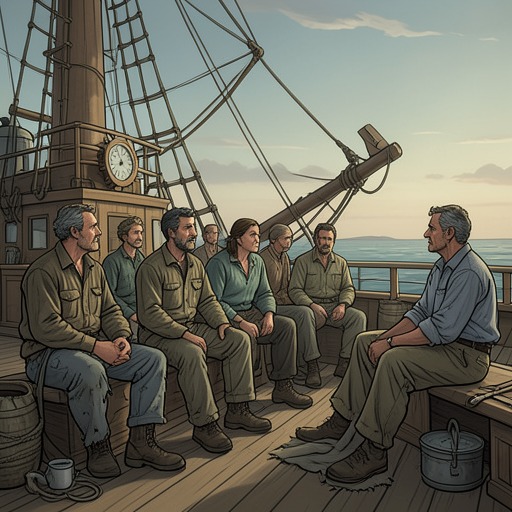
The decisive reversal occurs when the Endeavor prepares to depart. Montgomery reports that two crewmen, Martin and Oscar, refuse to return to the ship. Martin is the man who lost a hand; Oscar is the man who lost his voice. Antomine explains that both have chosen Terminus’s hospitality, and he has judged it unwise to remove them by force. Montgomery objects because Oscar has served with him since the early days and because the expedition needs every available crew member. He also refuses to abandon his people if the town is a trap.
Antomine offers the crucial interpretation of the defection. He does not believe occult control is twisting the men’s minds; rather, Terminus is simply pleasant while the outside world is terrifying. His admission makes the settlement’s power more unsettling, not less. The men may be choosing freely, yet the choice has been shaped by comfort, exhaustion, and fear. Terminus does not need chains when it can make departure appear irrational.
Departure and the Rejection of the Past
Jonathan finally orders the expedition to leave while it still can. He expects some opposition, but none appears. The lack of resistance confirms his suspicion that the trap has already succeeded: Terminus does not need to block the Endeavor because it has already altered what its visitors want. Antomine and Captain Montgomery follow Jonathan aboard, while the ship departs without a battle or visible supernatural confrontation.
As the lights of Terminus recede, Jonathan returns to his cabin and removes the books purchased there. These volumes contain secrets and knowledge he had wondered about throughout his life, yet he carries them onto the top deck and throws them one by one into the darkness. The gesture transforms departure into renunciation. The books belong to the past rather than the future, and Jonathan chooses the uncertain pursuit of sunlight over the inherited promises of scholarship, comfort, and settled civilization.
Narrative Significance
Terminus is a threshold settlement between the organized world of Beacon and the lethal eastern wilderness. Its bright streets reverse the usual expectation that danger belongs to darkness: here, illumination conceals rather than reveals. The event also extends a recurring contrast in Jonathan’s experience. Beacon’s zint-light already seemed dishonest beside sunlight, but Terminus makes artificial civilization almost perfectly persuasive, converting order and hospitality into instruments of seduction.
The stay’s consequences persist beyond the port. Jonathan’s suspicion of safe human spaces hardens into a governing principle, while Montgomery’s concern for Martin and Oscar exposes the human cost of continuing the expedition. The crew’s later wealth and the public excitement surrounding the Endeavor’s return contribute to the period that some in Beacon call the Winter of Blood, but Terminus itself leaves a quieter mark: it demonstrates that an expedition can be threatened by the desire to stop. Its departure is therefore both a geographical movement and a moral decision, in which Jonathan abandons valuable knowledge and accepts danger as the price of continuing east.