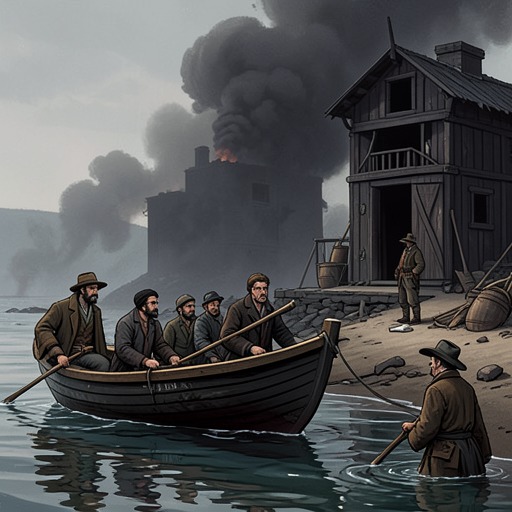
The Dead Must Not Linger in the Living World
Chasing SunlightThe Dead Must Not Linger in the Living World is an ancient rule of death and spiritual order that Antomine invokes when confronted by a powerful creature aboard the Endeavor. It presents death as a boundary that must be respected and completed: the dead belong elsewhere, and those who remain in the living world are suffering an improper condition that someone with religious authority must address. The rule therefore functions both as a metaphysical claim and as a justification for coercive action.
Definition and Religious Authority
The clearest formulation comes from Antomine’s explanation that a chaplain’s role is to ease the suffering of anyone encountered, because the dead should not remain in this world. He describes the principle as ancient knowledge reaching back to a time before civilization and extending across the scale of existence, from the lowest insect to the gods. In his account, the rule is not merely a human custom or a doctrine of the Illuminated King; it is a universal order that applies to every form of life.
Antomine speaks with such conviction that his words steady the men on the Endeavor’s bridge while the massive creature’s presence bears down on them. His statement gives religious language the force of physical resistance: the rule does not simply explain what death means, but enables him to stand beneath an overwhelming and inscrutable power. His confidence also shows how closely his identity as an Inquisitor is tied to service. He understands intervention after death as a duty, not as an optional expression of compassion.
Operation as a Boundary Rule
The rule establishes a sharp division between the living world and whatever state properly follows death. It consequently governs more than the treatment of animated corpses or lingering spirits. The broader journey repeatedly treats remains as dangerous or protected matter: the caravaneers tear apart a freshly killed beast according to their own rules of flesh and ownership, while Martin’s theft of a statuette is treated as a violation severe enough to cost him his hand. These episodes show a world in which bodies, relics, and objects connected to death cannot be handled casually; their status is controlled by ritual and communal law.
The same boundary appears at the Grave of Wood. Jonathan warns the crew of the Endeavor that nothing may be taken from the cemetery, probably not even its wood, although he has not tested the limit. Tethering there may be safe, but removal is forbidden. The cemetery is therefore not simply a shelter during the storm. It is a guarded domain whose protection depends on respecting the distinction between entering the realm of the dead and appropriating something from it.
Conflict with Human and Political Power
The rule’s ethical force is inseparable from the violence of the institutions that claim to enforce it. Antomine’s earlier demand to commandeer the Endeavor’s cannon shows how quickly sacred jurisdiction can become military authority. He identifies a town infected with forbidden secrets and argues that artillery must destroy it, while Captain Montgomery and Eleanor McAvey object that hundreds of people cannot be treated as members of the Gospel cult merely because they are present there. Antomine answers that the matter belongs to the Inquisition and frames resistance as treason.
This logic places whole populations outside ordinary protection. Jonathan supports the destruction in the specific case of the Third Gospel, arguing that people and buildings alike may retain its contaminating echoes. The rule concerning the dead belongs to the same structure of thought: exceptional knowledge suspends ordinary sympathy, and an authority declares what must be removed for the sake of a larger order. A person may be preserved only under a radically reduced condition, as when Martin is allowed to live after losing his hand for theft within the caravan. Survival remains possible, but mercy does not erase the governing penalty.
Consequences for the Dead and the Living
The rule also shapes the treatment of deaths that become historical or cosmic events. Jonathan’s path toward Bright Defile includes the death of Tiuni, the destruction of Tor Ilek, the sacrifice of Angkor Leng, and the laying of a god to rest before its corpse is burned. These acts differ in scale, but they share the insistence that death must result in transformation, removal, or finality rather than indefinite persistence. Even divine remains are not exempt from the demand that the dead be put into their proper condition.
At the same time, the rule does not make death simple or emotionally neutral. Each death becomes part of the cost Jonathan pays to reach sunlight, and the memory of those losses appears among the sacrifices that illuminate his passage through the final barrier. The dead do not linger physically in the living world, but their consequences remain embedded in the survivors’ choices. The rule thus separates bodily or supernatural persistence from remembrance: what must end is the dead person’s improper presence, not the historical weight of what happened.
Thematic Significance
The Dead Must Not Linger in the Living World expresses the book’s recurring concern with boundaries: between life and death, knowledge and contamination, sanctuary and trespass, authority and rebellion. It can be read as compassionate when Antomine describes the dead as suffering and presents release as a duty. Yet the same principle becomes threatening when attached to the Inquisition’s right to decide whose presence is intolerable and what force may be used to restore order.
Its strongest tension lies between care and exclusion. Antomine claims responsibility for those encountered, but his religious framework also permits the living to be classified as contaminated, sacrificial, or aligned with the enemies of the Illuminated King. The rule therefore does not merely state that death has a proper place. It asks who has the power to define that place, who may be expelled from the living world, and whether a doctrine of relief can remain humane once it becomes an instrument of sovereign violence.