The Dead Titan Funeral Rite
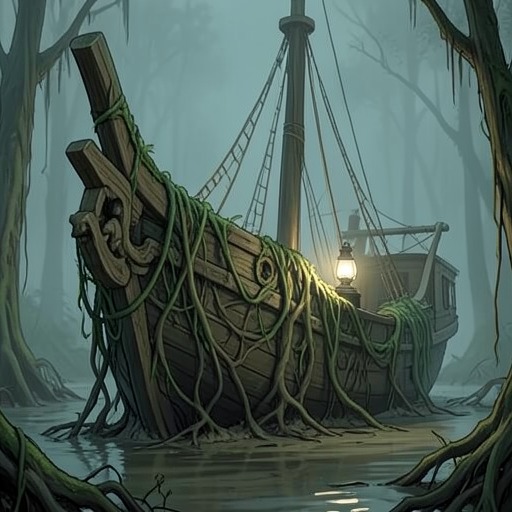
Chasing SunlightThe Dead Titan Funeral Rite marks the moment when the Endeavor’s struggle against an apparently motionless landscape becomes an act of exorcism and burial. Trapped above diseased briar that does not correspond to Jonathan Heights’s maps, the ship discovers that it has entered the remains of something vastly larger than an ordinary creature or terrain. The corpse is not harmless simply because its life has ended: its flesh, blood, air, and spatial residue continue to exert a malign force. Escape therefore requires more than navigation. Jonathan must identify the dead being, Antomine must grant it final rites, and Captain Montgomery must set its remains alight with ordinary fire.
Recognition of the Corpse
The rite begins with a failure of ordinary knowledge. The compass and triskolabe wander without purpose, while only the inverted zint indicator continues to point backward; outside the windows, diseased briar rises in every direction, yet the Endeavor remains suspended over the same depression despite the engines’ effort. Jonathan Heights’s maps offer no reliable landmark, and the surrounding terrain seems to belong to another place, time, or mechanism. Searching the ship’s records, Jonathan finds an account of a battle between titans beyond the great lavafall of the Godforge. Its description of a dead victor or loser whose blood, viscera, and every remaining fragment were as dangerous as a living god gives shape to the ship’s predicament. He then consults several forbidden books, including works excluded from Beacon because their authors were nonhuman, translating obscure passages and comparing references until ink smokes and sizzles against the parchment. The discovery is not merely a geographic clue: it identifies the apparent landscape as the corpse of an immense divine being and transforms the crew’s aim from finding a route through hostile country to performing a burial capable of releasing the ship.
Naming and the Burden of Final Rites
Jonathan Heights’s research produces a name powerful enough to become a physical danger. He tears the crucial page from his notebook, carries it down to the canteen, and presents it to Antomine with the conclusion that something has died but remains present. Antomine initially responds with disbelief at the request to administer final rites to a rotting heathen demigod, while Eleanor’s reaction is more immediate: when she looks over Antomine’s shoulder, she flinches, turns away, and rubs at eyes stung by the impact of the written name. The name is therefore neither neutral information nor a simple label. It possesses weight, provokes pain, and confirms that the ship is dealing with a being whose death has not ended its influence. Jonathan estimates the scale of the danger from the corpse’s insatiable hunger and putrescence, ordering a full canister of fire dust because an ordinary quantity of fuel could not plausibly consume what had once been godlike. Although Antomine hesitates, he accepts the page and the duty attached to it, while Jonathan promises the uneasy crew that their confinement will soon end. The ritual thus joins scholarship to religion: Jonathan supplies the forbidden knowledge that makes the corpse intelligible, and Antomine must convert that knowledge into an act of sacred disposal.
The Burning and Its Aftermath
Jonathan Heights carries the fire dust to the stern while the Endeavor begins moving through air that remains unnaturally dead. He breaks the seal on the cask and exposes a powder whose heat seems to reach beyond skin into mind and spirit, an invitation to surrender to the flames that he rejects in favor of the purity of sunlight. Tilting the container with extreme care, he lets the substance sift overboard in a long, luminous trail. He leaves no residue on the ship or on himself, since the powder burns steel, carisium, and flesh alike. As it spreads, the fire dust outlines something far more immense than a hill or thicket: limbs, alien protuberances, cavities, and rotted structures emerge beneath the diseased briar, suggesting that the Endeavor has been flying not simply above the corpse but through its distorted remains.
The revelation culminates when a vast hollow eye appears below the ship. Though the titan is dead, its regard remains piercing, and its attention falls upon Jonathan Heights and the Endeavor as they attempt to escape its grasping decay. The corpse is presented as a geographical impossibility as much as a biological one, an ungraspable contortion of land and space whose interior passages have become the ship’s prison. The fire dust does not ignite immediately; Jonathan waits for the proper moment while Antomine performs the unseen portion of the rite on the bridge. The sequence makes the corpse’s destruction dependent on coordination between material knowledge, religious authority, and the ship’s practical command rather than on any single character’s expertise.
Antomine completes the ceremony with the words, “From dust ye were made and dust ye shall be.” The bridge falls sober and silent, and even the ancient, alien being receives the formal respect accorded to the dead. Antomine then tells Captain Montgomery that it is time to light the pyre. Montgomery asks whether zint will suffice, but Jonathan explains that zint does not truly set things aflame and that ordinary fire is required. Antomine offers the paper bearing the titan’s name; Montgomery takes it carefully, steps onto the rail, and lights it with a match. The paper burns with unnatural intensity as it descends through the motionless air, becoming the spark that the fire dust has awaited.
The ignition transforms the funeral into a vast act of purification. Fire dust erupts in a roaring conflagration that consumes the briar, then flesh, bone, and even the surrounding air, because ordinary fire wrought through the right ritual can burn what was made by gods. Flames rise in patterns of dire and alien significance, prompting Antomine to warn the onlookers and leading the airmen to avert their eyes. Jonathan refuses to look away. His refusal establishes the rite’s final contrast: the fire destroys a dead divinity through sacred procedure, while Jonathan measures every revelation against the sunlight within him and finds nothing in the titan’s symbols more profound than that light.
Consequences and Narrative Significance
The funeral rite releases the Endeavor from a space where navigation, geography, and ordinary causality have failed. It is therefore both burial and escape mechanism, converting the ship’s apparent landscape into a pyre and restoring a route where there had been only circular instruments and immobile terrain. The event also anticipates the expedition’s later pattern of passage through dangerous thresholds: advancement requires the crew to identify what has trapped them, understand the rules governing it, and pay a material or spiritual price to proceed. The titan’s death shows that the eastern world does not divide cleanly between living threat and inert environment; even a corpse can possess agency-like force, demand recognition, and endanger those who cross it.
The rite’s consequences extend beyond the immediate escape. Jonathan Heights’s willingness to study forbidden, nonhuman records and to confront the corpse’s symbols without looking away becomes part of the accumulating burden he later carries toward Bright Defile. In the reckoning that enables his final crossing, he remembers the burning of the god’s corpse among the losses and sacrifices that illuminate his path. The funeral thus returns at the end of the narrative as one of the steps by which Jonathan abandons the ordinary world: an episode that began as an attempt to save the Endeavor becomes evidence of his increasing separation from human limits, conventional knowledge, and the fearful discipline represented by Antomine.