The Endeavor’s Departure from Beacon
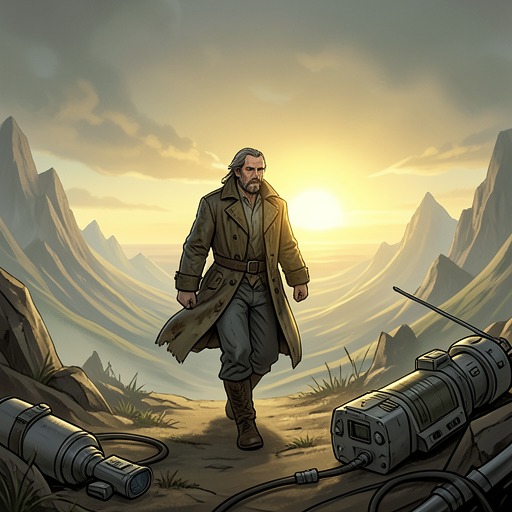
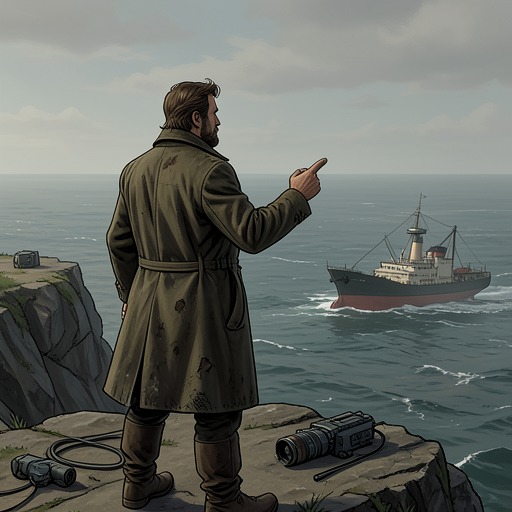
Chasing SunlightThe Endeavor’s Departure from Beacon is the decisive threshold event of Jonathan Heights’s eastern expedition. After liquidating much of his estate, arranging protection for Agnes and Johann, financing the rebuilt Endeavor, and sending supplies toward Danby’s Point, Jonathan leaves Beacon with Captain Montgomery, Eleanor McAvey, Antomine, Lux Guards, and a crew whose loyalties and competence remain uncertain. The departure converts his private obsession with sunlight into an organized voyage, while also carrying the institutions, wealth, surveillance, and ideology of Beacon into the darkness beyond its borders.
Preparation, Financing, and Departure
Jonathan’s final exit from his estate is marked by both logistical completion and deliberate emotional severance. In a violent wind, porters load his cases into a waiting carriage while Agnes begs him to return safely. Jonathan promises that he intends to come back, although the narrative makes clear that he is lying to reassure her. He has already liquidated most of his collection and arranged a financial cushion and legal protection for Agnes and Johann. The expedition thus begins with a material sacrifice: the estate that once anchored his life has been converted into the means of abandoning it.
The financial machinery of the voyage extends beyond Jonathan’s personal wealth. He gives Captain Montgomery blank golden plates to exchange for supplies and equipment, while Montgomery hints that he knows how to conduct dealings beyond the notice of the Crown’s tax and customs officials. Jonathan has experience outfitting expeditions and proposes shipping supplies by train to Danby’s Point, more than a hundred miles to the east, before the Endeavor is fully loaded. The arrangement presents exploration as an economic enterprise built from credit, exchange, unofficial commerce, and calculated risk rather than as a purely heroic departure.
By the time Jonathan reaches the Port Quarter, the Endeavor is visible under the port’s spotlights, long and sleek after its refit. Eleanor has frustrated several further sabotage attempts, including attempts associated with jealous enemies, a grudge against Crowley, Stanford, and Moore, and unexplained glass devices previously found in the zint tanks. No important culprit has been identified, leaving Jonathan with the uneasy conviction that the danger has merely become less visible. Antomine is already waiting beside two Lux Guards, while other white-clad personnel and the masked escorts make the ship’s departure inseparable from religious supervision and political surveillance.
Boarding the Rebuilt Endeavor
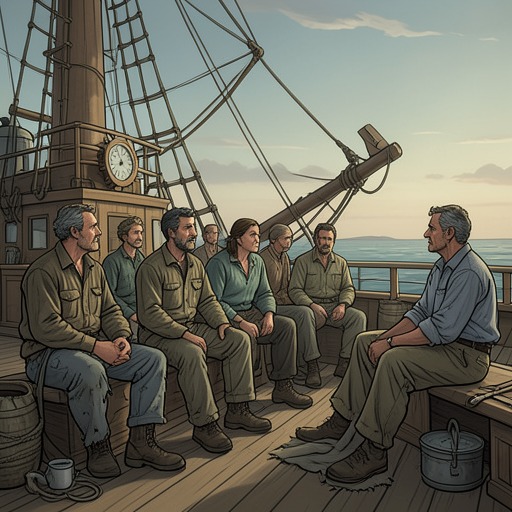
The boarding scene formalizes the expedition’s new order. Airmen move the cargo along the spar to the Endeavor’s ramp, and Jonathan directs the seven-person group toward the mid-deck. Although he is the majority owner after the refit, he asks Captain Montgomery for permission to come aboard. Montgomery grants it and welcomes the passengers to the Endeavor, establishing a courteous but significant distinction between ownership, command, and passage.
The rebuilt airship is presented as exceptionally clean and orderly. Its brightly painted walls, spotless grating, and soft, shadowless zint-light tubes contrast with the damaged vessel that Jonathan had previously paid to restore. Montgomery’s tour divides the ship into functional layers: cargo occupies the lower deck, the crew the mid-deck, and passengers the upper deck. Artillery is placed along the mid-deck, while the upper level contains twelve rooms, accommodations and a mess, and a large observation room with broad windows. Pale blue carpeting and furniture bolted to the floor suggest an attempt to impose domestic stability on a craft designed to carry people through violent weather.
The ship’s material abundance also exposes its vulnerability. Jonathan has arranged a portable luminiferous terrestrite distillation apparatus, a lifting-gas separator, water siphons and filters, portable searchlights, crew-served zint guns, food, water, spare parts, raw materials, clothing, bedding, soap, and other necessities. The added weight will make the Endeavor less agile and increase its fuel consumption, ensuring that future stops will be longer apart and less comfortable than city life. Some containers, particularly those holding fire dust and unflame, show signs of tampering, but Jonathan chooses not to report the pilferage because an investigation might delay departure. His impatience with delay has become stronger than his concern for perfect security.
The Launch into Darkness
Within an hour of boarding, the Endeavor casts off. Its engines flare with searing blue zint, reflecting from the soot-stained towers of the yards as the ship rises above Beacon and turns east. Eleanor presses toward the forward window, and Antomine displays nearly equal eagerness, while the Lux Guards and the so-called maids remain cautious and detached. The differing reactions establish the expedition’s internal pattern: wonder belongs to some passengers, discipline to others, and Jonathan occupies the uneasy position of a veteran who remembers what earlier expeditions cost.
From above, Beacon appears as a white city surrounded by a countryside arranged in diminishing grades of illumination. Illuminated railways draw straight lines from the walls, farms and ranches form a weaker lattice, and poor farms rely on the green glow of sheltershrooms rather than zint lamps. Other airships move through the darkness, their spotlights making temporary circles below. Yet the apparent security of human territory is incomplete. The Cult of Flame threatens from the south, Invidus Croft from the north, and the navy of the Illuminated King patrols mainly to detect incursions rather than to protect every settlement from monstrous life.
Antomine interprets this landscape through the doctrine of light, describing humans as creatures drawn to illumination and lost without it. Jonathan finds the delivery unsettling because Antomine is neither merely reciting scripture nor displaying the fervor of a zealot; he is a deliberate believer. The departure therefore carries a theological conflict from the first moments of flight. Beacon’s light is simultaneously infrastructure, civilization, religious principle, and an instrument of authority, while the darkness ahead is treated as danger before the expedition has even entered it.
The Planned Eastern Route and Its Stakes
The initial route is eastward but not direct. Jonathan explains that Captain Montgomery will choose the course from Beacon to Danby’s Point, using his own contacts and preferred ports. The planned stops are Autochthon Reach and Whither, after which the Endeavor will reach Danby’s Point and begin the more uncertain passage beyond established human territory. The itinerary combines Jonathan’s geographical knowledge with Montgomery’s practical command, making the voyage a collaboration rather than a simple execution of Jonathan’s private map.
Jonathan’s previous expeditions have taught him that going east requires more than maintaining a heading. The Endeavor must rest, resupply, repair damage, and gather its bearings in the black wilderness. He has charted crumbling mines, ruined cities, isolated oases, and caravan migrations, and he expects raw terrestrite to be essential for producing zint fuel. The expedition consequently begins with a surveyor’s attention to resources and routes, but its stated destination—sunlight—exceeds ordinary exploration. Every stop is both a practical necessity and a step toward a boundary that Beacon’s maps cannot adequately describe.
The economic logic of the departure continues after the ship leaves the city. At Danby’s, Jonathan tells the crew that raw metal stock is better for barter than gold or silver, and he carries rolled steel rods in his own case. The Endeavor’s provisioning, its cargo capacity, and the crew’s future access to food and water are all governed by exchange. This practical knowledge later produces tangible rewards: the battered Endeavor eventually returns carrying an immense quantity of gold, attracting more public interest than Antomine or the women who disembark with him.
From Departure to Irreversible Passage
The departure’s consequences quickly transform it from a controlled launch into a succession of thresholds. After the destruction of Danner’s Grasp, the Endeavor leaves a smoldering settlement behind while Antomine conducts a service for three dead crew members. Their caskets are rendered into dust through distilled luminiferous terrestrite and dispersed into the wind. The ceremony establishes a recurring pattern in the expedition: movement is repeatedly purchased through death, ritual, and the conversion of bodies or places into fuel for continued progress.
That pattern reaches a larger scale when Antomine speaks the funeral words, “From dust ye were made and dust ye shall be,” before the expedition burns the corpse of a dead titan. Later, Jonathan activates the golden mechanism beneath Angkor Leng by entering the sequence of commands that once caused an earthquake. The machinery fails, the ground shakes, and the fevered god-dream beneath Angkor Leng is released as the protective artifice collapses. The departure from Beacon has therefore grown into a voyage whose progress depends on dismantling the worlds it encounters, even when Jonathan and Antomine briefly share the same solemn purpose.
At the Arch of Khokorron, the expedition’s movement becomes explicitly conditional. The machinery opens into a tunnel several miles in diameter, lined with burning lights, and the Endeavor is drawn inside by the wind. The passage extracts knowledge as its toll, and Jonathan expects to pay with the life-fruit he has concealed in his suit. When the fruit is missing, the expedition’s earlier costs return as the only available currency. Jonathan’s empty estate, his servants, Tiuni’s death, the destruction of Tor Ilek, the books discarded from the Endeavor, the dead titan’s funeral, the sacrifice of Angkor Leng, his broken friendship with Eleanor McAvey, his banishment from Ukaresh, his rejection by the Players, and finally his cane are all figured as candles or stepping-stones across the impossible gap.
Jonathan’s crossing ends not with a return to Beacon but with entry into Bright Defile. He sacrifices his cane as the final bridge, takes the last step through darkness washed by light, and finds a green country beneath a vast blue sky. The sun stands beyond the narrow valley, while the shrouded lands he has left appear as a dim mote behind him. In this sense, The Endeavor’s Departure from Beacon is the beginning of a journey whose true destination requires the destruction of the conditions that made departure possible. The ship eventually limps back with gold, and Captain Montgomery spends part of the wealth repairing it, but Jonathan himself does not return. His departure culminates in separation from Beacon, from his companions, and from the ordinary human world whose lights first gave him the desire to travel.