The Gambler in the Battle of Death Meets
Chasing SunlightEncounter at the Dead Battle is the decisive confrontation between Jonathan Heights and the Players, the incomprehensible powers whose Game underlies the apparently frozen combat witnessed from the Endeavor. What first seems like an altered view of a strange battlefield becomes an invitation to surrender human limits for access to primordial knowledge. Jonathan’s refusal preserves his independence, but it also marks him as an unusual figure at the boundary between humanity and forces that no longer belong to it.
The Dead Battle Becomes a Threshold
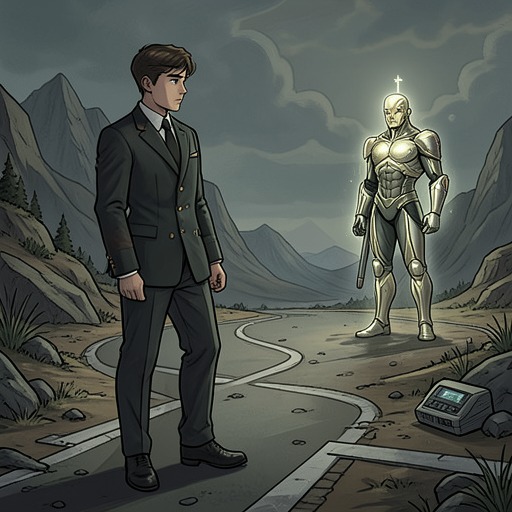
Jonathan’s encounter begins during a return visit to the Dead Battle, a spectacle in which two forces remain locked in desperate combat while the Endeavor passes above them unnoticed. At first, he treats the scene as impressive but ultimately passive: a recurring display whose violence has no immediate effect on the ship or its crew. Only after a full day does he recognize that this visit differs from earlier ones. The observation room has expanded by imperceptible degrees, its windows growing larger while the carpet flows outward over borders that seem to recede. At the same time, the battlefield becomes more visible under the Endeavor’s spotlights, as though the distant tableau has contracted. The alteration reveals an approach rather than a change in ordinary geography. Two immense figures emerge in the distance, mountain-sized forms shaped like people but concealed by shadow and obscurity. Jonathan recognizes them as beings comparable in transcendence to Ukari and as impossible to perceive in their true nature, much as the Illuminated King’s body resists human understanding. Their presence explains both the raw force of the Dead Battle and the fact that its particulars change from visit to visit. The battlefield is not merely a frozen historical scene; it is an instrument or projection of a larger contest.
The Players and Their Game
Jonathan understands the two figures as Players directing a Game from an observation deck enlarged by the residue of their presence. Their Game is not a conventional contest for territory or political control. It extends across time and distance, reaching into mysteries, histories, secret fires, and forbidden knowledge. The visible conflict below is therefore only an outward form, a misleading miniature of strategies whose consequences reach into the deepest past and the most remote future. The Players speak through apparently ordinary voices, which makes their power more disturbing rather than less. One addresses Jonathan in the language of Beacon without an accent and identifies him by name. The voice is soft, commonplace, and deliberately unremarkable, while another voice is raw and ragged. Their words suggest that they possess a form of recognition that Jonathan cannot explain: they tell him that he and the speaker are acquainted and invoke the principle, “Once met, never strangers.” The encounter thus implies that Jonathan’s previous journeys have already established connections he does not understand. They also distinguish Jonathan from the other people aboard the Endeavor. When they refer to the Lightless Life, the Illuminated Order, and Jonathan himself, they say that even they cannot identify the hooks he has sunk into their world. The remark places his history within a larger network of powers and suggests that his pursuit of sunlight has made him more consequential than an ordinary explorer. Eleanor McAvey and Antomine are present, but the Players treat the rest of the crew as ephemeral beings who barely touch the surface of the larger structure and do not belong to the east.
The Invitation and Its Refusal
The immediate purpose of the meeting is an offer. After Jonathan presses the Players to state their deeper intention, one asks whether he wants to play a round. Jonathan sees the board and the Dead Battle simultaneously: simple pieces and massive forces, a shipboard object and a structure spread across time. The invitation appears to offer nearly unlimited access to knowledge and agency. Jonathan imagines himself made imperishable by sunlight, no longer dependent on the unenlightened, and able to pursue fundamental secrets wherever he wishes. That vision is also the trap. The more knowledge the Players offer, the more clearly Jonathan perceives the loss hidden inside it. Complete insight would narrow rather than enlarge his freedom; every action could become rote, personal aims could lose their meaning, and even the pursuit of sunlight might cease to matter. The Game promises power by turning the player into an instrument of understanding. Jonathan therefore declines, saying, “I respectfully decline,” and insisting that the offer is not meant for him. Antomine responds with a faint but unmistakable sigh of relief, indicating that the inquisitor already knows enough about the Players to fear what Jonathan might become by accepting. The refusal is a value reversal at the center of the event. Jonathan begins with the possibility of gaining a greater order of power and ends by defending the imperfect freedom that power would erase. The Players describe his decision as unusual because most who play have already secured their own stakes, including the Illuminated King or She-Who-Must-Be-Obeyed. Jonathan has not entered the Game on behalf of such a power. His stated interests remain his own, and he continues to insist that his destination lies beyond the Arch of Khokorron.
Eleanor, Penelope, and the Limits of Qualification
Eleanor attempts to seize the opportunity Jonathan rejects. She declares that she wants to play and offers to take his round, advancing toward the board with evident hunger. Yet the distance refuses to behave physically: despite her step, she does not appear to draw closer. The Players tell her that she does not qualify because she is “not yet herself.” The statement leaves her angry and bewildered, but it establishes a different barrier from Jonathan’s voluntary refusal. His obstacle is the danger of excessive knowledge; Eleanor’s is an incomplete or unstable identity. Penelope, the Endeavor’s cat, becomes the strange agent of the scene’s next alteration. She reaches out and nudges one of the pieces, which is simultaneously a small figurine and one of the enormous statues associated with the Game. The movement produces a minor realignment across interlocking perspectives and bodies of knowledge. Jonathan looks away rather than risk understanding too much, while Penelope retreats with the smug composure of an animal that has acted deliberately. She later curls up in Antomine’s chair, leaving Eleanor furious but unable to force her way into the Players’ order. The episode makes qualification depend on more than desire, courage, or proximity. Jonathan can refuse because he remains recognizably himself, while Eleanor’s hunger cannot compensate for the Players’ judgment that her selfhood is not yet complete. Penelope, by contrast, can touch the board without submitting herself to its invitation, introducing an animal intelligence that neither Jonathan nor Eleanor can fully interpret.
Aftermath and the Human Boundary
The Players warn Jonathan that their offer will not be repeated. By rejecting the favor of their master, he must reach the Arch of Khokorron by the hard way. Jonathan accepts the consequence. The distorted observation room then returns to normal: the Dead Battle remains below, the deck resumes its ordinary size, and the strange expansion disappears without resolving what it did to the Endeavor or whether the Players will remain uninvolved. Antomine explains the encounter afterward in terms of the Illuminated King’s prohibition. Those who play the Players’ Game cannot be allowed into human lands; the Players stand as one of the signposts dividing what is human from what is not. The explanation also reveals that the Illuminated King expected the Players to notice Jonathan. Antomine’s silence during the offer, his grip on his medallion, and his relief at Jonathan’s refusal all show that the confrontation has consequences beyond Jonathan’s private ambition. The encounter’s importance lies in its refusal of an easy heroic reward. The road east has already carried the Endeavor through places where ordinary law, geography, and logic fail, from the impossible civilization encountered in the wilderness to Ukaresh and its rule by power. At the Dead Battle, that movement reaches a more abstract threshold: the ship enters an observation space where a battlefield becomes a board and knowledge becomes an instrument of control. Jonathan does not return with a new weapon or secret. He returns with a boundary intact. Later, at the final barrier of Bright Defile, the rejection of the Players and the Game is remembered among the sacrifices lighting his path, confirming that this refusal is not an isolated hesitation but one of the costs by which Jonathan preserves a self capable of choosing.