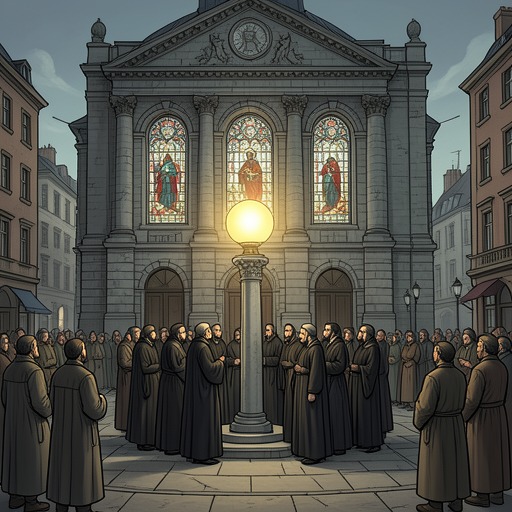
The Palace
Chasing SunlightThe Palace is the seat of the Illuminated King and one of the clearest architectural expressions of the world’s ruling ideology: civilization defines itself through light, while authority claims the right to regulate movement, knowledge, and contact with the darkness beyond human lands. Jonathan Heights’s visit reveals that its brilliance is not merely decorative. It is a system of power, built to impress, intimidate, and make obedience appear inevitable.
Setting and Architecture
The Palace is constructed from pillars, white stone, and zint, with tall arches threaded by veins of luminiferous terrestrite. Soldiers carrying rifles and white gilt swords stand at every intersection, while a spiraling central tower rises above the outer curtain wall, its windows and zint-lights visible over the entire complex. The inner courtyard is not barren: blue-green moss covers the ground, and sculpted vines bearing small red fruits wind around carved statues. This mixture of controlled natural growth, sacred brightness, and military order makes the Palace both a court and a fortress.
The central tower contains the Luminatory, the chamber in which Jonathan is received. He is led past lesser offices and through the Palace’s inner approaches before reaching the heavy steel door, whose wheel must be turned by two guards together. The route itself establishes a hierarchy of access: ordinary administration lies below, while the Luminatory belongs to the highest level of royal power. Jonathan had expected bureaucratic delay, bribery, flattering formalities, and veiled warnings from a lesser official; being taken directly to the tower instead makes him suspicious that the summons has a more consequential purpose.
The Luminatory strips the Palace’s visual language down to its most oppressive form. It is a simple stone room with a petitioner’s dais and a raised balcony, but it contains nothing except zint-light. There are no shadows, colors, or ornaments to soften the space; the white stone reflects the same unvarying shade of zint, turning the chamber into a shrine to light and to the King who commands it. The absence of shadows is not reassuring. It removes privacy and visual refuge, making the room feel less like a court for discussion than an instrument of exposure.
Jonathan Heights’s Audience
Jonathan is hardly surprised when the summons arrives. He assumes that the Reflected Council has sent him to the Palace as punishment for embarrassing it, even indirectly, and he regards a possible order from the Illuminated King forbidding him to leave the city as an inconvenience rather than an insurmountable barrier. His intention is already fixed: he will leave by one means or another. The Palace therefore receives him at a moment when royal authority is attempting to contain a man who has decided that his expedition cannot be contained.
Inside the Luminatory, Jonathan kneels on the petitioner’s dais when the signal sounds. He is not a fervent supporter of the Illuminated King, but he is careful not to display disrespect. The encounter is initially organized around protocol: the petitioner waits, lowers his head, and submits to a presence that is not visibly embodied. Then the hair on the back of his neck prickles, and he understands that he is not alone even though he cannot see anyone on the balcony.
The audience changes Jonathan’s understanding of the monarchy. He suddenly finds an inscribed white coin in his hand, faintly glowing, without any memory of how it came there or any understanding of the act that placed it there. The experience produces a physical recoil: he suppresses a shudder and grips his cane until his knuckles whiten. Passages in Reginald Heights’s notebooks acquire a new meaning, and Jonathan’s distrust of the monarchy becomes more than contempt for the habits of corrupt nobility. The Palace has demonstrated a power that can act upon him without explanation or visible process.
The Illuminated King answers Jonathan’s formal thanks with the brief statement, “Yes,” followed by the claim, “We are.” The bright light then dims, and the King is gone. A second tone signals the end of the audience, and the door opens behind Jonathan. He places the glowing coin inside his suit and bows to the empty balcony before leaving the Luminatory for the more tolerable world of ordinary light and color. The gesture preserves the forms of royal submission even as his private judgment of the regime darkens.
Political and Imperial Function
The Palace stands at the center of a government that presents itself as humanity’s defense against the eternal darkness. Under the authority of the Illuminated King and the endorsement of the Reflected Council, human society is cast as a vigil of light, while Jonathan’s expedition is treated as a dangerous movement toward regions that official civilization defines as remote, savage, and forbidden. The Palace is therefore not only a residence or court: it is the institutional point from which the opposition between human light and the eastern darkness is administered.
That ideology becomes more complicated when the expedition reaches Danby’s Point. There, the illuminated human settlement occupies one side of a plateau, while alien structures and nonhuman peoples press against it under other colors of light. The Inquisition is simultaneously strongest and weakest at this frontier: it tries to contain contact while bowing to the inevitability of trade. A great metal gate separates the human portion from the territory claimed by darker forces, yet the influence crosses in both directions. Spires farther from the wall are twisted and hunched, while those near the boundary have been pulled toward straighter lines. The border thus reveals that the Palace’s distinction between civilization and darkness is not stable; architecture, commerce, and proximity continually reshape both sides.
Jonathan’s maps and negotiations further expose the Palace’s wider relationship to knowledge. At Danby’s Point, he consults Tiuni before traveling beyond human lands, exchanging human literature for information about shifting forces, beasts, caravans, and ruins in the Verdant Expanse. His maps convert foreign territory into routes and strategic choices, while the Palace’s ideology supplies the language through which those territories are judged. The result is an imperial tension: human power depends on knowledge gathered from beyond its borders even as its institutions describe those regions as threats to be controlled.
Consequences and Significance
The Palace’s immediate practical consequence is the Illuminated King’s token. The coin cannot pay for goods, but it opens the doors of the best shipyards and zint-wrights, including establishments that money alone cannot access. Royal favor therefore operates through privilege rather than simple command. The Palace does not merely obstruct Jonathan’s expedition; it equips it, granting access that helps him assemble the Endeavor while also placing the expedition under a sign of royal authority.
That favor remains morally and politically ambiguous. Jonathan’s journey toward sunlight is presented as an act of resistance to common sense, since most people treat sunlight as a laughable myth, yet the Palace’s intervention makes the expedition legible to the regime as something worth monitoring or using. Later, when Antomine urges Jonathan to purge a possible nest of Umbraught in Angkor Leng, Jonathan refuses on the grounds that the Endeavor is not a navy and lacks the time and resources to cleanse a city. His refusal contrasts the expedition’s narrow goal with the Inquisition’s broader doctrine that civilization must pursue threats wherever they appear. The Palace’s influence persists in this conflict over whether exploration is a search for truth or an extension of state and religious duty.
The Palace is consequently a concentrated image of the book’s central contradiction. Its white arches, zint-veined stone, armed guards, and shadowless chamber promise order through illumination, but the royal encounter depends on concealment, unexplained power, and enforced submission. The same regime that defines humanity as a bastion of light also sends authority into spaces where contact, trade, mapping, and coercion blur the boundary between civilized and alien worlds. For Jonathan, the Palace is the place where that contradiction becomes personal: he leaves with the access needed to pursue sunlight, but also with evidence that the light governing his society may be as manipulative and unsettling as the darkness it claims to oppose.