The Players
Chasing SunlightThe Players are enigmatic beings encountered by Jonathan Heights aboard the Endeavor during the passage over the Dead Battle. They are not merely observers of that timeless battlefield but the architects of a Game extending across history, distance, knowledge, and possibility. Their appearance turns a familiar spectacle into a threshold encounter: Jonathan is offered access to a scale of understanding that could make ordinary human goals irrelevant, and his refusal becomes one of the clearest statements of his independence in the eastern journey.
Identity and Appearance
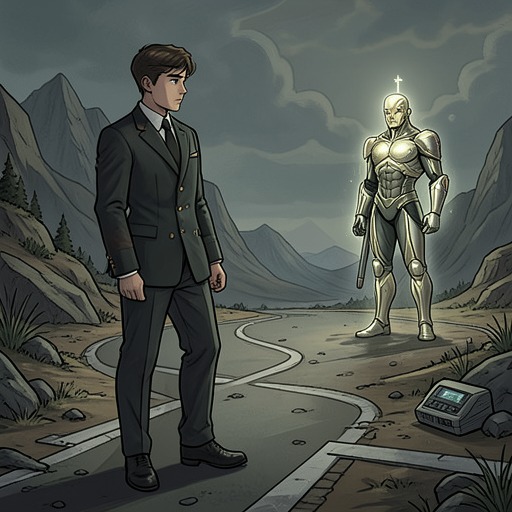
The Players appear as two immense, shadow-cloaked figures whose proportions cannot be stabilized by ordinary perception. At first they seem like distant mountains shaped into human form, then like nearer giants, yet their size and position remain constant through every change of apparent distance. Their forms are as indescribable and indecipherable as the true body of the Illuminated King, and their scale is compared with the transcendent magnitude associated with Ukari. They are therefore not simply large creatures inhabiting a remote place; they belong to a mode of existence in which space, identity, and physical proportion no longer operate according to human rules.
Their voices deepen this division from humanity. One voice is soft, ordinary, and apparently without an accent, speaking the language of Beacon with deceptive familiarity. The other is jagged and torn, as though ripped from a greater whole and thrown into reality without care. The contrast makes the pair seem less like two rounded individuals than two partial expressions of a larger intelligence. Even when one voice claims precedence or the other interrupts, Jonathan cannot determine which being is speaking with complete certainty, because both remain concealed within vestments of esoteric knowledge.
The beings disclose that one of them was present during Jonathan’s earlier encounter with its master, although the figure Jonathan saw then was of a higher order. In the Player’s account, beings such as this one are lost within the master’s presence, but rare events and people can still attract its attention. Jonathan’s expedition is one such event: the Players describe three humans forcing their way eastward under the weight of their secrets, while treating the rest of the Endeavor’s crew as ephemeral figures barely tracing the surface of reality.
Domain and the Game
The Players dwell at the Dead Battle, where the Endeavor’s observation room gradually expands and the battlefield below becomes both more visible and apparently smaller. The scene exists in a distorted temporality in which seconds stretch, movement becomes laborious, and the ship seems to cross immense distances while barely moving. This transformation reveals that the Dead Battle is not merely a historical remnant or a fixed landscape. It is a field whose scale and meaning can be altered by the presence of the Players.
The Game they direct is vastly larger than any contest for territory or political rule. Its pieces and positions encompass what must always be and what can never be, while its strategies reach into the distant past and the distant future. The Game concerns mysteries, histories, secret fires, forbidden fruits, and forces that exceed the human capacity to interpret them. Jonathan understands it as a grandmaster’s execution of a conflict in which the Explorer Society’s efforts appear infantile: human explorers fumble at the edges of knowledge, while the Players manipulate deeper structures of the world through strategies rendered incomprehensible by the understanding required to conceive them.
The Game is also linked to the eastern geography itself. The Players guard the Arch of Khokorron, but not to regulate whatever may travel outward from the lands beyond it. They describe the region past the Arch as a true east of wild lands and closed, forbidden, long-dead paths, from which no salutary thing can come. When Antomine objects that the expedition is already in the true east, the Players answer that there is always a further east. Their statement converts geographical exploration into an endless metaphysical progression: every apparent frontier conceals another, and every achieved position may be only the threshold of a deeper departure from human order.
Encounter with Jonathan Heights
The Players identify Jonathan as more significant than his companions. They recognize the marks of the Lightless Life and the Illuminated Order around him, but then distinguish Jonathan himself, declaring that even they do not understand the hooks he has sunk into their world. Their attention is therefore not based solely on his presence at the Arch or on the practical route of the Endeavor. It arises from the unusual combination of his history, his knowledge, and the unresolved force of his pursuit of sunlight.
Jonathan asks whether the Players guard the Arch and explains that what he seeks lies beyond it because he has seen sunlight. The Players do not challenge the claim directly. Instead, they offer him a round of their Game. The invitation is presented with apparent courtesy, but its implications are immense. Jonathan sees a possible future in which sunlight makes him imperishable, allowing him to pursue increasingly fundamental secrets without dependence on the unenlightened and to choose any path at any time. The temptation is not a simple promise of wealth or domination; it is the prospect of becoming an agent capable of reaching into the deepest levels of creation.
Jonathan recognizes the danger precisely because he can imagine the reward. The greater the insight, he understands, the fewer the choices that remain. Immersion in the Players’ knowledge would provide terrible clarity while reducing his actions to rote consequences of what he knew. His personal goals could become irrelevant, including the pursuit of sunlight itself. The Game would not necessarily destroy him through violence or malice; it would absorb the freedom that gives his ambition meaning. He therefore declines, stating that the offer is not meant for him, despite the future he has glimpsed.
Antomine’s quiet relief shows that the invitation carries political and spiritual danger beyond Jonathan’s private calculation. The inquisitor appears to possess prior knowledge of the Players and of what their Game represents. Eleanor, by contrast, responds with hunger and asks to take Jonathan’s round. The Players deny her because she does not yet qualify and is not yet herself. Her attempted step toward the board fails to bring her closer in any ordinary physical sense, while Penelope’s deliberate movement of a piece produces a minute realignment in what is known and what is believed. The encounter thus establishes that access to the Game depends not merely on desire, courage, or proximity, but on an alteration of identity and qualification that Eleanor has not yet undergone.
Refusal and Consequences
The Players make clear that their favor will not be offered again. By rejecting the master’s favor, Jonathan must reach the Arch the hard way rather than through the assistance or privileged access represented by the Game. His refusal therefore has a practical consequence: the expedition loses a possible shortcut into the deeper east. It also has a moral and existential consequence, because Jonathan chooses a difficult, uncertain path over an easier route purchased with surrender of purpose.
After the encounter ends, the observation room returns to its ordinary size and the Dead Battle resumes its familiar appearance. Jonathan immediately asks Antomine what the Illuminated King told him about the Players. Antomine explains that none who play their Game can be permitted to enter human lands. The Players function as a signpost at the boundary dividing the human from the nonhuman, although they are not the only such boundary. The Illuminated King had already judged that Jonathan was likely to attract their interest, meaning that the encounter was anticipated by the powers supervising his journey.
This revelation unsettles Jonathan because it confirms that his route has been watched and that his meeting with the Players was not wholly accidental. Yet the knowledge does not make him submit to the Illuminated King’s authority. Instead, it reinforces his decision to remain outside the Game. Later, when Jonathan’s journey reaches the final trial of Bright Defile, the rejection of the Players and the Game appears among the sacrifices that illuminate his passage. The refusal becomes part of the price he has paid to continue toward sunlight rather than exchange one form of dependence for another.
Narrative Significance
The Players embody knowledge detached from ordinary human scale. They are more than threshold guardians in a physical sense: they mark the point at which exploration becomes a choice about what kind of being the explorer is willing to become. Their Game resembles the ultimate version of Jonathan’s own exploratory impulse, extending the desire to know until it threatens to consume the knower. The contrast is central. Jonathan wants access to truth, but he does not want truth to erase the personal will that made the search meaningful.
Their presence also complicates the authority of the Illuminated King and the human institutions that claim to defend civilization. The Players recognize the Illuminated King as a participant with secured stakes, while Antomine reports that their players cannot be allowed into human lands. Human order therefore understands the Game as a danger, yet its highest sovereign is already implicated in it. Jonathan’s rejection refuses both the Players’ invitation and the larger structure of power that fears them while remaining entangled with their influence.
The Players’ Game stands as the dark inverse of sunlight. The Game promises an enormous, elegant web of hidden causes and future possibilities; sunlight exposes everything with an equally overwhelming but different finality. In Bright Defile, Jonathan must sacrifice his attachment to the Players and their Game just as he sacrifices his estate, his relationships, his cane, and other remnants of his former life. The Players consequently remain powerful even in absence: their rejected offer becomes one of the thresholds Jonathan must cross before reaching the sunlit world beyond the shrouded lands.