The Shadow of Jonathan over Beacon
Chasing SunlightThe Shadow of Jonathan over Beacon is the final visual consequence of Jonathan Heights’s crossing into Bright Defile: after surrendering the possessions, attachments, losses, and identities that had defined his journey, he reaches sunlight and briefly appears as a gigantic figure whose shadow stretches from the far east to Beacon. The apparition turns his personal liberation into a public disturbance, placing the truth he sought against the civilization that dismissed it as myth and governed by the authority of the Illuminated King.
From the Lightless World to Bright Defile
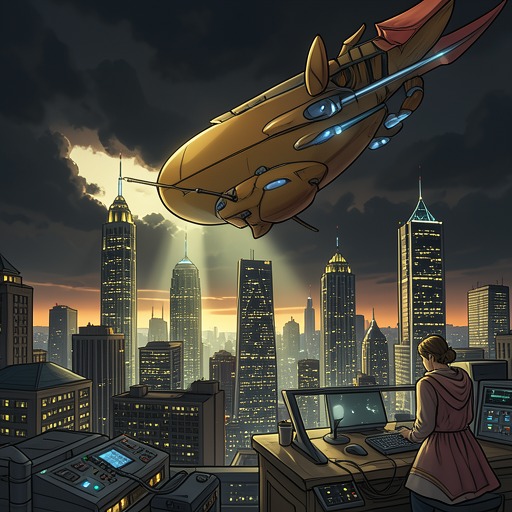
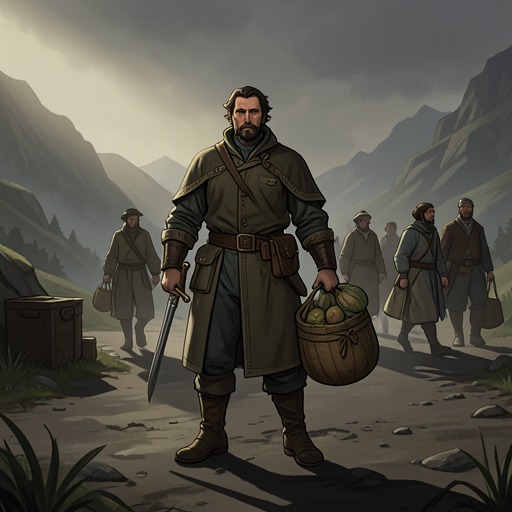
The apparition belongs to a world organized around the absence of sunlight. Humanity maintains a vigil of light against eternal darkness, while the Illuminated King and the Reflected Council authorize the political and ideological order through which that vigil is preserved. Jonathan’s expedition aboard the Endeavor begins as a forbidden movement toward the far east, where he claims to have seen sunlight despite the widespread belief that sunlight is only a laughable myth. His goal therefore challenges not merely geography but the accepted limits of knowledge.
The route toward that goal repeatedly carries the expedition through spaces where human authority becomes unstable. At Danby’s Point, the easternmost human terminus, blue-white zint illumination confronts the lights and architecture of other races; a great metal gate divides the human plateau from territories claimed by darker forces, yet influence passes in both directions. Beyond it, the fractured distort human forms, while immense tar-like beings occupy the spires. Jonathan’s maps and his dealings with Tiuni likewise show that the eastern world cannot be mastered simply by extending familiar categories: information must be purchased, routes narrowed, and alien movements interpreted before the journey can continue.
The same instability appears farther along the expedition’s path. An impossible settlement of walls, mooring towers, streets, and machinery shines from the wilderness around a vein of Luminiferous terrestrite, making civilization appear as an isolated and unexpected flame rather than a natural condition. Terminus presents another version of the threshold, offering a temptation whose purpose Jonathan comes to regard as malign even though no direct opposition emerges. Ukaresh, with its hazardous weather, sparse air traffic, and inhabitants governed by few laws beyond power, requires Jonathan to barter an insect collection for the Endeavor’s berth and safety. The journey east thus strips civilization of its claim to universality before Jonathan reaches the place where sunlight itself will strip away his remaining shadow.
The Passage into Sunlight
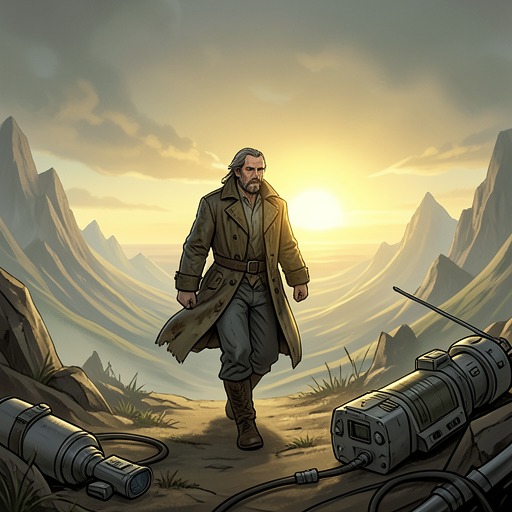
The decisive action takes place beyond the final threshold of Bright Defile. Jonathan reaches a gulf where the physical landscape and a barrier of understanding become indistinguishable. Although the land is defined by sunlight, the gulf is dark; its darkness is not concealment but the last boundary of what Jonathan has not yet surrendered. The final barrier can be crossed only by shedding everything that still gives him a shadow, because life in sunlight requires complete exposure to truth.
The crossing is paid for through a sequence of sacrifices. Jonathan’s empty estate burns first, followed by his connections to his chauffeur and housekeeper. Other costs rise into the same illumination: the death of Tiuni, the destruction of Tor Ilek, the books he threw from the deck of the Endeavor, the laying to rest and burning of a god, the sacrifice of Angkor Leng, the loss of his friendship with Eleanor McAvey, and his banishment from Ukaresh. The memory of She-Who-Must-Be-Obeyed joins the pyre, as does Jonathan’s rejection of the Players and the Game. Finally, he lays down his cane, the object associated with his former self, as a thin blade across the last stretch of the gulf.
Once across, Jonathan enters a green country of mountains, white clouds, rivers, leaves, stones, and grass in which the secrets of all time and space are written into every material thing. Above it is a blue sky and a sun older than worlds and time, vaster than anything he could have imagined. The contrast is absolute: the shrouded lands behind him become a dim mote suspended between sunbeams, while the world ahead offers not another cryptic territory but the unveiled totality of reality. Jonathan feels the sun’s warmth, the wind at his back, and the freedom of truth, and smiles.
The Eastern Apparition
Immediately after Jonathan enters Bright Defile, a flash of light appears in the lands westward from him. A great silhouette takes the shape of a man, and Jonathan’s shadow stretches from the furthest east all the way to Beacon, where the Illuminated King stands in his tower. For a moment Jonathan becomes a titan apparently capable of bestriding the world, after which the apparition disappears.
The image expands the scale of the expedition’s ending. Jonathan does not return to Beacon in person, nor does the text describe him bringing sunlight back as a practical resource. Instead, his passage is registered symbolically and physically across the distance he has crossed. The shadow connects the newly revealed world to the center of human authority, making the farthest point of Jonathan’s journey visible at the very place from which the human order defines light, civilization, and permissible knowledge.
The apparition is also deliberately double-edged. Jonathan has reached a land where truth leaves no shadow, yet the first sign of his arrival in the west is precisely a gigantic shadow. That apparent contradiction gives the event its force: the shadow is not evidence that Jonathan remains ignorant or divided, but the visible projection of a truth that Beacon cannot contain. Bright Defile removes Jonathan’s personal shadow while causing his image to fall over the civilization that rejected his claim.
Political and Narrative Consequences
The event reverses the presumed hierarchy between Beacon and the eastern frontier. Earlier, Danby’s Point marked the end of the illuminated track and the limit at which the Inquisition was simultaneously strongest and weakest. Human infrastructure pressed against alien forms, attempting to contain contact while relying on trade. Jonathan’s shadow reverses that direction of pressure. What had seemed to lie beyond the boundary now reaches back across it, and the remote traveler becomes larger than the institutions that once framed his expedition as a dangerous pursuit of a myth.
Jonathan’s conduct during the journey clarifies the kind of challenge the shadow represents. He repeatedly treats the expedition’s purpose as prior to the projects of institutional order. At Angkor Leng, he refuses Antomine’s demand to survey and cleanse a city-sized threat, insisting that the Endeavor is not a navy and lacks the time and resources to pursue the Inquisition’s interests. Antomine answers that civilization is built by doing more than the bare minimum for those who come after, but Jonathan rejects the claim that this obligation can displace his search for sunlight. The shadow’s appearance therefore follows a sustained conflict between a universalizing doctrine of civilization and a singular quest that refuses to be absorbed into it.
The return route further emphasizes the event’s threshold character. After the expedition passes through the Arch of Khokorron, the immense monument gives way to a smaller aperture set into a barren desert, opening onto the Lofted Lakes. The westward journey is described as easier than the eastward passage: supplies last longer, navigation is simpler, and the paths of travel differ. Yet Jonathan’s crossing into Bright Defile is not a return to the old order. The apparition marks the point at which he has passed beyond ordinary travel and leaves behind an image capable of reaching Beacon without restoring him to it.
Significance of the Shadow
The Shadow of Jonathan over Beacon is the book’s final transformation of exploration into revelation. Jonathan begins as a veteran explorer who claims to have seen what humanity has declared impossible. He ends not with institutional recognition, safe reintegration, or a conventional return, but with direct contact with sunlight and a momentary enlargement into a world-spanning figure. The result is less a victory parade than a rupture in scale: one man’s sacrificed past becomes an image cast across the entire map of human civilization.
The event also completes the book’s recurring tension between light and darkness. Human lands use artificial illumination to hold darkness at bay, while the eastern territories complicate the distinction between civilization and otherness through trade, architecture, mapping, and violence. Bright Defile offers a different kind of light, one under which secrets cannot remain hidden. Jonathan reaches that light only after abandoning the relationships, possessions, instruments, and former loyalties that could have carried him back. His shadow over Beacon is consequently both a farewell and a warning: the seeker has entered a reality beyond the old order, but the old order is forced, however briefly, to receive his image.