The Sunlight Trial
Chasing SunlightThe Sunlight Trial is the decisive ordeal at the end of Jonathan Heights’s expedition, where the promised Sunlight ceases to be a distant objective and becomes an active force of revelation. In Bright Defile, advancement is measured not by distance alone but by the capacity to endure truth. Jonathan must pass beyond the limits that defeated earlier seekers, relinquish the people and possessions that define his former life, and enter a world in which the darkness behind him becomes only a remote fragment of creation.
Background and Approach
The trial fulfills the purpose that has driven Jonathan from the human lands into the far east. Humanity lives beneath lightless skies, while the Illuminated King and the Reflected Council uphold a civilization organized around the belief that the eternal darkness is the natural boundary of human existence. Jonathan, however, claims to have seen sunlight and refuses to accept it as a myth. His expedition aboard the Endeavor therefore carries both geographical and metaphysical stakes: he is not merely seeking a source of illumination, but testing whether the world can be larger and truer than the civilization that has named its limits.
The journey has already made Jonathan increasingly severe. When Eleanor McAvey accuses him of having abandoned Stoneface and others on a previous expedition, he responds with physical violence and insists that he betrayed nobody; in his account, the expeditionaries simply proved unequal to what they found. He declares that he intends to correct that deficiency. The confrontation establishes the moral danger of the trial before it begins: Jonathan’s pursuit of sunlight is also a campaign to remake himself into someone who will not yield, even when that resolve isolates him from other people.
The approaching setting intensifies the conflict between human order and what lies beyond it. Danby’s Point is the eastern terminus of the illuminated human track, built against bruised-purple rock where human zint light meets the territories and architectures of other races. A great metal gate divides the human portion of the plateau from darker forces, although influence passes in both directions. The Fractured, whose forms shift from one moment to the next, and the tar-like Umbraught occupy a world that human categories cannot comfortably contain. Jonathan’s dealings with Tiuni, who supplies intelligence about the Thrantin and the changing Verdant Expanse, show him treating forbidden eastern knowledge as practical route information. His willingness to press onward, even while Antomine argues that threats must be cleansed for the sake of civilization, makes the trial the culmination of a long conflict between institutional duty and personal revelation.
The Revelation of Sunlight
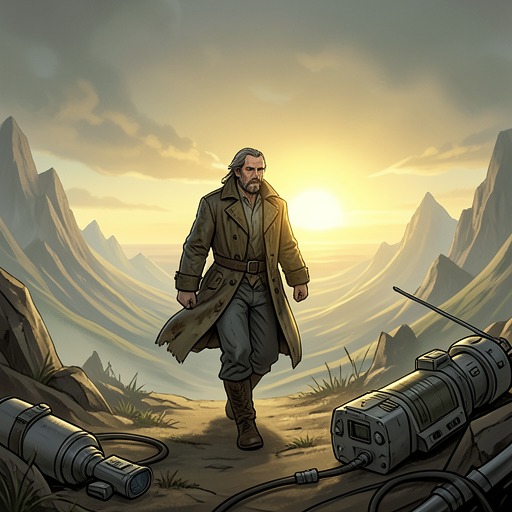
Sunlight appears suddenly beyond a narrow valley between two mountains, filling Bright Defile with a single pure ray. It casts no shadows; its illumination produces only more light, revealing colors more vivid than ordinary reality and carrying a warmth that reaches both body and soul. Yet its central power is not physical brightness. To see it is to understand immediately and intimately what is seen, because the light contains an irrefutable revelation of its own nature. The first sight therefore changes the value of knowledge itself: what had been pursued through maps, fragments, ruins, and dangerous interpretation is confronted as direct certainty.
The path into Bright Defile is marked by salt statues. Some are so ancient that their original forms can no longer be identified; others clearly represent beings foreign to humanity. The two newest statues are human, and later Jonathan recognizes the statues of Captain Hardiman and Stoneface among the failed pilgrims. Their presence turns the landscape into a record of previous attempts. The trial is not an unprecedented miracle awaiting a uniquely chosen hero, but a recurring ordeal in which seekers are drawn forward by the promise of truth and destroyed when their judgment, attachment, or will proves insufficient.
Jonathan warns the expedition that each step permits greater vision and understanding while also demanding more from the person who takes it. Marie, Captain Montgomery, and most of the crew remain at the threshold, content to absorb the smallest possible exposure. Airman Stutt kneels at the liminal edge, while Antomine and the Lux Guards follow Jonathan farther. The contrast defines the trial’s terms: remaining outside preserves a person’s place in the ordinary world, whereas entering the light risks the dissolution of the identity that made that place meaningful.
The Trial of Self and History
Once Jonathan steps beyond the threshold, the light becomes a pressure on the spirit, the self, history, and deed rather than a physical weight. The trial is not a puzzle with correct answers. It does not reward a particular doctrine or permit clever evasion. Either the person’s understanding is sufficient to carry him onward, or he crumbles beneath what the light reveals. Jonathan experiences the path as something wrought from his own self: every person he has known, every place he has visited, and everything he has owned, discovered, or lost becomes manifest for scrutiny.
The ordeal gathers the geography of the expedition into a moral landscape. Beacon and Jonathan’s home appear through the lens of his years there; Danby’s Point, Autochthon Reach, and the ruined Danner’s Grasp stand behind him as illuminated ideas rather than merely distant locations. Terminus offers the temptation to settle for a life that is merely good enough. The Players and their Game represent the temptation to pursue the wrong dream. Tor Ilek, Angkor Leng, and Ukaresh, with She-Who-Must-Be-Obeyed at its heart, become part of the same total vision. Sunlight thus makes the whole world available at once, but not as a collection of scenic wonders: each place becomes evidence of what Jonathan chose, endured, rejected, or failed to save.
The revelation also strips away uncertainty and deception. Secrets and mysteries are unraveled or rendered moot, and the deeper structure of the world opens before Jonathan as an expanse in which the greatest secrets he has previously extracted from creation appear to be only small stones beside a vast fertile country. This scale of truth explains both the attraction and the danger of the journey. Jonathan has spent his life accumulating fragments of knowledge, including the information he trades for passage, aid, and access; sunlight reveals that even his most profound discoveries are preliminary beside what lies beyond the final barrier.
Antomine reaches farther than Jonathan expects, but the inquisitor suffers beneath the light’s demands. Progressively less substantial versions of Antomine stream behind him as the illumination exposes the faith and beliefs layered into his identity. Jonathan interprets Antomine as a warning about the past: a creature of his king, bound so completely to the Illuminated King that accepting a reality in which the king is irrelevant would destroy the structure of his being. Antomine’s struggle gives the trial a political dimension. The light does not simply test private character; it exposes how thoroughly a person has been made by institutions, loyalties, and inherited powers.
Sacrifice and Passage
At the final barrier, physical distance and lack of understanding become indistinguishable. A gulf opens before Jonathan in a land defined by sunlight, and the darkness within it is not a hidden mystery but a clearly perceived absence. Crossing requires that everything else be shed, because life in sunlight permits no remaining shadow. Jonathan’s empty estate burns first, followed by his connections to his chauffeur and housekeeper. Each sacrifice illuminates another fraction of the gulf, turning the accumulated past into literal stepping-stones toward the future.
The final payment incorporates the entire expedition. The death of Tiuni, the destruction of Tor Ilek, and the burning of the corpse of a god become lights along Jonathan’s path. The sacrifice of Angkor Leng appears as the ephemeral radiance of a golden city within a god’s dream. His lost friendship with Eleanor and his banishment from Ukaresh are likewise converted into fuel, as is She-Who-Must-Be-Obeyed’s commanding visage when it flashes before him and joins the pyre. Jonathan also gives up his rejection of the Players and the Game as a competing dream. The trial therefore does not allow him to preserve even the experiences that justify his self-image; every victory, loss, relationship, and alternative must be surrendered if he is to proceed.
The last object he relinquishes is his cane. It lies across the final stretch like a thin sword blade, offering a precarious bridge over the impossible gap. Jonathan sacrifices it and takes the final step. The gesture is especially significant because the cane has accompanied his altered, controlled public identity; abandoning it leaves no practical or symbolic support between him and the light. He passes through the last infinitesimal darkness and enters Bright Defile itself.
Consequences and Significance
The trial completes Jonathan’s transformation from an explorer seeking proof into a person willing to let revelation dictate the terms of existence. Earlier, he had returned from a failed expedition with the conviction that others had been unequal to what they found. At Bright Defile, that conviction becomes a personal test. He succeeds not because the light confirms every prior choice, but because he accepts the destruction of the attachments through which those choices had been understood. His progress is therefore both triumph and impoverishment: the stronger his commitment to truth becomes, the fewer ties remain connecting him to ordinary human life.
The confrontation with Eleanor receives its final resolution within the light. She challenges Jonathan over the crusade into which he has drawn her, but the force of sunlight makes it impossible to call the revelation false or illusory. Jonathan tells her that he did not intend for the secrets of the Black Garden to hurt her, then tells her to live as she wishes. He defines the separation between them in stark terms, declaring that she belongs to the dark while he belongs to the light. He then releases both his anger and his fondness for her. Her phantom presence fades, and the connection between them is permanently severed. The trial thus changes a relationship not through reconciliation or mutual understanding, but through the removal of the emotional bond itself.
Antomine stops before Jonathan does. He has carried a box with a mirrored glass-and-crystal interior, apparently designed to trap and transport a small portion of sunlight, but Jonathan cannot determine whether the device succeeds. Antomine insists that they have reached the limit and that no one can go farther. Jonathan nevertheless advances, making the disagreement between them absolute: Antomine seeks to bring a controlled fragment of the light back into the world under the authority of the Illuminated King, while Jonathan accepts that the truth cannot be reduced to an artifact or returned as an institutional possession.
Beyond the defile lies a great green country beneath proud mountains, white clouds, swift rivers, and a vast blue sky. Every leaf, blade of grass, stone, and drop of water bears the secrets of time and space, while the sun itself is older and greater than anything Jonathan had been able to imagine. The shrouded lands behind him shrink to a dim mote suspended between sunbeams. That ending gives the trial its final value shift: the darkness that once contained the whole human world becomes marginal, while sunlight becomes not merely a destination but the measure by which the previous world is understood. The expedition’s apparent search for a place ends as an irreversible passage into a different order of knowledge and being.