The Sunlit Black Garden
Chasing SunlightThe Sunlit Black Garden is the altered state of the Black Garden after Jonathan Heights releases sunlight in the Pits of the Condemned. It marks a decisive reversal in the book’s opposition between darkness and light: sunlight repels the Garden’s original darkness, but the resulting illumination does not restore a human or orderly world. Instead, the Garden absorbs a new principle and becomes greener, more expansive, and no less consuming. Its transformation converts Jonathan’s faith in sunlight from a private source of power into a force capable of changing an entire alien environment.
Origin in the Pits of the Condemned
The transformation begins when Eleanor McAvey, already corrupted by the Black Garden’s knowledge, tries to take the life-heart fruit and then turns violently against Jonathan. Jonathan understands that esoteric knowledge may remain true even when separate truths contradict one another, yet he places his faith in the purity, sanctity, and reality of sunlight. He therefore summons sunlight from within himself as a scorching blaze intended to drive back the Garden’s grasping roots and crimson appetite.
The immediate result is a denial of the Garden’s former primacy. The dark vines can no longer dominate the space as they did before, and both Jonathan and Eleanor are protected from their worst effects. The light, however, does more than repel an attack. The Black Garden looks through Eleanor, perceives the radiance, and joins its own secret knowledge to Jonathan’s. The encounter becomes an exchange neither participant fully understands: sunlight enters the Garden’s system, and the Garden responds by changing its nature rather than simply yielding.
Transformation and Expansion
The Garden’s darkness shifts into something greener and greater. Its new form flourishes in the presence of what Jonathan regards as the one true light, but its growth retains the Garden’s consuming character. The change is therefore not a purification in any simple sense. Light has altered the Garden without making it safe, humane, or controllable; the former Black Garden becomes a green force whose vitality is itself invasive.
That invasion erupts through the Pits of the Condemned. Something claws its way out of Eleanor and bathes in the radiance of Jonathan’s memory, while the surrounding pits lose the protection that had shielded the two humans. The Keeper of the Pits, previously a stitched barrel-like monstrosity, reacts with confusion and amusement as two new limbs appear: woody trunks burst from its body and wave before the barrel splits apart. A blood-slick trunk then thrusts upward, while roots crack the stone floor.
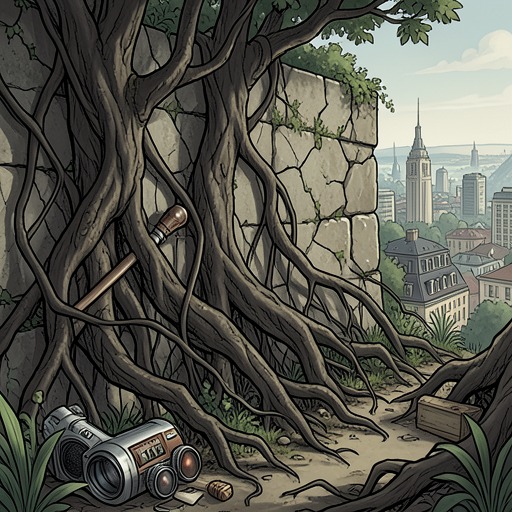
The transformation spreads beyond a single creature. Eleanor screams as blood leaks from her eyes, tongue, and nails, and every pit begins to tremble. Hundreds of trees rise in the torchlight, one from each pit, until the Garden has come into the Pits themselves. The growth pierces the ceiling, sends chunks of stone raining downward, and threatens to remake the entire enclosed structure. Even after Jonathan withdraws the sunlight and Eleanor collapses, the transformed Garden continues to grow. Its persistence proves that the light has not merely produced a temporary flare of power; it has established a lasting alteration.
Consequences for Jonathan and Eleanor
Jonathan’s intervention saves Eleanor from the immediate danger of hurting herself, but it also exposes how little control he possesses over the knowledge he invokes. He had expected the sunlight to drive back the Garden’s roots, not to teach the Garden something new. After escaping, he gives orders for the Endeavor to depart Ukaresh as quickly and as high as possible, carrying the unconscious Eleanor to her attendants. He describes the errand as successful in its narrow purpose while acknowledging that sunlight has changed the nature of the Black Garden and that the Garden has learned from the exposure.
The event also deepens the danger surrounding Eleanor’s corruption. Her contact with the Garden is not passive: its knowledge moves through her body, and the transformation manifests through her before spreading into the surrounding pits. She is protected from the worst physical destruction only while Jonathan’s intervention shields her; once the light fades, she remains unconscious while the altered Garden continues its independent expansion. The episode thus binds Eleanor’s condition to the Garden’s development without reducing the Garden to a mere symptom of her illness.
Ukaresh and the Value of the New State
Ukari treats the transformation as an assault on her city and authority. She tells Jonathan that the Black Garden is gone and holds him responsible for striking one of Ukaresh’s pillars after abusing her hospitality. Jonathan does not deny that his visit produced an unwanted result. Instead, he argues that the Garden is not exactly gone: it has changed because of sunlight, and whatever new form and insights it possesses may make it the only thing on that side of the Arch of Khokorron to hold those secrets apart from Jonathan himself.
This argument partially reduces Ukari’s anger because it converts destruction into acquisition. The altered Garden may contain knowledge unavailable elsewhere, even though neither Jonathan nor Ukari knows what the final result will be. The uncertainty is itself part of the state’s significance: the transformation creates value and danger simultaneously, giving Ukari a reason to consider what has been gained rather than only the insult done to her.
Narrative and Thematic Significance
The Sunlit Black Garden embodies the book’s larger conflict between the claimed civilization of light and the supposedly alien darkness beyond human lands. Human institutions repeatedly treat light, order, and expansion as civilizing forces, while eastern regions and nonhuman peoples are described through the language of threat, contamination, and disorder. Yet the Garden’s transformation complicates that hierarchy. Sunlight defeats the Garden’s previous condition but does not erase its agency; instead, the encounter produces a hybrid power that is more verdant, more expansive, and still dangerous.
The state also exposes the limits of Jonathan’s confidence. He begins with faith that sunlight is real and pure, a conviction opposed to a world in which sunlight is dismissed as myth. That faith proves materially effective, but effectiveness does not equal mastery. The light changes the Garden in a way Jonathan neither intends nor understands, and the result leaves destruction in his wake. His expedition therefore produces knowledge through intervention, but every discovery carries a cost: the world is not simply revealed by sunlight; it is altered by whoever brings the light into contact with what darkness has concealed.
The final image of the defiled engraving smiling as Jonathan flees gives the transformed state an especially ominous afterlife. The Garden has spread through the pits, the ceiling is breaking, and its new growth continues after the source of sunlight has been withdrawn. The Sunlit Black Garden is consequently neither a defeated enemy nor a completed revelation. It is an enduring, expanding consequence of contact between incompatible systems of knowledge, left behind in Ukaresh as a changed power whose secrets may prove as valuable as they are destructive.