The Theft of Jonathan’s Maps
Chasing SunlightThe Theft of Jonathan’s Maps is a targeted burglary aboard the Endeavor at Autochthon Reach, and its importance lies in what the thieves leave behind as much as in what they take. Jonathan Heights loses the maps that chart his eastern ambitions, but the method of the intrusion reveals that someone has identified his cabin, understood the value of his papers, and possessed enough skill and access to search the ship without immediate detection. The incident turns the Endeavor from a temporary refuge into a compromised expeditionary space and gives Jonathan a concrete adversary to pursue.
Circumstances and Vulnerability
The theft occurs while the Endeavor is unusually exposed. The ship is quiet, with half the crew absent: Antomine is occupied with prisoners and messages to Beacon, while Eleanor McAvey has disappeared into the city, apparently acquiring ammunition and perhaps attending to Reflected Council business. Jonathan Heights returns to the vessel already unsettled by an earlier encounter with André Ludwig, and the silence of the ship magnifies his suspicion. The removed top hatch provides a practical route from above, while the reduced watch leaves fewer people able to observe an intruder.
Jonathan’s assumption that the Endeavor, or at least his own cabin, would remain untouched within port proves dangerously complacent. The alarm elsewhere in the expedition has accustomed the crew to overt threats, but this attack is quiet, selective, and intimate. It does not announce itself through a confrontation like the dark ship that once attempted to intercept the Endeavor; it appears first as disorder in a private room, making access and betrayal more important than firepower.
The Break-in and Discovery
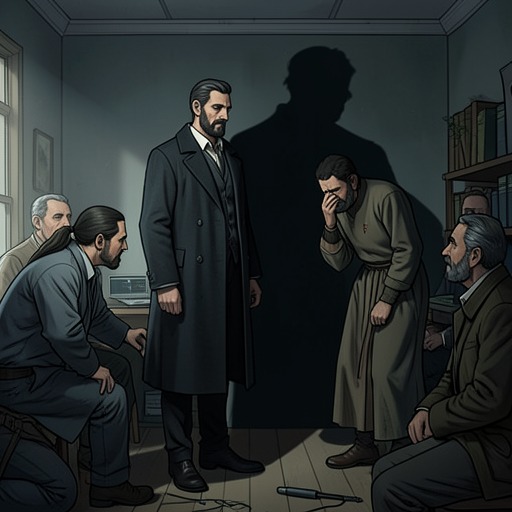
The intruders force open crates, splintering myceliplank with hurried crowbar work and spilling clothing, tools, and artifacts across the floor. They open Jonathan’s desk drawers and cut into his mattress, searching through places where valuable records might have been concealed. The destruction is not random: Jonathan recognizes in the mess the same hand he has been seeking, connecting the burglary to the broader pressure already gathering around his expedition.
He bars the cabin door with his cane before approaching the safe. Breaking the safe or carrying away its massive iron body would have been difficult without attracting notice, but cracking it would have been possible. When Jonathan rotates the familiar combination and opens it, the papers and petty cash remain. The conspicuous absence is his maps.
The maps are not his only records. Jonathan uses a fragment of broken mirror to inspect the safe’s reflection and activates the hidden compartment concealed behind it. His original notes and Reginald Heights’s notebooks are still intact. This distinction changes the nature of the loss: the thieves have taken the expedition’s working navigational material, not the irreplaceable archive from which it was derived. Jonathan can reconstruct the maps, but doing so would consume time he refuses to surrender while an opponent is actively moving against him.
The maps are also written in cipher. Their removal therefore creates a delay rather than an immediate transfer of knowledge. Anyone who copied them would still need to interpret them, and the thieves would have difficulty reproducing the entire collection under the conditions of the hurried search. Jonathan consequently treats the loss as recoverable, though not trivial. The maps represent accumulated labor and the practical means of reaching sunlight; their disappearance threatens the expedition’s schedule even while preserving a tactical advantage for their owner.
Investigation and Suspected Perpetrators
Jonathan informs André Ludwig in writing, although he gives equal odds that André himself arranged the theft. The letter demonstrates Jonathan’s investigative method: he distributes information while withholding trust, treating every contact as a possible source of assistance and a possible channel of danger. He then waits at the gangplank for Eleanor McAvey, deciding that Antomine’s particular talents are unlikely to help with a burglary investigation.
Eleanor returns with only one maid, Sarah, because Marie is presumably convalescing elsewhere. Jonathan tells her that the maps are gone and that recovering them would be faster than reconstructing them, especially if the recovery identifies the person who has set himself or herself against the expedition. He leaves unstated the further consequence he imagines: once located, the enemy could be removed. Eleanor responds by ordering Sarah to secure their quarters and verify that nobody has entered them.
Eleanor examines Jonathan’s cabin and opens his safe with an ease that suggests either knowledge of the combination or a more esoteric talent. She concludes that the burglars were a group rather than a lone trespasser. The safecracker was considerably more skilled than the accompanying muscle, which gives her confidence that the pair or group can be found if the right questions are asked in the right places. Sarah reports that Eleanor’s rooms are untouched. The contrast is decisive: the intruders went directly to Jonathan’s cabin, indicating foreknowledge rather than a general search for valuables.
Jonathan and Eleanor infer that at least one crew member disclosed the location or significance of the cabin. The likely informants are among the sailors who abandoned the Endeavor after its recent difficulties. This suspicion broadens the theft from an external intrusion into an internal security failure. The missing maps expose not only hostility beyond the ship but also the danger created by demoralization, desertion, and the circulation of expeditionary information among former crew.
The Trail to the Society of Explorers
Eleanor refuses to bring Jonathan into the Reflected Council business that she intends to pursue, and he accepts the separation because he has another lead. He visits the courier ship Lady Green and tells its captain that a thief stole navigational maps from his ship. Jonathan believes the stolen material may have been intended to guide the Endeavor toward the courier’s most recent passenger, a man from Beacon. The captain identifies that passenger as Harrington, who represented the Society of Explorers and had instructed the courier to send messages to the Faithful Respite in the Merchant Quarter.
The captain’s reluctance and Jonathan’s controlled menace make the exchange feel less like a formal inquiry than a warning held in reserve. Jonathan does not accuse the courier crew of participation; he promises that trouble will go to those who deserve it and leaves after receiving the address. The information points toward Harrington and the Society of Explorers, whose rivalry with Jonathan provides a plausible motive. Jonathan considers the Society capable of stealing his maps, especially because its presence in Beacon had previously been constrained by both the Crown and the Reflected Council.
Yet the motive remains uncertain. Hiring a mercenary ship to harass an exploration vessel would require an extravagant expenditure, and the Society’s limited coffers make such a decision difficult to explain. Jealousy could motivate such waste, but Jonathan distinguishes emotional hostility from the practical ability to fund an operation. Harrington’s name is unfamiliar to him, but Jonathan hopes the man can be used to persuade the Society that further interference will be costly.
Consequences for the Expedition
The theft forces Jonathan to revise his understanding of security aboard the Endeavor. He repairs the visible disorder, questions the airman on watch, and recognizes that the missing hatch allowed approaches from above without even the warning noise that a normal entry might have produced. The watchman saw nothing, but the failure is not treated as proof of supernatural concealment; Jonathan identifies a dozen possible routes and accepts that his own assumption of safety was the immediate weakness.
He chooses not to delay the voyage with a formal investigation into minor cargo tampering discovered elsewhere. Later, cases containing fire dust and unflame show signs of having been opened, with some small pilfering, but most supplies remain intact. Jonathan suppresses the matter because the Endeavor has already endured too many delays and he will not allow another inquiry to obstruct its departure toward sunlight. The map theft therefore occupies a special category: unlike scattered theft from cargo, it is precise, strategic, and directly connected to the expedition’s route.
The event also clarifies the value of Jonathan’s cartographic work. The expedition carries an enormous range of equipment, including a portable luminiferous terrestrite distillation apparatus, a lifting-gas separator, water siphons and filters, searchlights, crew-served zint guns, food, water, spare parts, clothing, and bedding. Those supplies can be replaced through trains, ports, and trade; the maps embody a more personal accumulation of knowledge and cannot be exchanged for ordinary provisions. Their theft threatens the expedition’s future while proving that Jonathan’s enemies understand which possessions matter most.
The maps ultimately remain a danger to their thieves as well as to their owner. Because they are encoded and derived from protected notes, possession does not immediately grant mastery of the route. Jonathan can reconstruct them, but the time required would be substantial, and the stolen originals give an adversary the possibility of following or redirecting the Endeavor. The burglary thus establishes a contest over knowledge in which navigation, secrecy, crew loyalty, and political rivalry become inseparable.