The Third Gospel Outbreak at Danner’s Grasp
Chasing SunlightThe Third Gospel Outbreak at Danner’s Grasp, also known as the Destruction of Danner’s Grasp and the Smiling Man Incident, is a decisive crisis during the Endeavor’s eastward expedition. What begins as a storm-forced landing at a remote settlement becomes an encounter with the Third Gospel of the Smiling Man, a corruption Jonathan Heights regards as capable of spreading through people, buildings, and even remembered words. The outbreak exposes the expedition’s central moral division: whether forbidden knowledge must be contained at any cost, or whether destroying an infected community is itself an intolerable atrocity.
Storm-Bound Arrival
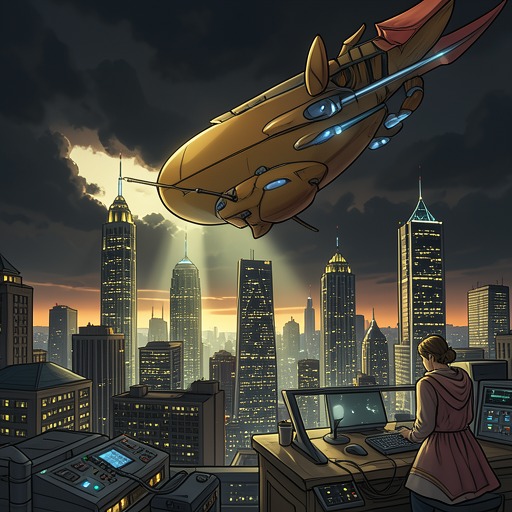
The crisis begins when the Endeavor, pursued by a mercenary ship, is driven toward Danner’s Grasp by violent weather. A lightning flash reveals the settlement below: farmland and rugged vegetation surround two enormous, six-fingered stone hands rising from the ground, the surviving fragments of an ancient monument. Human settlers have fastened mooring rods to the fingers and placed lights in the empty palms, building their town beneath the exposed remains. The lightning disappears almost immediately, but the brief illumination gives Captain Montgomery enough guidance to turn the Endeavor southward toward the settlement while the storm throws the pursuing ship off course.
The Endeavor reaches the monument in a precarious condition, anchored to three stone fingers while another line is tied to a small building on one palm. With Montgomery occupied and the ship unstable in the gale, the party goes ashore at its own risk. Jonathan carries Marie down by force while Eleanor McAvey and Sarah follow the handholds behind him. A three-fingered gaffer directs them along a rain-slick wooden walkway that spirals down the monument’s wrist. The settlement’s structures have not been driven into the stone; instead, ropes and chains hold the creaking walkways in place against the wind, making the town’s connection to the ancient monument visibly provisional.
The streets are unnaturally empty. Jonathan expects inhabitants of such a remote settlement to endure the weather and continue their business, yet no one appears among the pitted cobbles, and neither candles nor sheltershrooms reveal ordinary movement. The group follows the gaffer’s directions to a chirurgeon’s building marked by a red heliograph light, where several Endeavor crew members wait in the anteroom. The apparent medical refuge becomes the threshold of the outbreak.
Recognition of the Gospel
Jonathan discovers that the town’s doctor has locked the interior door, and a low, murmured cadence comes from beyond it. He breaks the latch and enters the operating theatre, where the doctor and George, a wounded crewman, turn toward him with smiles. The doctor’s grin stretches almost to the back of his neck, exposing more teeth than a human mouth should contain. George’s smile is nearly as broad; his injured body is covered with stitches, while his teeth have begun to stretch and divide into doubled versions of themselves. The physical deformation makes the infection visible as a transformation of the human face and body rather than merely a change in belief.
Eleanor asks whether the phenomenon is the Second Gospel, but Jonathan identifies it as the Third Gospel of the Smiling Man. He knows the First Gospel, encountered in Beacon, to be comparatively harmless, while the Second and Third are not meant for the human mind. The distinction changes the party’s objective immediately: the doctor and George are no longer patients or stragglers to be rescued, but evidence that the settlement has crossed into a form of contamination that Jonathan believes cannot be safely confronted by ordinary violence or negotiation.
The Gospel itself exerts a dangerous attraction. Jonathan hears the doctor reciting words with a nauseating, seductive quality, yet the remembered reality of sunlight helps him resist listening. Rather than fight the two infected men inside the building, he withdraws, refusing to escalate the encounter before he understands its extent. Outside, the storm conceals the sound of the recitation, and Jonathan orders the others to flee toward the Endeavor. When Jameson asks about George, Jonathan answers that George is gone and orders everyone to reach the ship.
Lightning then reveals the true scale of the outbreak. Figures have emerged throughout the streets as if summoned by an invisible command. Without their cloaks and hoods, the townspeople’s faces show the same agonizingly wide smiles. Jonathan tells the others to block their ears and runs ahead with the sword drawn from his cane, knocking aside clubs and belaying pins and using the blade when necessary. The townspeople are too numerous to count, but the party reaches the monument because the Endeavor is close and the storm prevents the infected crowd from overtaking them. The gaffer’s hut has been smashed, leaving behind a hissing, glowing residue of zint that indicates Antomine’s guards have already begun using force to secure the retreat.
The Inquisition’s Decision
Back aboard the Endeavor, Antomine immediately identifies the settlement as a Smiling Man cult, though Jonathan recognizes that the outbreak exceeds the ordinary meaning of a cult. The townspeople remain visible through the rain as figures gathered on the stone palm, still chanting while zint spotlights pass over them. Their words are indistinct, but the sound vibrates through the ship, preserving the Gospel’s power even after the expedition has escaped the streets. Antomine therefore asks Captain Montgomery to commandeer the ship’s cannon, declaring that the town has been infected with forbidden secrets and that artillery can resolve the danger. His request turns the outbreak from a flight for survival into a dispute over the fate of everyone left below.
Eleanor McAvey objects at once, insisting that hundreds of people are present and that they cannot all be assumed to be Gospelites. Montgomery likewise refuses to make the Endeavor an instrument of mass slaughter. Antomine answers by invoking the authority of the Inquisition and asking whether their resistance amounts to treason. The moment strips away his earlier boyish manner and reveals the dangerous Crown agent beneath it: the outbreak is no longer merely a religious emergency, but a test of obedience to the state’s doctrine that forbidden knowledge must be purged.
Jonathan intervenes reluctantly. He does not defend the Inquisition’s excesses, yet he argues that the Third Gospel creates a threat unlike the First or Second. In his judgment, ordinary soldiers with guns and swords might contain the lesser Gospels, whereas the Third Gospel leaves no one safely untouched; even buildings must be destroyed because they may retain echoes of the contamination. His argument recalls the scale of an earlier encounter in which a village was erased so completely that a deep lake occupied its former site. By presenting destruction as containment rather than vengeance, Jonathan gives Antomine the practical justification needed to proceed, while revealing how his pursuit of sunlight has made him capable of endorsing the same brutal logic he distrusts.
Antomine finally limits the operation to his two guards and tells Montgomery that the Inquisition will bear the burden alone. Montgomery hesitates before yielding, and Jonathan’s small nod helps settle the decision; the captain orders his crew to continue cleaning and repairing the Endeavor while Antomine’s agents act outside. Eleanor then accuses Jonathan of taking Antomine’s side. He answers that he wishes otherwise, but the Third Gospel is an unspeakable menace and the storm has left them unable to depart safely. His response does not reconcile the disagreement. It establishes the outbreak’s enduring moral injury: survival requires the expedition to abandon the ordinary distinction between rescuing the infected and destroying them.
Destruction and Aftermath
The decision is followed by the destruction of Danner’s Grasp. By the time the Endeavor leaves, the settlement is no longer a place to which the expedition can return but a smoldering ruin of zint, lingering fire, and shattered sheltershrooms whose green light survives among the debris. The storm has passed, allowing the airship to resume its course, while the mercenary ship has been blown far away and is unlikely to pursue them soon. The outbreak therefore ends through a double release: weather frees the Endeavor from immediate pursuit, and fire is used to sever the settlement from the spreading Gospel. The town’s removal is treated as a necessary quarantine, but the imagery makes clear that containment has required the obliteration of a human community.
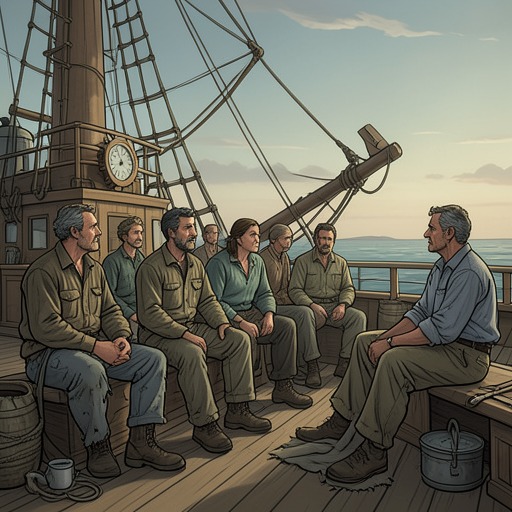
The aftermath extends beyond the burning settlement into the survivors’ treatment of death. Antomine conducts a service for the three crew members killed during the encounter, while George’s casket remains empty because no one attempts to recover his body from the ruined town. Each sealed casket is immersed in distilled luminiferous terrestrite and reduced to dust before the remains are scattered into the wind. The ceremony gives the expedition a formal passage out of the disaster, but it cannot restore the missing crewman or resolve the question of whether the town’s inhabitants were victims, converts, or both. Even the ritual’s language of proper burial is therefore shadowed by the outbreak’s contamination logic: the dead are honored only after being rendered incapable of remaining as physical traces.