The eternal darkness
Chasing SunlightThe eternal darkness is the governing condition of the world in Chasing Sunlight, not merely an absence of daylight. It surrounds human civilization, determines where people can live and travel, conceals hostile life and forgotten histories, and gives every artificial light both practical value and ideological force. Against it, humanity presents itself as a vigil of illumination under the Illuminated King, while Jonathan Heights treats the darkness as a more honest reality than the manufactured radiance of Beacon and pursues the legendary Sunlight beyond it.
A World Beyond the Walls
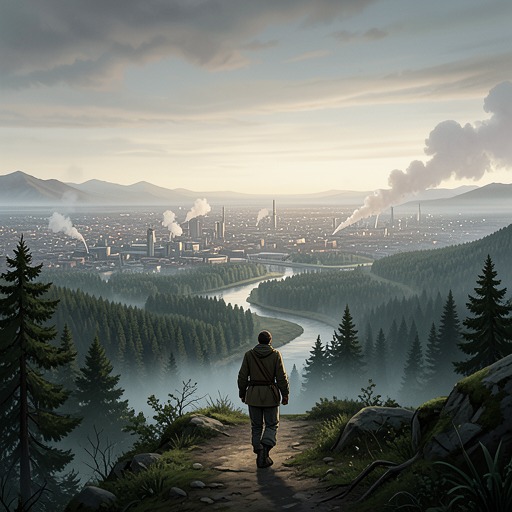
The eternal darkness defines the frontier outside human settlement. The human lands are enclosed and illuminated, but the territory beyond them is a black wilderness containing wonders, horrors, ancient ruins, abandoned cities, beasts, caravans, and forces that cannot be recorded on ordinary maps. Jonathan Heights has spent his life crossing that boundary, and his experience teaches him that survival depends on knowledge of conditions beyond the walls rather than on the confidence produced by civilization’s lights.
For the people of Beacon, light is infrastructure as well as protection. Zint-light fills the city, illuminates railways and roads, and allows farms, barracks, warehouses, and airships to function within the darkness. Yet Beacon’s brightness remains incomplete: poor farms rely on the green glow of sheltershrooms, while patrols must watch for incursions from the Cult of Flame, Invidus Croft, and monstrous life emerging from outside settled territory. The navy of the Illuminated King is therefore less a shield against every danger than a force constantly searching the border for the next breach.
Jonathan’s distrust of Beacon arises from this contrast. The city’s white stone and thousands of lights provide technology, heat, trade, and a form of safety, but he finds its illumination dishonest because it is manufactured and dependent on constant human effort. The lethal darkness outside the walls seems more truthful to him, while only Sunlight offers illumination that does not require concealment or maintenance. This distinction turns the darkness into a standard by which civilization itself is judged.
Navigation, Resources, and Threat
The darkness makes travel a practical discipline of preparation and interpretation. Jonathan does not believe that merely heading east is sufficient. Expeditions must rest, resupply, repair damage, and account for changing weather, beasts, caravans, and esoteric dangers. His earlier journeys have produced charts of crumbling mines, ruined cities, isolated oases, caravan migrations, and raw terrestrite deposits, resources needed to distill zint fuel for the Endeavor. Knowledge of the dark wilderness is therefore both geographical and logistical: a route is viable only when its supplies, hazards, and unknowns have been weighed together.
The Endeavor’s departure demonstrates how thin the illuminated zone is. Near Beacon, zint infrastructure traces bright lines through the countryside, but even there other airships must use spotlights to search the darkness below, and hostile things can still approach from beyond the settled perimeter. During the journey, a pursuing ship can run almost entirely dark, becoming visible only through the faint blue glow of its engines; boarders equipped with wingsuits and zint weapons emerge from that obscurity before the crew can fully identify them. Artificial light reveals danger, but it also announces a target.
Farther east, the darkness becomes a condition of scarcity and improvisation. The Endeavor encounters extensive damage, depleted tools, empty crates, and insufficient replacement parts while traveling through wilderness where supplies are difficult to obtain. Even a newly discovered settlement near a terrestrite vein appears impossible because it places an intense flame of civilization in the wildness of the dark. Such moments repeatedly unsettle the expedition’s assumptions about where human infrastructure ends and what powers may be extending it.
Borderlands and Unstable Spaces
The eternal darkness produces borderlands in which human categories lose their authority. At Danby’s Point, the easternmost terminus of human civilization, zint-lit human construction shares a plateau with alien illumination, nonhuman architecture, and peoples the Illuminated King does not acknowledge. A metal gate separates the human portion from territory claimed by darker forces, but influence crosses the boundary in both directions: distant spires bend into alien forms, while structures near the wall are drawn toward straighter human lines.
The inhabitants of Danby’s Point make the instability visible. The Fractured possess bodies whose faces, limbs, and proportions shift from moment to moment, while the Tarfolk range from ship-cat-sized creatures to immense beings barely comprehensible as living forms. Jonathan proceeds cautiously because trade depends on restraint as much as on power. He uses the settlement as a threshold rather than a destination, meeting Tiuni to exchange human literature for intelligence about the eastern lands. Her reports on Thrantin movements, caravan routes, beasts, and the shifting Verdant Expanse turn the darkness into an information network, although Antomine’s accusation that she has lied exposes how uncertain every map and testimony may be.
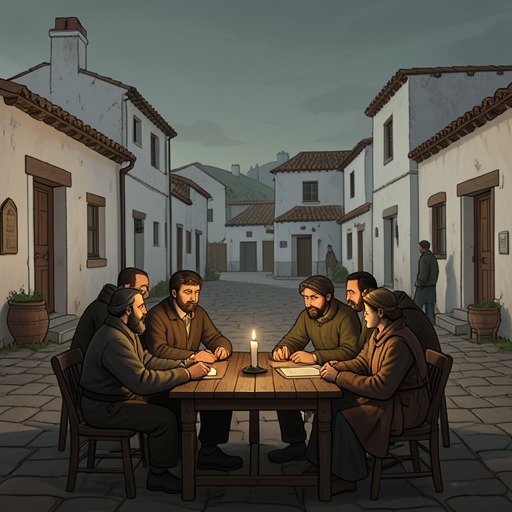
Other settlements offer different forms of disorientation. Terminus appears orderly, hospitable, and brightly maintained, yet Jonathan becomes suspicious precisely because nothing immediately troubles his instincts. Its apparent safety may be natural or artificial, genuine or synthetic, but he concludes that its temptation is malign and leaves despite the absence of open opposition. Ukaresh is governed by few laws beyond power, and its hazardous eastern weather makes a secure berth valuable enough for Jonathan to pay with an insect collection rather than ordinary currency. In these places, the darkness is not simply outside a city: it enters the city’s laws, economies, bodies, and forms of hospitality.
The Darkness as Metaphysical Boundary
The farther the Endeavor travels, the less the darkness behaves like a stable physical environment. At the Dead Battle, two forces remain locked in combat as if time itself has stopped, and the scene initially seems to be only an impressive spectacle beneath the ship. Gradually, however, the observation room appears to expand, its windows grow larger, and the battlefield becomes more visible as though the world below were shrinking. Two immense figures emerge in the distance, and understanding itself changes the meaning of what Jonathan has been seeing. The darkness is thus capable of concealing not only objects but the structure of reality.
The Arch of Khokorron provides another transformation. The Endeavor enters a vast monument and emerges through a much smaller aperture into a barren desert near the Lofted Lakes, a landscape of glowing flowers and water spheres bounded by air rather than earth. Travel through the darkness is consequently not always movement across a continuous map. It may be passage between incompatible systems of space, where familiar distance, direction, and geography no longer provide reliable measures.
At Bright Defile, the distinction between physical darkness and conceptual darkness finally collapses. Jonathan reaches a threshold where a gulf is simultaneously a feature of the land and a barrier of understanding. In a region defined by Sunlight, the remaining darkness is not ignorance in the ordinary sense; it is the final reserve of secrecy, and it can be crossed only by shedding every shadow. The passage presents illumination as revelation rather than comfort: to live in Sunlight means having no hidden self or protected past.
Human Response and Narrative Significance
Human civilization responds to the eternal darkness by building walls, laws, technologies, patrols, maps, and doctrines of light. Antomine understands the eastern wilderness through the obligations of the Inquisition and argues that threats such as the Umbraught must be confronted before they reach human lands. Jonathan rejects that demand during the expedition because the Endeavor is not a navy and lacks the time and resources to cleanse a city the size of Angkor Leng. Their dispute reveals two competing responses to darkness: organized civilization seeks to contain it, while Jonathan accepts exposure to it as the unavoidable cost of reaching Sunlight.
The darkness also exposes the limits of those responses. Human infrastructure can be sabotaged, supplies can be stolen, roads can end, and supposedly safe communities can become traps. The eastern journey repeatedly forces Jonathan and his companions into spaces where law, identity, time, and even physical geography are unstable. Yet the darkness is not portrayed as empty chaos. It contains trade routes, mineral resources, memories, rival civilizations, and forms of knowledge that human institutions have excluded or misrepresented.
The final barrier at Bright Defile gives the concept its deepest significance. Jonathan’s passage is purchased through accumulated losses: his estate, his ties to Johann and Agnes, the death of Tiuni, the destruction of Tor Ilek, books discarded from the Endeavor, the burial of a god, the sacrifice of Angkor Leng, his friendship with Eleanor McAvey, his banishment from Ukaresh, and his rejection of the Players and the Game. The eternal darkness therefore marks the cost of every concealed attachment and every unexamined certainty. It is the world’s physical condition, the frontier of human knowledge, and the shadow that must ultimately be surrendered before Sunlight can become more than a myth.