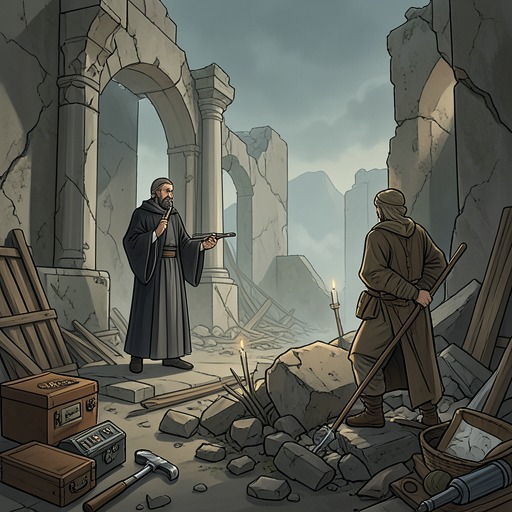
The more inhuman knowledge is, the less human those who understand it become
Chasing Sunlight“The more inhuman knowledge is, the less human those who understand it become” is a warning about the cost of understanding the world beyond human categories. Antomine speaks it aboard the Endeavor while the expedition weighs mystery against survival, turning the line into a concise statement of the book’s central anxiety: knowledge may enlarge human power while eroding the humanity of those who possess it.
Meaning and Immediate Context
The expression appears after Eleanor McAvey dismisses sunlight as an attraction and says that she has joined the expedition to get rich rather than become a cultist. Jonathan Heights and Antomine have no adequate answer for her skepticism. The narrative presents sunlight as something whose purity and reality cannot be conveyed through ordinary language, while also noting that Antomine may be acting under secret orders from the Illuminated King and that Eleanor has secrets of her own that avoid exposure to light. In this setting, knowledge is not neutral information: it is linked to revelation, secrecy, loyalty, and danger.
Antomine’s statement follows Jonathan Heights’s softer claim that the expedition still contains mysteries worth considering. Antomine rejects the idea that every mystery deserves admiration or pursuit. His wording makes “inhuman” knowledge a qualitative danger: the farther knowledge departs from human experience, the more severely it threatens the identity of the people who interpret it. The expression therefore answers Eleanor McAvey’s practical concern about staying alive while also challenging Jonathan Heights’s faith that discovery justifies continued movement eastward.
Knowledge Beyond Human Lands
The expedition’s surroundings give the expression concrete force. At Danby’s Point, human civilization ends at a zint-illuminated tower built into bruised-purple rock, while alien illumination and architecture press against the straight lines of human construction. A great metal gate separates the human section of the plateau from territory claimed by darker forces, yet influence crosses the boundary in both directions. The Fractured appear human only in unstable imitation, their faces, limbs, and proportions changing from moment to moment; other beings are spindly, many-limbed masses of black tar with human eyes, ranging from the size of Penelope to forms larger than buildings.
This environment makes “inhuman knowledge” more than an abstract philosophical category. Jonathan Heights’s maps and Tiuni’s information allow the expedition to plan routes through the Verdant Expanse, where caravans, forces, beasts, and ancient ruins shift in a landscape that behaves like a changing tide. Tiuni’s intelligence is indispensable, yet Antomine exposes one of her statements as a lie, reminding the expedition that knowledge from beyond human lands is valuable precisely because it is difficult to verify. The map can guide movement, but it cannot make the territory human or fully intelligible.
Civilization, Control, and the Cost of Discovery
The expression also belongs to the conflict between exploration and institutional control. The expedition begins under the authority of the Illuminated King and the Reflected Council, with Jonathan Heights pursuing the supposed myth of sunlight while agents of the crown and underworld join him aboard the Endeavor. Human civilization defines itself as a vigil of light against eternal darkness, but its eastern frontier depends on trade with nonhuman peoples and on restricting that contact through Inquisition power. The encounter at Danby’s Point thus exposes the instability beneath the language of civilization: the boundary is defended, negotiated, and continually altered by what lies beyond it.
Antomine’s conduct reflects this institutional perspective. When a possible nest of Umbraught is discovered in Angkor Leng, he argues that it must be purged because the Umbraught now know that zint exists and could carry the threat westward. Jonathan Heights refuses, insisting that the Endeavor is not a navy and lacks the time and resources to survey and cleanse a city the size of Angkor Leng. Antomine answers that civilization is built by doing more than the bare minimum, because present actions determine whether life will be easier or harder for those who come afterward. His warning about inhuman knowledge therefore operates alongside a doctrine of civilizational responsibility: knowledge must be contained, and civilization must expand its protective duties, even when the cost is high.
Yet the exchange also reveals the danger of Antomine’s position. His language of purging and cleansing treats unfamiliar beings as threats before their actual danger is established, while Jonathan Heights treats the same threat as a distraction from the journey to sunlight. Neither response fully resolves the problem. The expression stands between them, suggesting that both uncontrolled curiosity and unquestioned enforcement can become forms of dehumanization.
The Expression’s Narrative Significance
The line gives philosophical shape to the book’s recurring contrast between light and darkness. Light promises revelation, but revelation is not presented as simple moral improvement; sunlight may expose secrets, unsettle established beliefs, and force minds to confront realities that ordinary human categories cannot contain. Darkness, conversely, conceals horrors but also protects those who are not prepared to endure disclosure. Eleanor McAvey’s resistance to sunlight and Jonathan Heights’s determination to find it represent opposing responses to this pressure, while Antomine’s warning recognizes that the conflict is not merely between ignorance and truth.
The expression also functions as a restraint on the romance of exploration. Jonathan Heights repeatedly relies on maps, trade information, and practical education to prepare his companions for foreign encounters, but the eastern world continually exceeds the systems used to describe it. The unstable bodies at Danby’s Point, Tiuni’s unreliable intelligence, and the unknown forces associated with Angkor Leng all demonstrate that information can be useful without becoming safe. The more alien the object of knowledge, the less confidence the explorer can place in the assumption that knowing it will leave the knower unchanged.
As a result, the expression is both warning and thematic thesis. It does not declare that knowledge should never be pursued; the expedition continues toward sunlight, and Jonathan Heights remains committed to discovery. Instead, it demands recognition that discovery carries an ontological consequence. To understand what is radically other may require surrendering the human measures by which understanding began, leaving the explorer caught between the promise of illumination and the fear that illumination will make a stranger of the person who reaches it.