Third Gospel Containment Rule
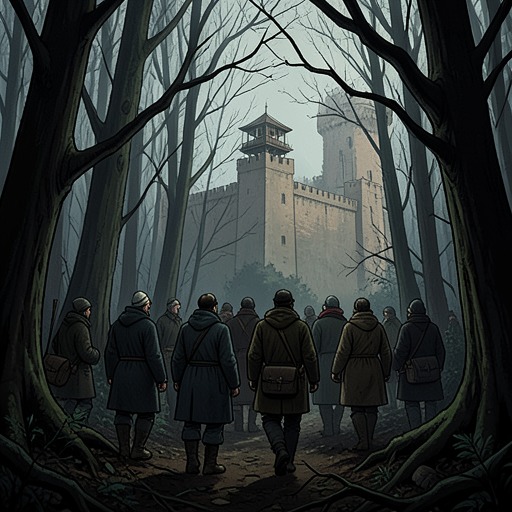
Chasing SunlightThe Third Gospel Containment Rule is the harsh quarantine principle applied when the Third Gospel of the Smiling Man appears: because the Gospel can taint minds, communities, and places, ordinary suppression is considered inadequate. Its decisive consequence is that containment extends beyond infected individuals to the structures and acoustic traces associated with the recitation, authorizing the destruction of an entire settlement rather than allowing the corruption to spread.
Definition and Scope
The rule emerges from the distinction between the lesser Gospels and the Third Gospel. When Jonathan Heights encounters the smiling doctor and the grievously wounded George in a small operating theatre, their impossible smiles and distorted teeth identify the scene as more than an ordinary religious disturbance. Eleanor McAvey initially recognizes the danger as the Second Gospel, but Jonathan corrects her: the threat is the Third Gospel of the Smiling Man. He knows that the First Gospel encountered in Beacon was mostly harmless, whereas the Second and Third are not meant for the human mind.
The rule therefore treats the Third Gospel as a contamination of perception and understanding, not merely as doctrine. Its recitation possesses a nauseating and seductive quality, capable of drawing listeners toward words they should not hear. Jonathan escapes before the most dangerous words are spoken, aided by the rain and thunder, whose noise drowns out the Gospel. The practical logic is unmistakable: exposure itself is dangerous, and physical distance is the first form of protection.
Application at the Infected Town
After the escape, Antomine identifies the group as associated with the Smiling Man Cult and asks Captain Montgomery to commandeer the Endeavor’s cannon. Townspeople remain on the enormous stone hand, chanting while the ship’s spotlights struggle to reveal them through the rain. Eleanor McAvey objects that hundreds of people are present and cannot all be like the smiling doctor and George; Captain Montgomery likewise refuses to make the airship participate in wholesale slaughter.
Antomine answers that the matter belongs to the Inquisition and frames resistance as possible treason. Jonathan Heights, although no supporter of the Inquisition’s excesses, confirms the underlying danger. If the outbreak involved only the First or Second Gospel, he would recommend armed men with guns and swords. The Third Gospel changes the response because nobody exposed to it can be assumed to remain untainted. In Jonathan’s account, even the buildings must be destroyed lest they retain echoes of the recitation. His previous encounter with the same Gospel ended more aggressively, leaving a deep lake where a village had once stood.
The rule thus transforms a rescue or policing operation into a program of total eradication. Antomine ultimately says that his own guards will be sufficient and releases Montgomery and the Endeavor’s crew to continue their duties, but the apparent limitation of personnel does not soften the principle. The Inquisition’s burden is to remove the contaminated site and prevent the Gospel from acquiring a route outward through survivors, architecture, or remembered sound.
Containment as Institutional Power
The Third Gospel Containment Rule is not merely a medical precaution; it is also a mechanism through which the Inquisition converts an epistemic danger into a mandate for sovereign violence. Antomine invokes the authority of the Inquisition when Eleanor McAvey and Captain Montgomery resist the proposed bombardment, treating hesitation as a possible form of treason rather than as an ordinary moral objection. His position places the rule within the political order of the Illuminated King: once the Gospel is classified as an enemy of that order, the destruction of contaminated people and places becomes an official duty. Jonathan Heights distrusts the Inquisition’s excesses, yet his knowledge of the Third Gospel gives Antomine’s demand a practical justification. The rule therefore joins two forms of power that are not identical but become mutually reinforcing: the Inquisition claims the right to define the threat, while Jonathan supplies the experiential evidence that makes extraordinary measures appear necessary.
Its most disturbing feature is the way it suspends ordinary distinctions between guilty and innocent, person and building, belief and environment. Eleanor points out that the town contains hundreds of people who may not share the doctor’s or George’s grotesque condition. Jonathan’s response does not establish that every inhabitant is visibly transformed; instead, it asserts that exposure to the Third Gospel makes contamination impossible to assess safely. The rule consequently abandons individualized judgment. A crowd cannot be separated into trustworthy and untrustworthy listeners, and a settlement cannot be treated as a neutral container once the recitation has taken place within it. Even after the immediate speakers are removed, the site remains dangerous because the Gospel may persist as an echo in its structures. Destruction is thus presented as a form of quarantine for matter as well as for minds.
The rule also explains why the Endeavor’s escape is conducted as urgently as a military withdrawal. Jonathan does not stay to debate the chanting townspeople or attempt to determine how far the infection has spread. He gets Eleanor, Marie, and the others back aboard the airship, uses the rain and thunder to mask the recitation, and leaves Antomine’s guards to bear the Inquisition’s responsibility. That division of labor reveals the rule’s ethical fracture. Captain Montgomery and his crew are unwilling to participate in wholesale slaughter, while Antomine accepts the burden as part of his office; Jonathan, meanwhile, recognizes the danger without embracing the institution that acts upon it. The containment principle therefore produces no shared moral consensus. It produces withdrawal, coercion, and a decision to continue the expedition while the infected town is made someone else’s responsibility.
Boundaries, Exceptions, and Wider Patterns
The rule’s severity becomes clearer when set beside the other prohibitions governing the expedition. In the Grave of Wood, Jonathan Heights warns Captain Montgomery that nothing may be taken from the cemetery, because even an apparently harmless object such as its wood may fall under the site’s protection. In the eastern lands, theft within a caravan carries penalties, and Jonathan bargains over a crewman’s stolen statuette without asking for clemency. These rules differ in content, but they share a structure: contact with a forbidden place, object, or practice creates consequences that cannot be reduced to ordinary intention. The Third Gospel Containment Rule is the most catastrophic version of that logic because its prohibited medium is speech itself. The recitation crosses from human mouths into minds, buildings, and memory, making the boundary between infected and uninfected impossible to secure by inspection alone.
That logic also clarifies why the rule conflicts with Jonathan Heights’s priorities. Throughout the expedition, he treats danger as something to be assessed against the journey’s limited time and resources. When Antomine argues that an Umbraught nest in Angkor Leng must be purged before the creatures learn the value of zint, Jonathan objects that the Endeavor is not a navy and cannot survey and cleanse a city of that size. The Third Gospel is different only in Jonathan’s judgment that delay would expose everyone to a danger ordinary force cannot contain. He therefore accepts the necessity of destroying structures, even while rejecting the Inquisition’s broader authority and refusing to let Antomine’s political objectives determine the expedition. The rule’s force rests on this uneasy convergence: practical knowledge makes extermination seem unavoidable, while institutional power supplies the means and the legal language to carry it out.
Its implications extend beyond the single town. The expedition moves through a world in which human civilization defines itself through light, walls, paperwork, trade, and regulated passage, yet remains surrounded by forces that ignore those boundaries. Beacon’s artificial illumination does not possess the honesty Jonathan associates with sunlight; Danby’s Point is a pressured frontier where human and nonhuman architecture reshape one another; and the Verdant Expanse contains shifting caravans, ruins, and powers that cannot be made legible through a single map. Against that background, the Third Gospel appears as an especially terrifying form of border violation. It does not merely attack a city from outside. It inhabits the channels by which a community understands itself, turning shared language and built space into possible carriers of the darkness beyond human control.
Wider Implications
The Third Gospel Containment Rule also clarifies the novel’s larger concern with knowledge as both protection and hazard. Jonathan Heights’s expedition depends on maps, testimony, trade intelligence, and accumulated experience: Tiuni’s reports narrow the routes through the Verdant Expanse, while Jonathan’s prior encounter with the Gospel determines what can safely be attempted in the infected town. Yet the rule marks a limit to ordinary exploration. Information cannot always be preserved, exchanged, or carried away; some knowledge must be cut off at its source because its transmission is itself the danger. The Gospel therefore inverts the expedition’s usual practice of gathering and transporting discoveries. A map can guide the Endeavor, a book can serve as currency, and a stolen object can be returned, but the Third Gospel turns words into a contaminating substance whose traces must be denied both to people and to places.
This principle exposes the unstable boundary between civilization and the darkness surrounding it. Beacon presents itself as a city of white stone, zint-light, machinery, walls, and regulated institutions, while Danby’s Point makes the frontier visible through its uneasy mixture of human and nonhuman buildings, trade, and enforced separation. The Inquisition attempts to preserve human order by classifying the Gospel as an enemy and destroying its material channels. However, the need to destroy a settlement because sound may remain in its walls reveals that civilization is less secure than its architecture suggests. Buildings are not passive shelters; they can become repositories of forbidden knowledge, just as minds can become its vessels. Containment consequently protects the boundary only by admitting how porous that boundary has always been.
The rule’s lasting significance lies in this contradiction. It is presented as necessary because the Third Gospel cannot be safely judged by visible symptoms, yet its application authorizes violence on a scale that makes innocence impossible to distinguish from guilt. Antomine can call that violence an Inquisition duty, while Jonathan can regard it as a practical response to an extraordinary threat, but neither position resolves the moral cost. The rule preserves the possibility of human survival by demanding the destruction of the social world in which survival is supposed to have meaning. Its quarantine is therefore both a defense against contamination and a demonstration of how fear, once institutionalized, can make annihilation appear to be the only form of care.