Tor Ilek
Chasing SunlightTor Ilek is an ancient, crumbling city suspended over the Khorus River, distinguished by its ruined bridges, domes, arches, and impossible architecture. It is both an archaeological frontier and a dangerous remnant of civilizations older than humanity’s known past. Jonathan Heights had encountered it before the expedition described in the narrative, when the city had already been largely stripped by earlier explorers; yet its easily visible emptiness concealed deeper structures and technologies. Its eventual destruction transforms the city’s meaning: Tor Ilek is no longer merely a site to be entered and studied, but a lost civilization whose final traces acquire commercial and intellectual value after its disappearance.
Setting and Ancient Remains
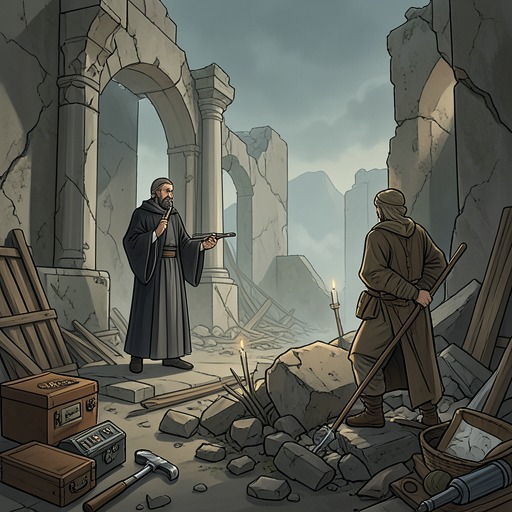
Tor Ilek rises over the Khorus River, whose green water passes beneath innumerable rotted bridges and around tumbled arches. The city itself leeches color from the river, leaving the water pale and ghostly downstream, while rust streaks its dark stone and the metal skeletons of demolished towers and spires curl upward through the ruins. Sharp corners and rounded domes appear suddenly in the lights of the Endeavor, making the city seem less like an abandoned settlement than a dead structure still exerting power over its surroundings.
The ruins preserve evidence of several successive civilizations. Jonathan Heights identifies the builders of Tor Ilek as the same races responsible for Angkor Leng, while also judging the civilization connected with the catastrophe surrounding Tor Ilek to be older than the people who made the bells, who in turn were older than the builders of Angkor Leng. The site therefore defeats any simple historical sequence. Its surviving architecture offers fragments, hints, and possible connections rather than a coherent account, and Jonathan warns that such matters are often best not contemplated too closely.
The Expedition and the Hidden City
The Endeavor reaches Tor Ilek after a week of following the water. Jonathan Heights directs the crew toward a particular knurled dome whose broken iron buttresses resemble twisted, rotted teeth, ordering them to tether to its southern spikes because it provides an entrance. The descent proceeds in silence through stairwells and long-deserted halls, with apertures briefly admitting illumination. Earlier explorers have already picked over the accessible chambers, leaving no obvious treasure, but Jonathan knows that the portions easiest to find do not represent the whole city.
The party eventually enters a chamber divided between a crumbled expanse dropping toward the faint phosphorescence of the river and an intact monolith that stands amid dust and rubble. Jonathan approaches the monolith despite its coffin-like, imposing geometry, treating it as a surviving mechanism rather than a decorative remnant. The expedition’s interest in Tor Ilek is therefore practical as well as scholarly: the ruin contains facilities and instruments that can support later travel, including the circle guide Jonathan created there and intends to use in reaching Angkor Leng.
Tor Ilek also supplies a vocabulary for dangers encountered farther east. Jonathan recalls phenomena that include storms capable of turning iron to glass and glass to water, places where time appears not to pass, and travelers from different epochs frozen together. These warnings place Tor Ilek within a broader system of anomalous spaces rather than isolating its danger as a single accident. Its ruins are records of powers that human explorers can observe without truly understanding.
Destruction of Tor Ilek
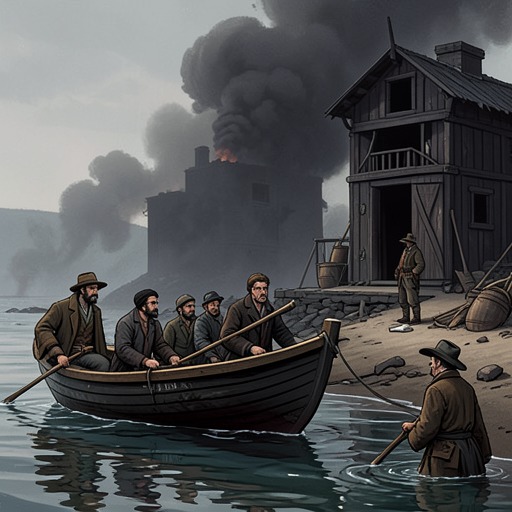
Tor Ilek’s decisive event occurs when an airman awakens something within the ruin. A stygian conflagration and ravenous light merge into a single destructive force, then race outward through ancient streets and decrepit halls. The disaster illuminates the city more completely than the expedition’s lamps ever could: for one terrible instant, Jonathan Heights sees the scale and strangeness of the forgotten architecture as the city’s crumbled glory is exposed by the force consuming it.
The destruction is produced by the convergence of two horrors, one associated with the distant south and the other with the depths beneath Tor Ilek. It is not presented as an ordinary fire or structural collapse, but as the collision of incompatible powers that reveals and annihilates the city at once. Jonathan is forced to brace himself with his cane as the party stumbles, while the expanding conflagration turns the ruin into a final illumination. Tor Ilek becomes visible precisely because it is being destroyed.
Aftermath and Material Legacy
The city’s destruction gives its remaining artifacts a new value. Collectors of curios and artifacts become intensely interested in the last trinkets recovered from Tor Ilek, whose strange architecture was already known within the Exploration Society and popular among people who pursued forbidden knowledge. Once the city is gone, even innocuous remnants become valuable because they are among the final material links to a doomed civilization.
The expedition’s wider economic machinery also frames Tor Ilek as a source of extractable value. The Endeavor carries extensive equipment, including a portable luminiferous terrestrite distillation apparatus, lifting-gas equipment, filters, searchlights, zint guns, spare parts, food, clothing, and raw materials. Jonathan has earlier arranged for supplies to be shipped toward Danby’s Point and later manages cargo, barter, and division of recovered wealth; raw metal stock is more useful in exchange than gold or silver in some frontier markets, while the crew’s attitude can be improved by distributing valuable finds. When the Endeavor returns with immense quantities of gold, customs traffic turns the passengers into minor celebrities, and Tor Ilek’s relics attract a separate market among collectors.
Narrative Significance
Tor Ilek functions as a concentrated image of knowledge that cannot be separated from danger, extraction, or loss. Jonathan Heights approaches it as an explorer who maps, enters, interprets, and reuses ancient infrastructure, yet the city resists becoming a stable object of knowledge. Its chronology is fragmented, its mechanisms remain only partly legible, and its deepest forces destroy the very evidence they expose. The expedition gains instruments and memories, but not mastery.
In Jonathan’s later retrospective vision, the destruction of Tor Ilek appears as a burning city that lights his path. Alongside the death of Tiuni, the sacrifice of Angkor Leng, the loss of his friendship with Eleanor McAvey, and his banishment from Ukaresh, the city becomes one of the irreversible markers by which he understands his journey. Tor Ilek’s fire is thus both catastrophe and illumination: a historical ruin made briefly visible at the moment it is removed from the world. Its final legacy lies in that contradiction, since human civilization can possess only fragments of the city after the forces that made it knowable have consumed it.