Ukaresh
Chasing SunlightUkaresh is the great city at the eastern edge of Jonathan Heights’s known routes, a dark counterpart to Beacon and one of the expedition’s indispensable gateways. Unlike the human city, it has no central light and no enclosing wall: its subdued radiance seems to grow from the surrounding landscape, while buildings, streets, trees, and mushrooms overlap in a continual ambiguity. The city is both a place of necessary passage and a political warning. Jonathan can reach the farther east only by treating Ukaresh as a possible port, but the city recognizes few laws beyond power, and its ruler can erase it from a traveler’s map with a single decree.
Setting and Spatial Character
Ukaresh appears to the Endeavor as the eastern mirror of Beacon. Beacon’s white stone, bright lights, walls, and gates make civilization appear to stand against the darkness; Ukaresh has no comparable boundary, and its tenebrous illumination blends into the colors and forms of the east. The city seems to emerge from the landscape rather than being imposed upon it. Tangled trees and mushrooms overgrow its indistinct borders, even as the city’s structures overgrow them in return.
Its architecture refuses stable categories. Human, nonhuman, and indeterminate styles are crammed together: rounded huts of myceliplank stand beside slanted stone dwellings and masses of black wire that glow from within. Buildings can alter their own position and form. One structure raises itself on stilts, moves around the city’s perimeter like an enormous creature, and settles on a mound of an entirely different architectural style. The city therefore cannot be understood as a fixed arrangement of streets and landmarks. It is an active environment whose geography changes with its inhabitants and whose routes demand a specifically local, “twisted logic.”
The palace of marble and glass remains the city’s stable center, but even this stability is relative. Ramps and elevated walks cross between buildings, open tunnels run beneath them, and lights of many kinds cast shadows in numerous shades across the streets. Beings with two, four, six, or eight legs move through this layered space, surrounded by foreign perfumes and the exhalations of alien life. Ukaresh is clean because Ukari will not tolerate filth, but cleanliness does not make it orderly. Personal disputes may become violent, while any conflict threatening to spread beyond the individuals involved is suppressed with murderous force.
Arrival and Political Order
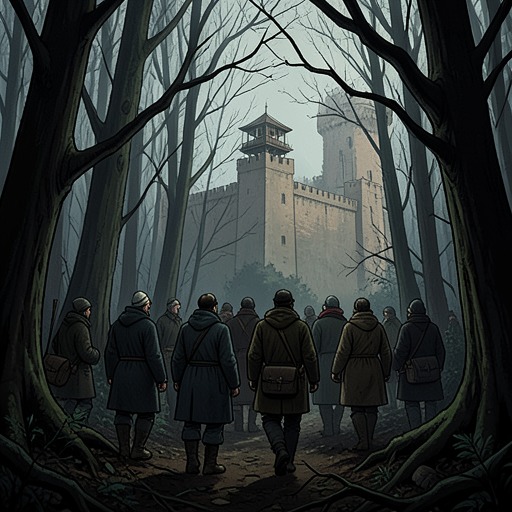
Jonathan brings the Endeavor to Ukaresh because the route through the Crimson Caldera has carried the expedition as far east as its current supplies and maps permit. He expects Ukaresh to provide the final components needed for the journey toward the Arch of Khokorron. Other routes exist, but some are closed, others are too dangerous or insufficiently known, and the chosen path is merely the best available rather than a safe one.
The Endeavor has little company in Ukaresh, since eastern weather makes air travel hazardous without the protections Jonathan arranged. There are no obvious moorings, so he directs Captain Montgomery to a building used during one of his previous journeys. He plans to negotiate the berth himself and pays with imported goods rather than ordinary money, relying on an insect collection obtained in Beacon to compensate the lodging’s proprietor for the ship’s place and safety. The detail shows that entry into Ukaresh depends on practiced knowledge of local appetites and customs, not on the bureaucratic procedures that govern the human settlements.
The city’s political order is concentrated in its immortal sovereign, Ukari, also known as She-Who-Must-Be-Obeyed. Jonathan introduces Eleanor McAvey and Inquisitor Antomine to her as the unquestioned ruler of Ukaresh. Ukari’s authority is not merely administrative or military. Her movement can remake the built environment: as she takes three steps, walls slide apart, a chasm tears itself from the street and becomes a ceiling beam, and a throne of gold and ivory forms around the assembled petitioners. The city’s architecture is thus an extension of sovereignty, visibly rearranged by the ruler’s presence.
Ukari’s rule also differs sharply from the authority claimed by the Illuminated King and the Inquisition. Antomine arrives as an agent accustomed to invoking Crown power, but Ukaresh makes that authority provincial. Its inhabitants are dangerous enough that few attempt to turn disorder into open insurrection, while Ukari can resolve a dispute through direct, supernatural judgment. The city is not lawless; it is governed by an intensely personal and exceptional form of law in which power decides what protection, punishment, and belonging mean.
Jonathan Heights and Ukari
Ukaresh is personally significant to Jonathan because it is not his first visit and because he once shared an intimate relationship with Ukari. The ruler recalls his shamelessness with approval, and Jonathan responds with restraint, recognizing that familiarity offers no security before a being who can alter the city by walking through it. Their past gives the meeting an emotional and political double edge: he is neither an ordinary petitioner nor a protected equal, but a former intimate whose access depends on Ukari’s memory of what they once shared.
That relationship becomes decisive when Jonathan’s actions threaten Ukaresh’s order. Ukari acknowledges their former connection by allowing him to live, but she refuses to treat intimacy as immunity. She casts out Jonathan Heights and everyone associated with him, declaring Ukaresh forbidden to them from that moment until the end of time. The punishment is not a temporary expulsion from a gate or district. It is a permanent transformation of their geographical possibilities, converting a known city into a place they can no longer reach.
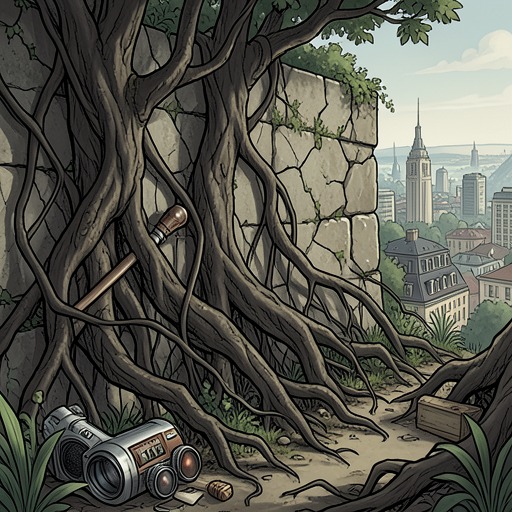
The force of the decree is immediately demonstrated. A rush of wind and a roar like thunder pass over the expedition, and Ukaresh vanishes. In its place stand cracked stone, tangled briars, and lumpen mushrooms rising through buried shapes that may or may not suggest a former city. Jonathan understands that he escaped lightly, partly because he transformed the Black Garden rather than destroying it, and partly because Ukari had evidently enjoyed the chaos produced by the destruction of the Pits. Had her mood been worse, neither argument nor force would have saved him.
Ukaresh in the Expedition’s Memory
After the disappearance, Antomine asks whether the city itself is simply gone. Jonathan answers that it is gone for them. Other travelers may still find it, but Ukari’s command means that he and his companions will not. This distinction preserves Ukaresh as a real place while making it inaccessible through the expedition’s own history. The city has not merely been destroyed; it has become a forbidden coordinate, erased from Jonathan’s usable world by an act of sovereign exclusion.
The loss reverberates during the sunlight trial. When Bright Defile exposes Jonathan’s memories and knowledge, Ukaresh appears among the places that constitute his life: Beacon, Danby’s Point, Autochthon Reach, Danner’s Grasp, Terminus, Tor Ilek, and Angkor Leng. Ukaresh is present with She-Who-Must-Be-Obeyed at its heart, showing that the city is not only a logistical waypoint but one of the central encounters through which Jonathan defines his past. Later, when the memories of sacrifice illuminate the path toward sunlight, his banishment from Ukaresh becomes one of the costs laid upon that passage, alongside the loss of Eleanor McAvey’s friendship and the rejection of the Players and their Game.
Ukaresh therefore occupies an unusual position in Jonathan’s story. He seeks the city as a practical necessity, reads it through maps and prior experience, and expects to use it as a platform for further exploration. Yet the city ultimately defeats that instrumental approach. Its ruler turns personal history into a sentence, and the destination that once promised access to the east becomes an absence that must be navigated around.
Later Attempts to Reach the East
After Jonathan’s passage into sunlight, Eleanor McAvey leads another departure from Beacon aboard the Endeavor. She and Captain Montgomery acknowledge that Ukaresh can no longer be reached by their former routes, so Eleanor has acquired additional maps, some legitimately and most by other means. She explains that only occult maps can lead to places that do not exist, and says that her new understanding of the Green Garden should allow her to find it herself once the expedition is close enough.
This later plan confirms Ukaresh’s lasting geographical and narrative importance. Its disappearance does not end the eastern project; instead, it forces exploration to rely on forbidden or occult cartography and on knowledge gained from the city’s transformation. Ukaresh remains the destination that defines the limits of ordinary navigation: a place once central to the eastern network, now inaccessible to Jonathan’s party, and still powerful enough to shape the maps, ambitions, and risks of those who continue eastward.