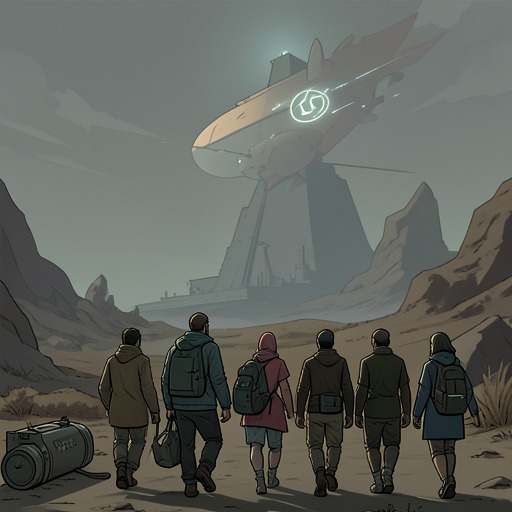
Ukaresh's banishment of Jonathan
Chasing SunlightUkaresh's banishment of Jonathan is the decisive severing of Jonathan Heights from the eastern power that once made his exploration possible. After his intervention changes the Black Garden and contributes to the devastation surrounding Ukaresh, Ukari confronts the Endeavor in a form vast enough to seize the airship. She spares Jonathan, but turns former intimacy and negotiated survival into permanent exclusion: Ukaresh is forbidden to him and his companions from that moment onward.
Causes and Setting
Jonathan's expulsion occurs within a world where travel beyond human civilization means entering territories governed not by ordinary law but by local powers, taboos, and ancient secrets. The expedition begins under the authority of the Illuminated King and the Reflected Council, with Jonathan seeking sunlight in the far east, but the journey repeatedly carries him across contested boundaries. Beacon presents human civilization as orderly and illuminated, while Danby’s Point marks the eastern terminus where human administration meets nonhuman architecture, trade, and force. Beyond that frontier, Jonathan treats knowledge of routes, peoples, and hazards as essential equipment, gathering intelligence from Tiuni about shifting forces and caravans in the Verdant Expanse.
Ukaresh is therefore not merely another destination on Jonathan’s maps. It is a ruled space whose hospitality has conditions and whose ruler can determine whether a visitor remains alive, welcome, or even capable of finding the city again. Jonathan understands that power before the confrontation. He has already argued that every eastern landmark is steeped in powers and secrets, and that caution alone cannot prevent conflict. His banishment makes that principle personal: the expedition’s movement is finally stopped not by distance, weather, or mechanical failure, but by a sovereign prohibition.
The Confrontation with Ukari
Ukari’s anger follows the transformation of the Black Garden. Jonathan insists that he had not intended to disrupt Ukaresh or damage one of its pillars; he had believed Eleanor McAvey’s introduction to the Black Garden might be helpful. Ukari rejects the language of accident. In her judgment, Jonathan came to her city, abused her hospitality, and struck at something central to its order. The Black Garden is gone in its former state, and she holds Jonathan responsible.
Jonathan responds through controlled concession rather than defiance. He acknowledges that his visit did not produce the result he wanted, but argues that the Black Garden has not simply vanished: sunlight has changed it into another form, perhaps one possessing insights found nowhere else before the Arch of Khokorron. This argument does not erase the insult, but it changes the value of the damage in Ukari’s eyes. Jonathan then appeals to what remains of their relationship, asking her to consider what has been gained rather than only what has been destroyed.
The appeal works only partially. Ukari’s recognition of their former intimacy is both personal and threatening. She remembers that Jonathan’s shamelessness once appealed to her, yet that memory does not restore equality between them. She stands over the Endeavor as a colossal ruler, reaching toward the ship with claws capable of gripping and tearing it apart. Antomine’s intervention briefly causes her hand to pause, but Jonathan’s words and the possible value of the transformed Garden do more to redirect her wrath than to challenge her authority.
Terms and Immediate Consequences
Ukari’s sentence is precise: in recognition of what Jonathan and she once shared, Jonathan may live, but he will not go unpunished. She casts out Jonathan Heights and his companions, declaring that they are no longer welcome in Ukaresh. The prohibition is not temporary and does not depend on continued hostility; Ukaresh is forbidden to them from then until the end of time.
The decree is followed by a physical and symbolic rupture. Ukari disappears in a rush of wind and thunder, leaving the Endeavor’s spotlights trained on cracked stone, tangled briars, and mushrooms rising through shapes that may once have belonged to a city. The visual remains refuse to settle into a clear account of destruction. Ukaresh has not simply been erased from the world, but its recognizable civic form has been replaced by desolation and uncertainty. Jonathan understands that he has escaped lightly because the Garden was transmuted rather than wholly destroyed, and because Ukari might have killed him had her anger been absolute.
Antomine asks whether the city is simply gone. Jonathan’s answer defines the practical force of the banishment: it is gone for them. Other travelers may find Ukaresh, but Jonathan’s party will not. The loss is therefore more than a moral reprimand. It removes the expedition’s access to a major eastern port, a place Jonathan had regarded as central to meaningful exploration. A prohibition issued by one ruler becomes a limit on the expedition’s future geography.
Authority, Relationship, and Exile
The banishment exposes the hierarchy between Jonathan’s exploratory ambition and Ukari’s territorial sovereignty. Jonathan is accustomed to bargaining with danger, mapping unfamiliar regions, trading information, and deciding when violence is necessary. His conduct toward the Smiling Man Cult shows how readily he can accept severe collective punishment when he believes forbidden knowledge threatens wider civilization; his treatment of Martin likewise demonstrates his willingness to enforce a frontier judgment through immediate bodily violence. Yet in Ukaresh he is not the adjudicator. He is the trespasser before a power whose hospitality he has violated.
The sentence also completes a reversal in Jonathan and Ukari’s relationship. Their former connection gives him a narrow route to survival, but it cannot protect his access to her realm. Intimacy becomes the reason for mercy, while sovereignty determines the punishment. Jonathan’s attempt to preserve the relationship through politeness and strategic groveling succeeds only in keeping him alive. It cannot recover trust, restore the Black Garden, or reopen the road east.
His response after the decree is characteristically impatient. He treats the danger of the eastern world as inevitable and argues that anyone unwilling to awaken its demons should never have undertaken the journey. The statement converts personal responsibility into a general philosophy of exploration. Yet the banishment contradicts his confidence in movement: the traveler who believes every boundary can be approached through knowledge and nerve now faces a boundary established by another’s will.
Narrative Significance
Ukaresh's banishment of Jonathan turns exploration into exclusion. Jonathan’s expedition is organized around reaching what human civilization dismisses as myth, and he repeatedly crosses from illuminated human districts into spaces defined as alien, savage, or forbidden. The banishment reveals that these spaces are not empty frontiers waiting to be claimed. They possess inhabitants, rulers, histories, and the power to regulate human passage. Jonathan can interpret and exploit eastern knowledge, but he cannot make himself sovereign over every place he enters.
The event also anticipates the later conflict at Bright Defile. There, sunlight makes concealment impossible, and Antomine declares that Jonathan may not proceed toward the revelation he seeks. In Ukaresh, Ukari forbids Jonathan’s return through a personal and territorial decree; at Bright Defile, Antomine attempts to stop him in the name of the Illuminated King and human protection. The two confrontations mirror one another: each places Jonathan before an authority claiming the right to define what may be entered, known, or changed, and each tests whether his pursuit of truth can survive the institutions and sovereign powers that surround it.
Most importantly, the exile leaves Jonathan alive but diminished in practical freedom. He retains his purpose, his maps, and his belief that the east cannot be explored without awakening its guardians. What he loses is the assumption that survival preserves access. Ukari’s mercy permits him to continue traveling, while her prohibition ensures that one of the expedition’s essential eastern connections is closed forever.