Ukari
Chasing SunlightUkari, also known as She-Who-Must-Be-Obeyed, is the immortal ruler of Ukaresh and one of the most formidable powers encountered by Jonathan Heights. She is not merely a monarch exercising authority through subjects or institutions: her presence makes the city itself tremble, rearranges its architecture, and turns ordinary political judgment into a personal, supernatural decree. Her encounter with Jonathan exposes both the limits of human authority and the dangerous intimacy of his past in the eastern lands.
Identity and Sovereignty
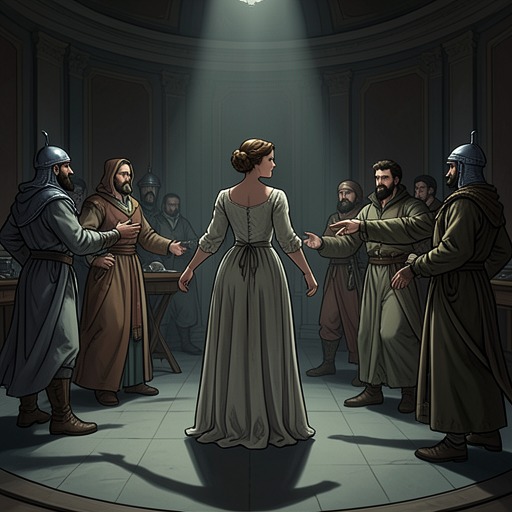
Ukari first appears when the ground of Ukaresh splits open beneath Jonathan Heights, Eleanor McAvey, and Inquisitor Antomine. A long crack advances toward them with the rhythm of approaching footsteps; buildings shake, windows shatter, and the chasm stops immediately before the travelers. She then stands before them with golden eyes, dark hair, marble-like skin, jewels, and a body that possesses the scale and force of a giant while retaining the form of a woman. Her beauty is inseparable from menace. Her teeth are slightly pointed, her nails are razor-sharp, and every motion carries the physical implication that the city is subject to her body.
Jonathan introduces her as the “unquestioned ruler of Ukaresh,” identifying her by the title She-Who-Must-Be-Obeyed and explicitly calling her immortal. Ukari confirms the claim while addressing Antomine as a “little candle-man,” a phrase that reduces the representative of the Illuminated King to something small and temporary before her power. Her sovereignty therefore stands outside the ordinary hierarchy represented by the Inquisition. Antomine may invoke the authority of the crown and threaten treason elsewhere, but in Ukaresh he is only another petitioner whose survival depends on Ukari’s mood.
Encounter with Jonathan’s Expedition
Ukari regards Jonathan’s arrival as an intrusion because the expedition has brought something into her city that should not be there. She tells him that even for Ukaresh, certain things are too old and extraordinary to be permitted, while other people are simply unwelcome. The distinction is revealing: her judgment combines a law concerning dangerous or ancient forces with a personal power to exclude individuals. There is no stable legal procedure separating those categories. Ukari decides what threatens the city and who belongs within it.
Her response to Eleanor McAvey shows the same mixture of curiosity, appetite, and domination. Ukari calls Eleanor an interesting morsel and inspects her by lifting her head with one finger, as though examining meat. She then asks why Eleanor has followed such a dangerous man so far from home, but the question is presented as an order rather than an invitation to speak. Ukari’s attention is itself a hazard. Eleanor remains visibly unsettled beneath it, while the servants Sarah and Marie retreat into silent maid personas and the Lux Guard stands motionless behind Antomine, all attempting to avoid becoming objects of the ruler’s interest.
Ukari’s power is not confined to intimidation. As she walks three steps away from the group, the walls of nearby buildings slide apart and reform around them; on the second step, the chasm in the street tears free and becomes the main beam of a hall; on the third, a throne of gold and ivory twists into existence. The travelers are suddenly inside an opulent petitioner’s hall populated by monstrous subjects. Ukari dismisses those subjects with a negligent wave, then reclines on the throne beneath her own illumination. Space, architecture, social order, and audience all become extensions of her will.
Relationship with Jonathan Heights
The meeting is dangerous partly because Ukari and Jonathan share a history. Jonathan considers asking her to remove him from the crisis, confident that the crew could not blame him for the actions of a capricious queen. He also believes that Antomine may remain useful, and asks Ukari to return the Inquisitor to the ship. Ukari grants the request with a gesture, making Antomine and the Lux Guard vanish without argument. Jonathan’s ability to negotiate this outcome depends less on formal diplomacy than on his familiarity with Ukari’s temperament and on the remnants of their former relationship.
When Ukari’s pursuit later threatens the fleeing Endeavor, she calls Jonathan’s name from across the receding city. Her voice fractures glass, and she rises above Ukaresh on a scale large enough to seize the airship in one hand. Antomine’s invocation briefly causes her reaching hand to pause, giving Jonathan time to address her. Jonathan apologizes for the unintended effects of his actions and insists that he never meant to disrupt Ukaresh or the Black Garden, but the language of apology cannot erase the underlying breach. Ukari responds by laughing at the history between them and says that Jonathan was always shameless, adding that she liked that quality in him.
The exchange makes their relationship neither a simple romance nor a simple alliance. It is a surviving bond between an explorer who repeatedly crosses boundaries and a ruler who treats boundaries as personal possessions. Their past gives Jonathan a chance that would otherwise be impossible, but it does not restore equality between them. Ukari can forgive him, preserve him, and punish him in a single decision; Jonathan can negotiate, but he cannot command or safely predict her.
Judgment and Banishment
Ukari ultimately declares that Jonathan may live in recognition of what they once shared, but that he will not go unpunished. She spreads her hands and casts out Jonathan Heights and all those with him, forbidding them from Ukaresh “from now until the end of time.” The judgment is an act of sovereign exception: it does not follow a visible trial, and it does not distinguish between Jonathan’s personal guilt and the status of his companions. Ukari’s authority creates the rule through its announcement and makes the punishment permanent through its wording.
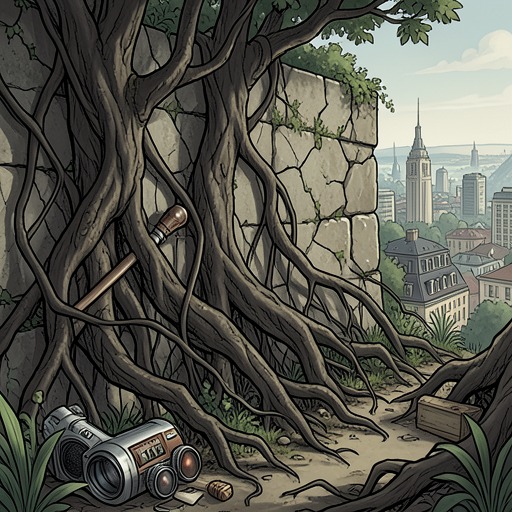
The result is immediate and total. A rush of wind and a sound like thunder erase Ukaresh from the travelers’ sight. The Endeavor’s spotlights fall on cracked stone, tangled briars, mushrooms, and buried shapes that may or may not be the remains of a city. Jonathan understands that he has escaped lightly, partly because he transformed the Black Garden rather than destroying it and partly because Ukari appeared to enjoy the chaos caused by the destruction of the Pits. Even after banishing him, she remains unreadable: the same power that could have killed him instead chooses exile, preserving both his life and the memory of their former connection.
Ukari in the Sunlight Trial
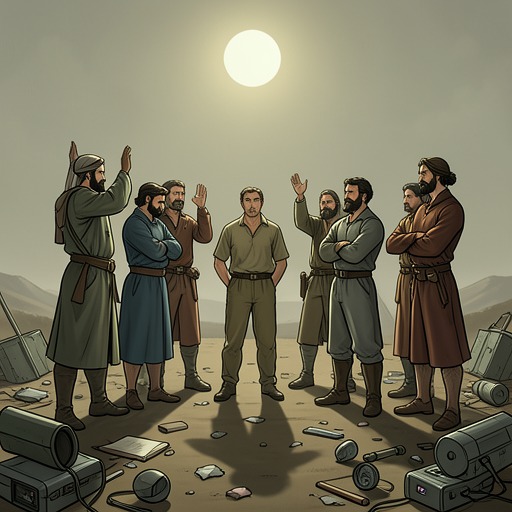
Ukari’s significance extends beyond the encounter in Ukaresh. When Jonathan later enters Bright Defile and undergoes the trial of sunlight, Ukaresh appears among the places projected through the lens of his life. The city is rendered whole despite its distance, with She-Who-Must-Be-Obeyed at its heart. Ukari herself may perceive a distant connection as sunlight draws the knowledge of her from Jonathan’s mind, suggesting that their relationship has become part of the structure of his identity rather than a closed episode of travel.
At the final barrier, Jonathan must surrender the ties and achievements that have defined his passage toward sunlight. Among the sacrifices are his loss of Eleanor’s friendship and his banishment from Ukaresh. Ukari’s visage flashes across the vision, stern and commanding, and appears perhaps to nod before joining the pyre. The image gives her a peculiar final role in Jonathan’s transformation. She is not only an external ruler who expelled him; she is also one of the powers whose claim upon him must be relinquished before he can cross into complete revelation.
Ukari therefore concentrates the book’s tension between civilization and the forces beyond it. Human institutions such as the Inquisition attempt to protect a fragile civilization through artillery, censorship, and exceptional punishment, but Ukari represents a more absolute sovereignty, one in which the ruler’s body, city, law, and desire are indistinguishable. Her relationship with Jonathan makes that sovereignty intimate, while her banishment demonstrates its final authority. In the architecture of the narrative, Ukari is both the living center of Ukaresh and one of the last shadows Jonathan must leave behind on his way to sunlight.