Ukari Expels Jonathan
Chasing SunlightUkari Expels Jonathan marks the moment when Jonathan Heights’s freedom to pursue sunlight collides with the territorial sovereignty of Ukari, the ruler of Ukaresh. After Jonathan’s actions alter the Black Garden, Ukari rises above the departing Endeavor, accepts that he may have created something valuable, but nevertheless forbids him and his companions from ever returning. The punishment changes the expedition’s geography as decisively as any physical disaster: Ukaresh remains in the world, yet becomes inaccessible to Jonathan, leaving him to continue eastward without the port he regarded as essential.
Causes and Setting
Ukaresh had been the eastern center from which Jonathan Heights expected significant exploration to remain possible. The wider expedition was already operating at the margins of human authority: its stated purpose was to find sunlight in lands beyond ordinary maps, while agents of the Illuminated King and the Inquisition accompanied Jonathan aboard the Endeavor. At Danby’s Point, human construction met nonhuman powers behind a great metal gate, and trade existed alongside an ongoing struggle over whose forms, laws, and knowledge would shape the frontier. Ukaresh represented a more concentrated version of that frontier order, governed not by the ordinary authority of Beacon or the Inquisition but by Ukari’s personal power.
Jonathan’s immediate offense was connected to the Black Garden. He had intended Eleanor McAvey’s introduction to the Garden to be helpful, but the Garden was affected by sunlight and changed into a new form. Jonathan acknowledged that his visit had not proceeded as intended, yet argued that the transformed Garden was not simply destroyed: it might now possess insights unavailable elsewhere, apart from the Arch of Khokorron and Jonathan himself. His defense therefore combined apology with valuation. He did not deny responsibility; instead, he tried to persuade Ukari that the damage had produced a rare and potentially useful result.
The Confrontation
As Montgomery pushed the Endeavor away from the city, Ukari’s voice came from the palace and cracked glass across the ship. She expanded to a titanic scale above Ukaresh, retaining her impossibly perfect appearance and self-generated illumination while becoming large enough to seize the airship in one hand. Her claws reached toward the vessel, and the threat was physical before it became juridical: Jonathan and the crew faced a ruler who could destroy them directly.
Antomine stepped onto the walkway and invoked mysteries Jonathan could not perceive. The gesture caused Ukari’s reaching hand to pause, creating the brief opening in which Jonathan could speak. He bowed and addressed her respectfully as My Lady Ukari, apologizing for the unintended effects of his attempt to address Eleanor’s behavior and insisting that he had never intended to disrupt Ukaresh or the Black Garden. Ukari rejected the language of accident. In her account, Jonathan had entered her city, abused her hospitality, and struck one of her pillars. The dispute was therefore not merely about botanical or supernatural transformation; it was about hospitality, territorial possession, and the right of a guest to alter what belonged to a sovereign.
Jonathan responded with calculated deference. He had already recognized that directly challenging Ukari could only fail, so he tried to divert her anger by presenting the Black Garden’s change as an acquisition rather than a loss. Ukari remained furious, but the possibility that the altered Garden contained valuable secrets weakened the immediate force of her anger. Jonathan then appealed to what remained of their former relationship, asking her to consider what had been gained rather than only the insult inflicted upon her. Ukari’s response recalled that Jonathan had always been shameless and that she had once liked this quality in him. The admission made the scene more than a diplomatic negotiation: personal history briefly interrupted the exercise of absolute power.
Sentence and Expulsion
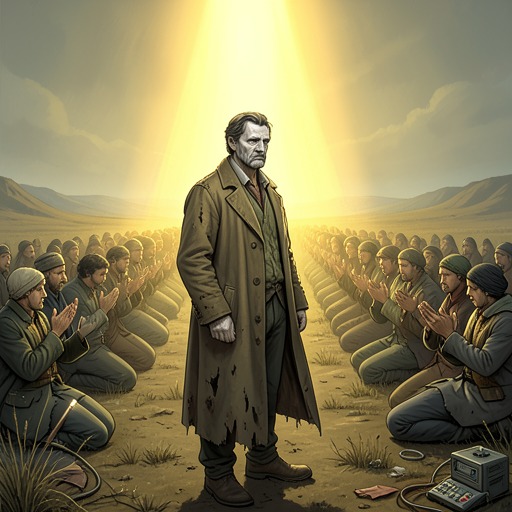
Ukari spared Jonathan because of what they had once shared, but she did not pardon him. Her sentence was explicit: Jonathan Heights and those with him were no longer welcome in Ukaresh, and the city was forbidden to him from that moment until the end of time. The decision illustrates a sovereign power that converts hospitality into conditional belonging. Jonathan survives, but survival does not restore his status as a traveler, guest, or potential ally. He is expelled from the territory and permanently excluded from its future possibilities.
The expulsion is enacted with spectacular finality. A rush of wind and a roar like thunder accompany Ukari’s disappearance. When the ship’s spotlights fall on the city, they reveal cracked stone, tangled briars, and lumpen mushrooms rising through buried shapes that may once have belonged to a city. Whether Ukaresh has physically vanished or has merely become unreadable to Jonathan is left deliberately uncertain. Antomine asks whether the city is simply gone, and Jonathan answers that it is gone for them. Other people may still find it, but Ukari’s prohibition means that Jonathan’s expedition cannot.
Consequences for the Expedition
The punishment removes the logistical and symbolic center of Jonathan’s eastern plans. He had treated Ukaresh as a port without which serious exploration would be impossible, so the expulsion forces a change in both route and expectation. The city is not destroyed in a conventional military attack, nor is Jonathan defeated by a failed engine or an enemy boarding action. Instead, access itself is revoked. The road remains somewhere beyond the darkness, but the person best placed to travel it has lost the place from which he meant to begin.
Antomine immediately treats the confrontation as evidence against Jonathan’s judgment. He warns that Jonathan is not absolved merely because he deflected Ukari’s wrath and insists that the expedition was fortunate to survive. Jonathan rejects the warning as an unavoidable condition of traveling so far east. In his view, every eastern landmark outside raw wilderness is saturated with powers and secrets, and every one has a protector or ruler. Caution cannot prevent all disturbance; entering the region means inevitably awakening forces that claim authority over it. Their exchange turns the expulsion into a dispute over the expedition’s governing philosophy: Antomine sees a preventable threat created by reckless interference, while Jonathan sees danger as the unavoidable price of discovery.
Narrative Significance
Ukari Expels Jonathan converts exploration into trespass. Jonathan’s maps, negotiations, and knowledge allow him to move through regions where human civilization meets nonhuman powers, but they do not grant him ownership of what he encounters. His attempt to make the Black Garden useful resembles the wider frontier practice of extracting information from unfamiliar lands, yet Ukari’s response exposes the limits of that imperial habit. The Garden may yield knowledge, but its transformation remains an injury to the sovereign who claims it.
The event also establishes a sharp value reversal. Jonathan’s immediate objective is achieved in the narrowest sense: he lives, and the Endeavor escapes. Yet the expedition loses the very refuge and eastern gateway on which its continued progress depends. The relationship with Ukari, once valuable enough to protect him, becomes the instrument of a permanent boundary. Jonathan’s survival is therefore paired with political and geographic exclusion, a pattern that anticipates the later conflict in which his pursuit of sunlight will place him beyond the authority of Antomine and the Illuminated King as well. Ukari’s decree does not end Jonathan’s journey, but it strips the journey of one of its essential guarantees: the assumption that every discovered place can remain available to the discoverer.