Verdant Expanse
Chasing SunlightVerdant Expanse is an enormous, volcano-wracked forest in the eastern lands, a region where geology, climate, vegetation, wildlife, and nonhuman societies form an active system rather than a passive backdrop. Its abundance makes it indispensable to long-distance travel, but its scale and volatility make every attempt to cross it a negotiation with forces that human technology can only partially manage.
Definition and Physical Setting
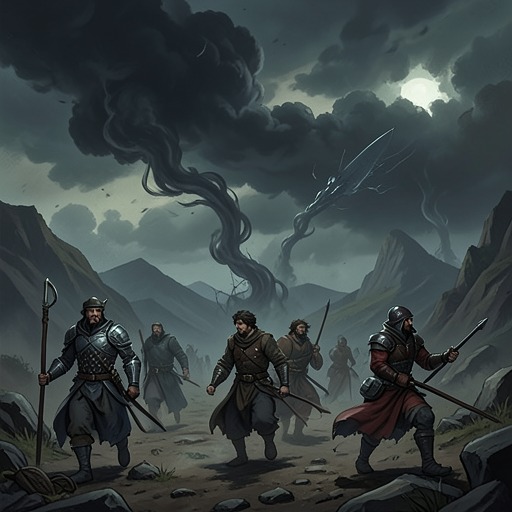
Verdant Expanse is described as a vast forest growing among enormous volcanoes, with a canopy that rises hundreds of feet above the ground. Lava pours from the cliffs in fast-moving waterfalls into depths that cannot be seen, while volcanic cones constantly spit ash and molten rock across the wilderness. The same eruptions that burn immense tracts of vegetation also fertilize astonishingly rapid regrowth: trees can sprout from fresh volcanic rock within hours, and the ground may be entirely overgrown within days. Destruction and renewal therefore occur on nearly the same timescale.
The region announces seasonal change beyond its own borders. Warm Greenwind carries the sweet scent of exotic fruit and spices into Beacon, while huge white seedheads, each as large as a carriage and bearing seeds the size of children, drift from the Expanse into the city. Their fine fluff supplies roughly half of Beacon’s cloth, turning the forest’s spring inundation into an important urban resource. The same wind that brings this abundance can become an inopportune headwind for an airship, making the Expanse’s influence felt far from its trees and volcanoes.
The landscape is also defined by water and violent weather. Rivers from both the north and south pour into the volcanic climate, producing sudden squalls and unstable conditions. A ship cannot simply fly straight through the region: clearings may vanish, and a seemingly open place may already be the lair of a dangerous creature. The Endeavor must contend with wind, rain, ash, lava, and water together, a combination that makes the environment itself a continual navigational hazard.
Navigation and the Endeavor’s Passage
The Endeavor approaches Verdant Expanse after the tedium of regulated airship travel has begun to replace the expedition’s initial tension. The change is announced by warmer air, the smell of greenery and water, and the red molten glow on the horizon. Eleanor McAvey goes above deck to watch the ship cross the abyss separating the Expanse from the rugged lands farther west, where lavafalls illuminate the tangled vegetation without revealing the depths below.
Finding a place to tether is one of the expedition’s immediate problems. Natural harbors are unreliable, and the volcanic weather can batter the ship in every direction. Jonathan Heights therefore relies on experience rather than a simple chart. He brings additional maps to the bridge and searches for the mobile caravans that travel through the dense canopy and understory. Those caravans are themselves large and capable enough to withstand the region’s hostile conditions, making them safer guides and shelters than any fixed landmark.
Locating such a moving refuge demands knowledge of routes, dates, volcanic peaks, and caravan migrations. Jonathan and the navigator can only determine the Endeavor’s position approximately, but information previously supplied by Tiuni allows them to estimate where a caravan should be. The method reveals that navigation in Verdant Expanse is partly cartographic and partly ethnographic: survival depends on understanding the movements of inhabitants who know how to live within an environment that resists permanent human infrastructure.
The Endeavor descends toward the canopy while its sailors use zint cannons against wildlife in the air. Huge dark forms move through the spotlights, and insects the size of carriages pass with wings that sound like drop-hammers. The ship finds a caravan before the approaching storm forces it to seek shelter, but even this success is provisional; the environment permits no confidence that a safe route or anchorage will remain safe for long.
Caravaneers and the Living Landscape
The people of Verdant Expanse are caravaneers, a reptilian nonhuman society whose mobile settlements travel through the forest. One caravaneer who approaches the Endeavor is twice the height of a human, with pearlescent scales, a long neck, razor claws, and an enormous luminous tail extending thirty or forty feet behind the body. The tail is marked by bioluminescent stripes and moves like a glowing streamer, making the individual both a person and a visible sign of the region’s distinct biology.
Jonathan Heights addresses the caravaneer in a language composed largely of whistles and clicks, learned in his youth. His imperfect but acceptable command allows the first contact to proceed as an exchange rather than a confrontation. The scene establishes that Jonathan’s expertise is not limited to geography or machinery: his ability to cross the linguistic and cultural boundary between human expedition and nonhuman caravan is part of the practical knowledge required to travel east.
The caravan’s camp is a mobile settlement under a vast roof of stretched, stitched, and oiled hide, wide enough to cover an area comparable to a city block. The shelter deflects the region’s wind, rain, and volcanic ash. Enormous sleds serve as houses with windows, doors, roofs, and balconies; when the caravan rests, these openings become shops and the camp turns into a marketplace. The settlement is therefore not an improvised refuge but a portable social and economic structure adapted to continual movement.
The caravaneers’ spectral lanterns alter the appearance of everyone beneath them. Reds become bloodier, whites take on the pallor of corpses, and dark clothing appears charred. The light also seems to remove solidity, making bodies nearly translucent and their edges uncertain. This illumination makes the camp feel as though it belongs to a different perceptual order, yet it is also a practical technology of communal life. Verdant Expanse does not merely contain the caravaneers; it has produced a society whose architecture, mobility, light, language, and economy answer directly to the forest’s conditions.
The camp’s relationship with wildlife is equally direct. After the Endeavor’s guns kill an enormous shaggy, long-faced beast, caravaneers haul its corpse into camp. Antomine suggests purchasing some of the meat, but the entire community suddenly descends upon the carcass and tears into it while it is still warm. Their savage feeding frenzy overturns the impression of polite marketplace commerce without contradicting it: hospitality, trade, and predation coexist within the same ecological and social order. The scene emphasizes that the human visitors are not entering a sanitized version of wilderness, but a culture whose survival includes immediate, collective consumption of dangerous game.
Resources, Knowledge, and Human Dependence
Verdant Expanse is valuable because it supplies several things an expedition cannot carry indefinitely. Its forests and caravan routes offer opportunities for hunting, while its mineral wealth includes zint-bearing veins that can replenish the Endeavor’s fuel. Jonathan later confirms that another zint vein lies only a few hours east of the Caldera, together with hunting grounds sufficient to refresh the ship’s food stores. The Expanse is thus both a hazard and a logistical solution: the same region that threatens the ship’s passage may be necessary to repair its dwindling supplies.
Its importance also extends into the interiors and furnishings of human civilization. Fine fluff from the enormous spring seedheads becomes a major textile resource, and material from the Expanse appears in wealthy human estates. At André Ludwig’s residence in Autochthon Reach, burgundy paneling from Verdant Expanse replaces native stone, warming the building while displaying the owner’s wealth. The forest is consequently present in urban life as commodity, decoration, and fuel-source even when its ecological violence is absent from view.
Jonathan’s intelligence about the region is mediated through Tiuni, whose information identifies the movements of forces and beasts, shifting caravan routes, and the changing growth of the Expanse. Her reports narrow the expedition’s possible routes and are treated as invaluable before any venture beyond human lands. The region’s geography cannot be separated from political and biological movement: the location of a caravan, the rise of a power among the Thrantin, the spread of the forest, and the presence of dangerous creatures all belong to the same navigational problem.
Narrative Significance and Consequences
Verdant Expanse gives the eastern journey a form of danger that cannot be reduced to a single enemy. Its storms disrupt movement, its volcanic activity remakes the ground, its wildlife attacks the airship, and its inhabitants control forms of knowledge that the expedition needs. Human power remains visible in the Endeavor’s zint cannons and navigation instruments, but those devices operate within an assemblage dominated by weather, mineral resources, animal movement, and caravan expertise.
The region also complicates the distinction between wilderness and civilization. It is described as monstrous and hostile, yet it supports mobile architecture, trade, textile production, hunting economies, and sophisticated environmental knowledge. By contrast, supposedly civilized places depend upon Verdant Expanse materials and information while treating the region’s inhabitants and resources as things to be acquired. The forest’s narrative force comes from exposing that dependence: civilization’s apparent autonomy is sustained by landscapes it does not control and peoples it does not fully acknowledge.
Later journeys continue to carry the consequences of the Expanse. The Endeavor’s return helps produce the period some observers call the Winter of Blood, and its airmen become wealthy through the expedition and the artifacts associated with eastern disasters, while the ship is soon prepared for another departure. Verdant Expanse therefore belongs not only to one passage through a dangerous forest. It is part of the recurring eastern circuit of extraction, survival, knowledge, and renewed risk, a place that continually supplies the expedition even as it demonstrates the limits of expeditionary mastery.