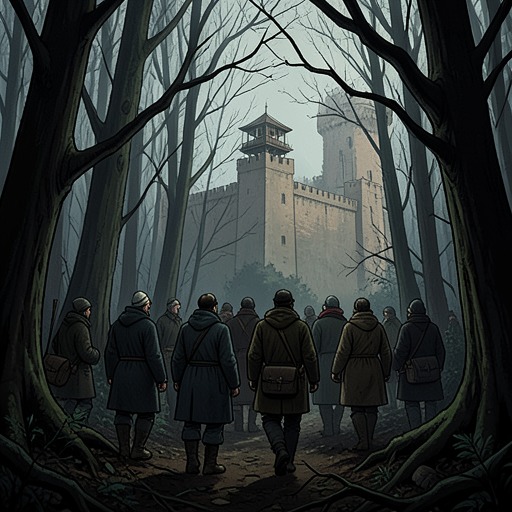
Verdant Expanse Caravan Encounter
Chasing SunlightThe Verdant Expanse Caravan Encounter is a decisive resupply and threshold event in the Endeavor’s eastward expedition. Facing volcanic storms, flooded jungle, hostile wildlife, and no reliable natural harbor, Jonathan Heights locates a moving caravaneer community and secures shelter through language, trade, and disciplined negotiation. The meeting keeps the expedition alive, but it also unsettles the boundary between human civilization and the nonhuman societies that the crown and the Inquisition attempt to contain.
Causes and Setting
The encounter arises from the Verdant Expanse’s refusal to function as ordinary territory. Volcanoes continually throw ash and lava across monumental vegetation that regrows almost immediately, while rivers from both north and south generate violent weather. A clearing may be temporary or occupied by something dangerous, and the Endeavor cannot safely fly straight through the region’s unstable climate. Jonathan therefore treats the caravaneers as the best available form of safe harbor: their moving communities know the forest, can defend themselves against its inhabitants, and travel along routes that an outsider could not reliably find.
The search depends on accumulated expeditionary knowledge. Jonathan and the navigator use imperfect charts and intelligence previously obtained from Tiuni to estimate where a caravan should be, then look for a trail rather than a conventional anchorage. The trail is visible because the canopy has been cleared enough to reveal a dark river and unusually large fruits and flowers. This method places Jonathan’s mapmaking beside the caravaneers’ own mobility and ecological knowledge: his charts narrow possibilities, but their route is what makes survival practicable.
The meeting also follows the expedition’s passage through increasingly unstable borders. At Danby’s Point, human construction and the architecture of darker forces press against one another across a great metal gate, and the human side of the plateau is already being altered by contact with nonhuman peoples. The Endeavor’s journey thus moves from a fortified frontier of trade and restraint into a wilderness where the supposed outsiders possess the practical knowledge on which human travelers depend.
Approach and First Contact
As the Endeavor follows the caravan trail, Montgomery lowers the ship toward the canopy while sailors use zint cannons against the wildlife. Huge insects pass through the spotlights, and a green-scaled creature with a head nearly the size of the Endeavor’s envelope rises from the trees. Sustained cannon fire drives it away without clearly inflicting much damage, making the ship’s vulnerability unmistakable even before contact with the caravan begins.
Jonathan recognizes the caravan ahead as a line of ghostly white forms and orders Montgomery to extinguish the forward spotlights. He knows from earlier experience that the caravaneers dislike intense zint light, so courtesy becomes part of the ship’s defensive strategy. Jonathan then joins Montgomery on the lower platform, whistles to announce himself, and waits for the community to respond rather than forcing an approach.
The first caravaneer to reach the ship is a radically nonhuman figure. It is twice the size of a human apart from its tail, with a long neck, a reptilian head, razor claws, pearlescent scales, and a vast tail that floats thirty or forty feet behind it. The tail’s glowing stripes resolve the approaching whiteness into a living, bioluminescent body. Its movements are sharp and separated by absolute stillness, a physical rhythm that contrasts with the human expectation of continuous motion.
Jonathan addresses the visitor in the caravaneers’ language of whistles and clicks, learned in his youth. His command of the language is merely acceptable, but sufficient to establish recognition and reciprocity. He asks for shelter and supplies, offering human stories and weapons in return. The request is practical rather than sentimental: the Endeavor needs a safe place to moor and must obtain food and water before the expedition can continue.
Bargain and Temporary Hospitality
The caravaneer accepts the proposal under a precise condition. Storms are approaching, and the Endeavor may share the caravan’s clearing provided that the human party guards it as its own. Hospitality is therefore framed as a reciprocal obligation, not a gift. Jonathan translates the exchange for Montgomery, then continues negotiating the practical details of mooring, weapons, and resupply. Montgomery’s presence ensures that the Endeavor is positioned so it can benefit from the camp while also contributing to its defense.
The caravan is not a single simple vehicle but a moving settlement. Enormous reptiles, each comparable in size to the Endeavor, clear the route by biting through leaves, trunks, vines, and flowers and by flattening the ground beneath their feet. Most of the caravan consists of house-sized sleds drawn behind these vanguard beasts, accompanied by smaller vehicles tended by the long-tailed caravaneers. Their mobility is simultaneously transportation, labor, infrastructure, and protection against the living environment.
Jonathan warns the expedition that the arrangement has absolute limits. No crew member or passenger may touch anything without invitation; theft or injury will bring death, and the human party will not retaliate or intervene. Mere offense would also force the Endeavor to leave and attempt to gather supplies without native support, an undertaking Jonathan has already established as perilous. The warning is directed at everyone, but his cold gaze lingers on Eleanor McAvey, whose judgment he considers potentially hazardous even though he does not regard her as foolish.
The ship is tethered with a thick braided vine attached to one of the pack-beasts’ harnesses. A gondola then approaches along the tether, propelled by means the humans do not understand, and a rope bridge connects it to the Endeavor. Jonathan leads the party into the basket, whose walls are lit by grey-green globes, and the conveyance lowers them into the caravan’s camp. The descent marks a literal movement from the airship’s controlled human platform into a nonhuman social space governed by rules Jonathan can explain but does not control.
Exchange, Hunting, and the Limits of Translation
Trade is organized around scarcity and usefulness. Jonathan tells the expedition that raw metal stock is the best barter because steel is more valuable to the caravaneers than gold or silver. He carries a case of rolled steel rods himself, while the Endeavor has been loaded with extensive equipment: a portable luminiferous terrestrite distillation apparatus, a lifting gas separator, water siphons and filters, portable searchlights, crew-served zint guns, spare parts, food, water, clothing, and other necessities. The encounter converts part of that carefully assembled expeditionary infrastructure into access to local resources.
The caravan offers immediate shelter while the storm passes, but the greater opportunity is future cooperation. Jonathan explains that the humans may trade during the delay and later accompany hunting parties for supplies. Montgomery notes that the expedition will soon need water and fresh food, even if its stored provisions can last for a few more weeks. The caravaneers therefore provide more than a marketplace: they offer access to an ecological labor system capable of obtaining food in a landscape where the human travelers cannot safely hunt alone.
Communication remains an unequal but workable process. Antomine objects that the caravaneers do not speak the human tongue, while Montgomery answers that gestures are enough for a simple exchange. Jonathan’s linguistic knowledge goes further than pantomime, but he still insists on learning the rules peculiar to each caravan. He understands that the reptiles may appear calm and then erupt into coordinated violence without visible provocation. Their society is not rendered safe by translation; it is made legible enough for the humans to avoid violating it.
The relationship between protection and predation becomes stark when a creature attacked by the Endeavor’s guns is brought into camp. The rain stops suddenly, and the remaining humans return toward the gondola as the caravaneers haul in the carcass of an enormous, long-faced, shaggy-maned beast, nearly the size of their pack animals and capable of supplying thousands of pounds of meat. Antomine begins to suggest purchasing some of it, but the entire caravan descends upon the still-warm body, tearing into it in a savage struggle over the entrails. His revulsion and immediate withdrawal of the proposal expose the difference between human commercial assumptions and the caravan’s collective feeding practices.
Consequences and Narrative Significance
The encounter’s immediate consequence is survival. The Endeavor obtains a protected place to wait out dangerous weather, access to water and fresh food, and the possibility of joining hunting parties. Its crew is also given a disciplined framework for interacting with a society whose customs are dangerous to violate. The ship’s expeditionary capacity is not enough by itself; its continued movement east depends on negotiated dependence.
The event also complicates the expedition’s claims to civilization. The world presents humanity as a vigil of light under the authority of the Illuminated King, while the eastern peoples are treated as savage, dark, or outside official recognition. Yet the caravaneers possess the specialized knowledge that permits travel through the Verdant Expanse, and they organize transport, defense, resource gathering, and hospitality with formidable efficiency. Human civilization arrives with charts, zint weapons, paperwork, and trade goods; the caravan answers with ecological mastery and a social order whose rules are no less exact.
Jonathan’s role is correspondingly double. He is the expedition’s indispensable mediator, using an old language, personal experience, maps, and logistical judgment to secure passage. At the same time, he remains committed to the expedition’s larger extractive purpose: he identifies routes, seeks resources, offers weaponry, and treats local knowledge as something to be acquired for the journey toward sunlight. His later refusal to divert the Endeavor into cleansing Angkor Leng of Umbraught shows the same prioritization. He rejects Antomine’s demand to pursue an Inquisition objective because the ship lacks the time and resources, placing the eastward mission above the broader defense of civilization.
The meeting therefore becomes a model for the book’s repeated crossings of human and nonhuman worlds. Earlier, the passage of Glacilium over Beacon reveals how human cities live beneath the migration of mountain-sized beings and the threats carried with them. At Danby’s Point, a gate attempts to separate human construction from darker forces, even as influence crosses in both directions. In the Verdant Expanse, no gate can preserve that separation. The Endeavor must lower its lights, speak another language, accept another people’s rules, trade steel for necessities, and rely on creatures whose scale and customs make human categories unstable.
Its broader aftermath belongs to the expedition’s return and to the changing reputation of the Endeavor. The unusual incidents surrounding the voyage contribute to the period later labeled the Winter of Blood, though the name is treated as exaggerated and the public reduces extraordinary events to gossip. The expedition’s wealth also enters a larger economy: many airmen become rich from the journey and some leave the profession, while artifacts from the destroyed Tor Ilek become valuable to collectors. Against that retrospective transformation, the caravan encounter stands as one of the quieter but essential exchanges that made the later wealth possible. It is not merely an exotic stop; it is the moment when an isolated human airship survives by recognizing that the wilderness already has roads, economies, laws, and hosts.