
From Recruit to Combat Medic
CherryThis flow traces how the narrator’s attempt to become a useful Army medic collides with institutional discipline, inadequate preparation, and the escalating danger of deployment.
increasing Bearing strength in each event
 decreasing
Bearing strength in each eventdecreasingEnlistment Under Pressure
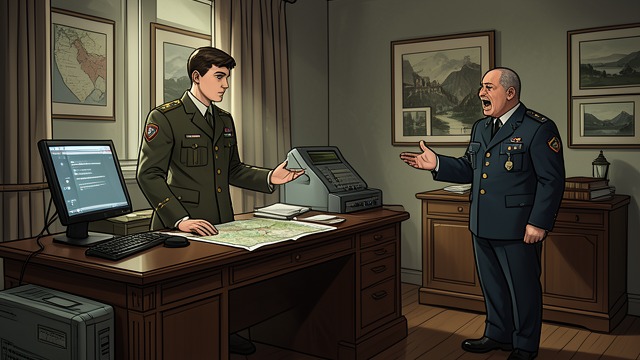
Choosing the Army
A decision made without conviction
The narrator enlists in the United States Army after leaving college and struggling to imagine a civilian future. He treats military service less as a calling than as the next available course of action, even as the Iraq war makes its costs increasingly visible.
He tells himself that an Army medical specialty might let him remain near Ohio and continue his relationship with Emily. The enlistment thus begins as an uneasy compromise between personal attachment and a desire to escape an aimless life.
The institution’s bargain
Recruiters emphasize benefits, career options, and a path to education, while the narrator senses their urgency to fill places. He accepts the promise of a manageable future without grasping how little control he will have over assignment and deployment.
That mismatch establishes the conflict that follows: he enters voluntarily, but the conditions of service steadily make his choices feel less voluntary. His private hopes are already in tension with the Army’s operational needs.
Basic Training’s Performance
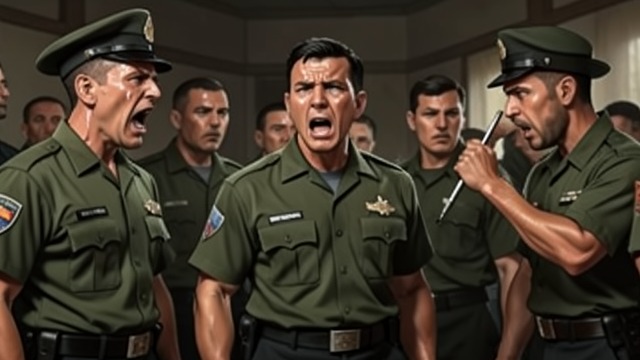
Learning to Pretend
Discipline as theater
At Fort Leonard Wood, drill instructors use shouting, humiliation, physical punishment, and exaggerated threats to remake recruits. The narrator and his fellow trainees gradually recognize that much of the anger is a performance, yet they must still obey the people performing it.
His color blindness exposes the limits of the training system. Although he had disclosed it and received a medical specialty for which it was supposedly acceptable, he struggles to distinguish targets and is struck on the head by an instructor who treats the problem as defiance.
A contradiction that persists
The narrator concludes that the recruits pretend to be soldiers and the Army pretends to be the Army. The joke offers distance from fear, but it cannot remove the real power imbalance or the physical risks of the training.
His medical identity is likewise unstable: he is being prepared to treat injuries while being subjected to a system that normalizes cruelty. The conflict is not simply between one recruit and one instructor; it is between institutional toughness and the vulnerable people expected to embody it.
Training Turns to Injury
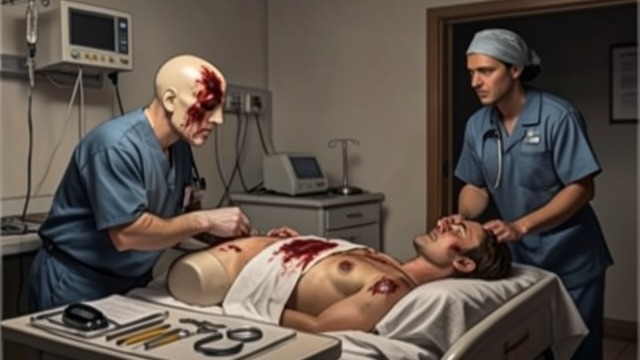
The Body Becomes Evidence
Learning care in an imperfect system
At Fort Sam Houston, the narrator studies emergency care through lectures, mannequins, and hospital rotations. He encounters patients whose injuries demand more than the confidence his training has given him, including a severely burned young soldier he can only observe from outside an isolation room.
The work makes the abstract promise of being a medic concrete. He must examine people, make judgments, and act despite uncertainty, while knowing that a mistake could add to someone else’s suffering.
Military humor and medical risk
A prank leaves him with a painful groin injury that is initially treated as a joke. The swelling worsens during field exercises, and he eventually returns to the hospital with internal bleeding and an inflamed epididymis.
Even after receiving orders to rest, he is sent back into training and mocked by his superiors. The episode shows how a medical institution can recognize an injury while the chain of command continues to treat the injured soldier as a problem to manage rather than a person to protect.
A Medic Sent to Infantry
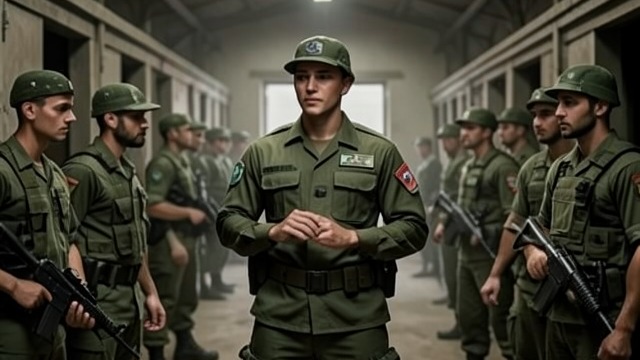
Choosing the Front Line
Assignment against expectation
After arriving at Fort Hood, the narrator is placed in the medical section but dislikes its older personnel and unfamiliar jargon. He asks to join a combat company instead, and his request puts him in Echo Company as an infantry medic.
The choice gives him a place among soldiers whose daily work he can understand, but it also moves him closer to the violence he had hoped to meet only as a medical professional. He is young, inexperienced, and entering a unit preparing to deploy.
Belonging without security
The narrator is accepted gradually through the ordinary tests of barracks life and patrol duty. He wants to be useful and to be taken seriously, yet his fellow soldiers’ appetite for combat and his own uncertainty pull him in different directions.
By choosing the front-line company, he has traded the relative distance of a medical section for exposure to the same dangers as the infantry. His attempt to define his role therefore intensifies the very conflict he hoped a medic’s identity might contain.
First Casualty Response
The First Dead and Wounded
An attack just outside sight
After the unit deploys to an Iraqi forward base, an improvised explosive device strikes a patrol. The narrator is initially frustrated that he and his section are too far away to see the impact, a reaction that reveals how training and expectation have made danger seem like something he ought to witness.
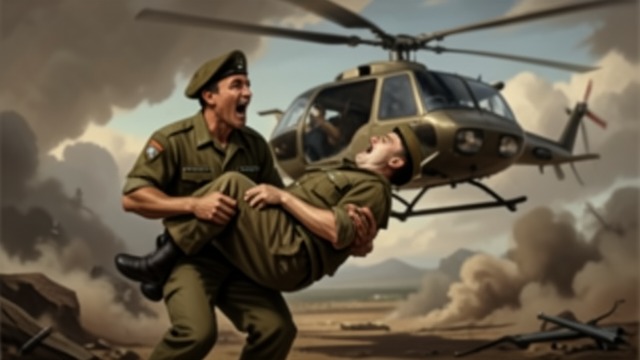
When he reaches the scene, the injured have already received substantial care, but he helps carry a casualty toward a medical helicopter. He tells the man, loudly over the rotor noise, that he will take care of him.
Confidence meets consequence
Back at the base, the narrator hears that the wounded men have died. The report leaves him questioning what the medical team could have missed and whether his confident reassurance meant anything.
His first exposure to death is thus not a clean initiation into competence. It is a collision between the medic’s promise to help and a battlefield where treatment may not be enough, where information is confused, and where a living casualty can become a fatal loss before the unit understands what happened.
Early 2005, before basic training
Winter 2005, at Fort Leonard Wood
During the medical course at Fort Sam Houston
September 2005, at Fort Hood
Soon after the unit reaches its Iraqi base
