
Emily and the Shared Addiction
CherryThis thread follows the narrator and Emily as reunion, heroin use, and repeated promises to stop turn their love into a close but destructive partnership.
increasing Bearing strength in each event
 decreasing
Bearing strength in each eventdecreasingA Marriage Under Strain

Separation at War
Love Across Distance
The narrator and Emily speak by phone while he is deployed, but their conversations repeat familiar declarations: they miss each other and still love each other. Emily’s life continues in Ohio, while his days are shaped by patrols, danger, and the long distance between them.
He worries that she may be involved with other men and reacts suspiciously when she mentions a Puerto Rican man who robs ATMs and has become her friend. Emily objects that he does not trust her; the narrator insists he does, while admitting that he believes men are rarely simply kind.
Intimacy Fraying
The calls preserve their connection, but they also expose how little reassurance either can offer the other. Emily says people think he does not exist because they never see him, and asks why she cannot have a boyfriend she can actually be with.
The narrator responds with promises about when he might come home. Their marriage remains a source of hope, but distance turns that hope into a fragile routine of postponement, jealousy, and mutual longing.
The Postwar Return

Coming Home Unevenly
A Reunion That Misses Its Promise
After returning from Iraq, the narrator is greeted by a staged homecoming in a gymnasium, then separated from Echo Company and returned to barracks life. Emily is not there when he arrives, and he feels hurt and resentful because he has been longing for her intensely.
Drunk, he accuses her of sleeping with other people and tells her she has broken his heart. Emily says she does not understand and that he sounds like a psychopath. The reunion begins not with the comfort he imagined but with mistrust and accusation.
Emotional Aftershocks
The narrator’s suspicion has been growing during deployment, and the war has left him unable to return smoothly to ordinary intimacy. Emily cannot simply restore the relationship by being present; his anger and fear have become part of the homecoming.
Their bond survives this confrontation, but the scene establishes a changed relationship. The person who comes home is still attached to Emily, yet carries experiences and expectations that make closeness harder to sustain.
The Divorce and the Phone Call

Losing Emily Again
The Marriage Ends
After leaving the Army, the narrator returns to Ohio and stops in Elba. Emily wants a divorce, and they proceed with it before he returns home. The legal ending arrives after years of separation, suspicion, and a marriage whose promises have become difficult to inhabit.
The narrator has money and begins using drugs more heavily, telling himself that getting high may allow him to cope until something good happens. Instead, the divorce leaves him increasingly isolated and fixated on the possibility that he cannot manage without Emily.
A Plea for Return
After taking cocaine, he calls Emily in the middle of the night and says he forgives her, needs her, and cannot hold himself together without her. He asks whether she is with someone, saying he will not discuss what happened before.
The call reveals that the divorce has not ended his attachment. He does not ask for a careful rebuilding of trust; he asks for her return as relief from despair. That desperation sets the terms of their eventual reunion.
The Shared Heroin Life
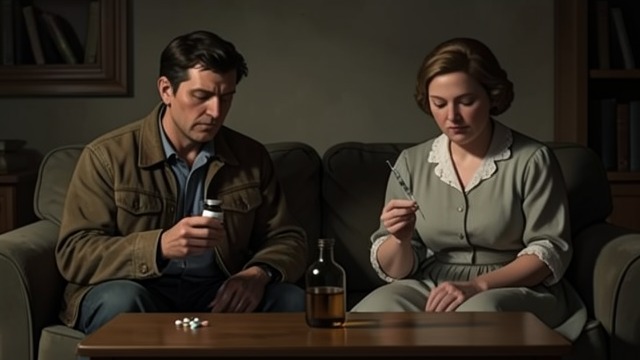
Together in Addiction
A Domestic Routine
Emily moves in with the narrator after graduating from college with honors. They buy furniture and try to make a shared home, but the narrator’s drug use and emotional instability undermine the life he is trying to construct.
They use opioids and heroin together, relying on student aid and other money to buy drugs. Their days can feel bright while they are high, but the narrator recognizes that they are accumulating debt, sickness, and dependence on dealers who may exploit them.
Love as Mutual Ruin
The narrator describes their bond as a kind of teamwork in self-destruction. Each can see that the other is in trouble, but their shared habit makes it easier to postpone stopping and to interpret another dose as the thing that will keep them functioning.
Emily’s intelligence and academic work remain visible to him, and he is proud of her, even as their lives narrow around obtaining drugs. Their affection has not disappeared; it is being used to justify a shared pattern that is steadily harming them.
The Dog and the Promise

Livinia and a New Vow
A Shared Responsibility
Emily suggests that they get a dog, and they adopt Livinia from an animal shelter. The shy, mixed-breed dog gives them something vulnerable to protect, and they promise that from then on her life will be safe and good.
The decision offers the couple a picture of ordinary care. They can feed and shelter Livinia, and the dog’s dependence makes the promise to look after her feel concrete in a way their plans for their own future have not.
The Promise to Stop
Emily says that they must quit heroin, and the narrator agrees. She agrees too. But their declaration comes while both are still using and have not yet built a reliable path out of addiction.
The dog becomes a measure of the distance between what they want to be and what they continue to do. They love Livinia and want to protect her, yet remain a couple organized around a drug habit that makes stability increasingly difficult.
The Overdose and the Withdrawal

The Edge of Survival
Emily Keeps Watch
The narrator and Emily are attempting to stop using, and both suffer through withdrawal in separate parts of the house. Emily lies on a mattress while the narrator stands at the kitchen sink, drinking water only to vomit it back up.
The narrator is deeply moved by Emily’s physical suffering. He notices the sweat, her hair, and the sound of her groaning, and his love becomes most vivid precisely when both of them are at their weakest.
A Narrow Kind of Hope
Earlier, when the narrator overdoses on heroin, Emily responds urgently and uses ice to try to revive him. Their relationship repeatedly places one in the position of rescuing the other, even though neither can make the other safe for long.
By the late narrative, they remain bound by love, shared dependence, and danger. The emotional connection has not resolved into recovery; it persists as care offered inside a cycle neither has yet escaped.
During the narrator’s year in Iraq
The narrator’s first days back at Fort Hood
After the narrator leaves the Army and returns to Ohio
After Emily moves into the narrator’s Cleveland Heights apartment
After the narrator receives notice of his college debt
Near the end of the book, after their bank robberies
