
Two Lives in Mutual Decline
CherryThis thread follows the narrator and Emily’s bond as it shifts from first love and marriage into separation, reunion, shared addiction, and a fragile domestic life repeatedly endangered by their dependence.
increasing Bearing strength in each event
 decreasing
Bearing strength in each eventdecreasingThe Beginning of Attachment

The Beginning of Attachment
Attention and Recognition
The narrator becomes drawn to Emily through her voice, humor, and guarded intelligence. Their early conversations and physical intimacy develop alongside his unresolved feelings for Madison Kowalski, but Emily gradually becomes the person whose judgment and presence matter most to him.
Love Without Security
Their relationship is never free of mistrust. Emily questions his honesty, and he admits that he was first attracted to her sexually; nevertheless, their closeness grows through moments of compassion and shared private humor.
The bond begins as a form of recognition rather than a promise of safety. They see one another’s vulnerabilities, but neither has yet learned how to build a life that can protect them from them.
Marriage Against Distance

Marriage Against Distance
A Practical Decision
As the narrator prepares to deploy, he and Emily marry privately in Elba. She frames the marriage as practical: military benefits and financial support could help them, even if she expects that they may later divorce.
A Brief Shared Certainty
The wedding is modest, and the narrator leaves with a bloodied nose after an unrelated fight. Yet for a few minutes the two believe themselves to be the most beautiful people in the world; at the airport they cry together before he leaves.
Their marriage holds hope and calculation in the same small space. It gives them legal connection and a memory of shared certainty, but it cannot erase the distance or guarantee that either will remain emotionally present.
Love Through Long Distance

Love Through Long Distance
Calls Across Separation
The narrator and Emily maintain their relationship through calls and messages while he is deployed. He worries about her friendships and possible affairs, while she feels that he is absent from her life and does not understand what she is doing at home.
Hope Turns Into Suspicion
He sends an orchid and imagines their future together, but Emily’s responses often disappoint or confuse him. He clings to the marriage and to plans for a life after the deployment even as their communication reveals emotional distance.
Their bond remains powerful precisely because it is uncertain. Each uses the idea of the other as a reason to endure, but distance also gives fear and jealousy room to grow without being resolved.
Reunion Under the Drug

Reunion Under the Drug
A Familiar Connection
After years of separation and failed attempts to build separate lives, the narrator and Emily meet again in Cleveland. She says she has begun injecting heroin in Florida, and he helps her obtain supplies; they use together and recover a sense of familiarity through the drug.
Intimacy Without Repair
They kiss, exchange apologies, and acknowledge that they have missed one another. But Emily does not want to have sex until the narrator has an HIV test, and the conversation makes clear that affection cannot simply undo the betrayals and damage between them.
The reunion restores their partnership while also introducing its most destructive shared habit. Heroin becomes an easy language of closeness, one that offers immediate comfort without requiring them to resolve what has made the relationship unsafe.
A Home Organized Around Need
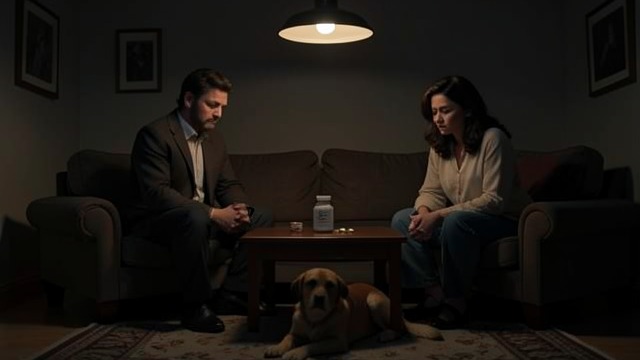
A Home Organized Around Need
A Promise to Change
Emily and the narrator adopt Livinia and tell one another that they will stop using drugs. The dog gives them a shared responsibility and a chance to imagine a gentler future, but they continue to use heroin and pills.
Affection Inside the Cycle
Their home holds tenderness, arguments, sickness, and constant calculations about money and supply. They sometimes comfort one another and sometimes blame one another for the same dependence they both sustain.
The relationship persists, but its intimacy is increasingly inseparable from the addiction. The dog and the household represent a possible life outside the cycle; their inability to preserve that possibility exposes how love can remain genuine while still failing to prevent mutual harm.
At college, before the narrator enters the Army
In autumn 2005, before the narrator deploys to Iraq
During the narrator’s Iraq deployment
After Emily returns from Florida and visits Cleveland
After the couple adopts Livinia and begins living together again
