
Emily’s Search for Independence
CherryThis thread follows Emily from an economically precarious student to a capable scholar whose effort to build an independent life is repeatedly entangled with her relationship with the narrator.
increasing Bearing strength in each event
 decreasing
Bearing strength in each eventdecreasingA Self-Reliant Student
Independence built from small sacrifices
Financial pressure
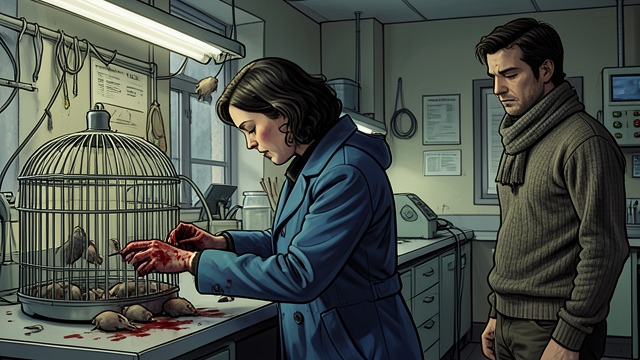
Emily works nights in a university science building, cleaning cages and killing laboratory mice because she needs money. Her parents’ divorce and her father’s refusal to support her leave her navigating college without the safety net the narrator takes for granted.
She pays attention to the cost of ordinary necessities and will walk through bad weather to save a few cents. Her resourcefulness is not a pose: it is how she keeps herself enrolled and fed.
Guarded affection
When Emily meets the narrator in English class, she is curious about him but wary of his drug use, self-absorption, and claims of affection. She can be tender, funny, and attentive, yet she distrusts the idea that love is reliable.
Her connection with him begins alongside her effort to define a life of her own. She is attracted to him, but she does not confuse attraction with confidence that he will be a dependable partner.
Leaving for Montreal

Education competes with attachment
A future she tries to fund
Emily saves for college in Montreal by working extra shifts and living with her aunt. When money problems force her to leave school and return to Elba, she has to revise the plan without giving up on education altogether.
Her choices repeatedly show discipline that the narrator lacks. She keeps up with coursework and jobs even while navigating a relationship that swings between tenderness, jealousy, and painful arguments.
The cost of departure
Before leaving, Emily tells the narrator she plans to study in Canada. He hears the departure as rejection, but for Emily it is also an attempt to move toward a future not organized around his instability.
The separation does not erase their bond. It instead establishes a pattern in which Emily tries to advance her education and independence while the narrator treats distance as a threat to the relationship itself.
Marriage Under Wartime Pressure

A practical promise becomes intimate
A marriage kept quiet
When the narrator prepares to deploy, Emily agrees to marry him in Elba. The arrangement promises practical advantages, including increased pay and health coverage, but it also expresses a real tenderness between them.
They keep the marriage secret. Their decision takes place amid the pressure of departure, and the couple has little time to test what married life will mean beyond the immediate need to remain connected.
Distance unsettles the promise
During the deployment, Emily continues school and work while the narrator contacts her from military training and Iraq. Their calls still contain declarations of love, but they also reveal how little control either has over the other’s daily life.
Emily’s marriage to the narrator becomes a fragile bond stretched across distance and suspicion. The practical logic that helped them marry cannot protect them from the deeper differences in their expectations or from the narrator’s growing instability.
Achievement and Estrangement

Success does not restore intimacy
Building a life of her own
While the narrator is deployed, Emily studies and works hard, eventually maintaining strong grades and keeping her educational plans on track. She has ambitions and responsibilities of her own, rather than simply waiting for the narrator to return.
Her life is not made easier by the marriage. She experiences loneliness, develops friendships, and has relationships with other men while the narrator is away. The narrator interprets these developments through jealousy, but Emily’s choices also reflect the distance and uncertainty between them.
A homecoming that does not heal
When the narrator returns, Emily is not waiting in the uncomplicated way he expects. Her work and plans have continued, while he comes home carrying combat memories, heavy drinking, and an urgent demand for reassurance.
Their arguments increasingly revolve around what the narrator believes she has done and whether she still wants to be with him. Emily’s academic progress stands beside the disintegration of their marriage, showing that her capacity to build a future does not guarantee that the relationship can survive.
Addiction, Relapse, and Return

Love re-enters the cycle
Separate lives converge again
Emily moves to Florida and begins using heroin with another man. When she passes through Cleveland, she asks the narrator to get drugs, and the two inject together before she resumes her journey.
The reunion renews their intimacy without resolving the years of betrayal, separation, and pain. Emily’s return to the narrator’s life is not a simple reconciliation; it is an encounter between two people who are already vulnerable to the drug that will organize their days.
A fragile household
Emily and the narrator eventually live together and become deeply dependent on heroin. She studies and teaches while he seeks drugs, and both participate in a routine that consumes money, attention, and trust.
They adopt Livinia and promise to stop using, but the promise does not hold. Emily enters treatment, yet the narrator relapses, and their shared addiction pulls them back toward the same crisis. Her fate is left inside that unresolved struggle, not transformed into a completed recovery arc.
Around 2003, when she meets the narrator at college
From the first winter together through the following summer
Autumn 2005, shortly before the narrator deploys to Iraq
During the Iraq deployment and the narrator’s return home
Several years after the narrator’s deployment, from Florida to their shared home
