
A Marriage Under Pressure
Children of the CornThis thread follows how the couple’s long-running resentment shapes their choices during a crisis that neither can control.
increasing Bearing strength in each event
 decreasing
Bearing strength in each eventdecreasingThe Argument on Route 17
The Argument on Route 17
Old grievances in a moving car
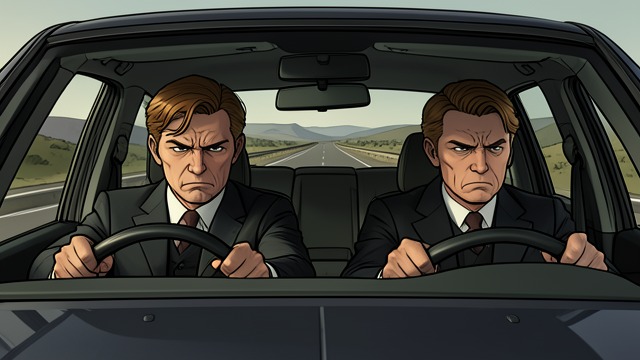
Burt drives while Vicky navigates, and their conversation quickly returns to the accumulated resentments of a strained marriage. He resents having done the driving; she rejects the implication that she has refused to help, citing the migraines she gets during long drives.
A detour becomes a test
Their decision to leave the turnpike has exposed them to unfamiliar roads and renewed their conflict. Burt grips the steering wheel and privately imagines striking Vicky, then recognizes that their trip was meant to repair rather than worsen the relationship. That recognition does not make him gentler; it only confirms how little patience remains.
The quarrel leaves both travelers distracted at the moment the boy appears. Their marriage is not the cause of his death, but its hostility determines the emotional conditions under which they face it. A journey intended as a last effort at reconciliation becomes a test of whether they can respond together to an emergency.
Grief Turns into Blame
Grief Turns into Blame
Shock at the roadside
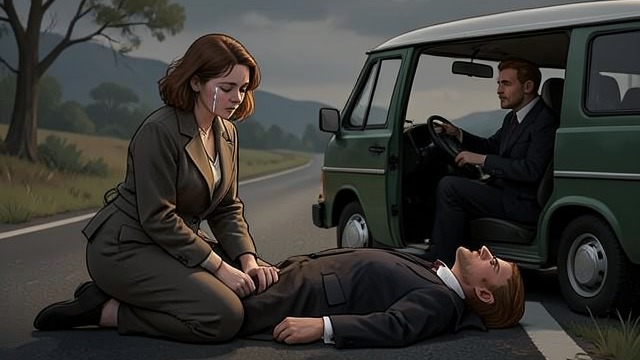
Vicky gets out of the car and vomits, then breaks down beside the body. Burt remains momentarily fixed behind the wheel, absorbing the smell of the fields and the knowledge that he took his eyes off the road.
A rupture of compassion
When Burt discovers the boy’s cut throat and returns with the suitcase, Vicky’s grief has become hysterical anger. He slaps her, and she warns that he will go to jail. The blow briefly interrupts her distress but also turns a shared crisis into a direct act of marital violence.
Burt answers the immediate accusation with the suitcase and a blunt reference to the dead child. Their exchange does not resolve blame: the boy was already gravely wounded, yet Burt’s car did run over him, and both know they must live with uncertainty about what happened in the final moments. The couple’s first response to tragedy is thus both cooperation and mutual injury.
The Turnaround Dispute
The Turnaround Dispute
Fear against responsibility
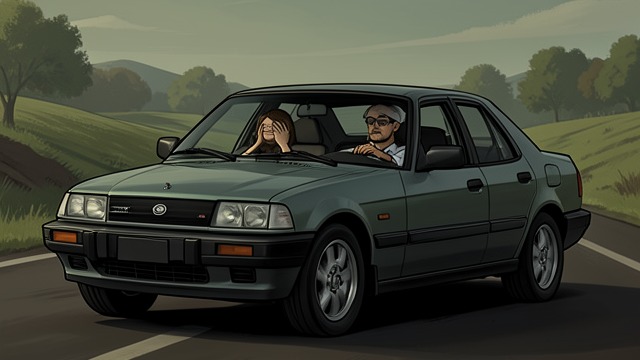
On entering Gatlin, Vicky sees a deserted town and asks Burt to turn around and take the body to a larger city. Burt admits that the place feels wrong but insists that they must still report the death, since the boy is someone’s child and his killer may escape.
The argument hardens
Vicky’s fear rises into resistance, while Burt interprets her refusal as another instance of a familiar marital pattern. He raises his voice and makes clear that he will not treat the body as an inconvenience to be carried onward. The urgent need to decide what to do with the remains becomes a proxy for their deeper struggle over who gets to set the terms of their shared life.
Burt’s decision to continue toward the civic center is ethically understandable but also entangled with stubbornness. He hears his own resolve as moral duty and Vicky hears it as a refusal to listen. Their disagreement leaves them together in the car but increasingly divided in their trust of each other and of their surroundings.
The Keys and the Church
The Keys and the Church
Fear becomes explicit
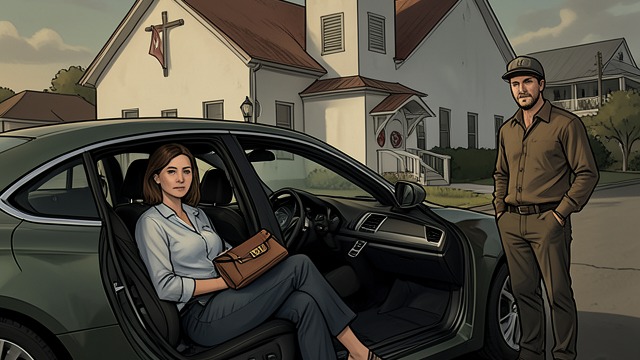
When Burt stops at Grace Baptist Church, Vicky says she is scared and refuses to go inside. She asks him not to leave her alone and threatens to drive away if he does not return quickly, making clear that the deserted town has overwhelmed her.
Control replaces reassurance
Burt does not calm her or negotiate a plan. He takes her purse, empties it onto the car seat, and pockets her keys to prevent her from leaving. Vicky cries and pleads, but he walks toward the church after dismissing her fear as another attempt to control him.
The gesture is practical only in Burt’s narrow calculation that he must keep the couple together; emotionally, it repeats the coercive dynamic already present in their marriage. He wants to investigate and believes he is acting for the good of both of them, yet his method deprives Vicky of agency precisely when she feels most vulnerable. The scene makes their relational damage concrete rather than merely verbal.
The Interrupted Reconciliation
The Interrupted Reconciliation
An attempted warning
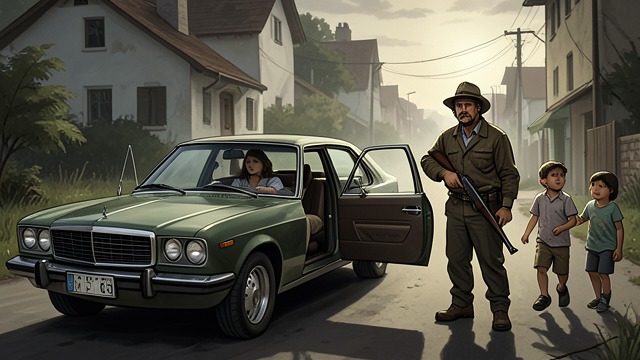
Burt leaves Vicky in the car despite her plea, and his brief investigation becomes a separation at the moment danger is approaching. When he sees children converging on the vehicle, he shouts for her to get the shotgun, but she is frozen by panic behind the glass.
A bond tested by violence
The children destroy the car and drag Vicky away while Burt struggles to reach her. His earlier control of the keys has not protected her; it has only left them both trapped in the situation he chose to investigate. When he asks where she has been taken, a child answers with a gesture across the throat.
Burt’s terror now mixes with the recognition that he and Vicky have not repaired their marriage. The crisis makes their dependence on each other unmistakable, but it arrives after distrust and coercion have shaped their choices. Their attempted second honeymoon ends not in reconciliation but in separation enforced by violence.
Before the boy enters the road
Immediately after the collision
At the edge of Gatlin
Before Burt enters Grace Baptist Church
When the children attack the car
