
Signs of a Closed Town
Children of the CornThis thread traces the roadside and town clues that turn an ordinary detour into the discovery of a community cut off from normal time and public life.
increasing Bearing strength in each event
 decreasing
Bearing strength in each eventdecreasingA Sermon Through Static
A Sermon Through Static
A voice in the car
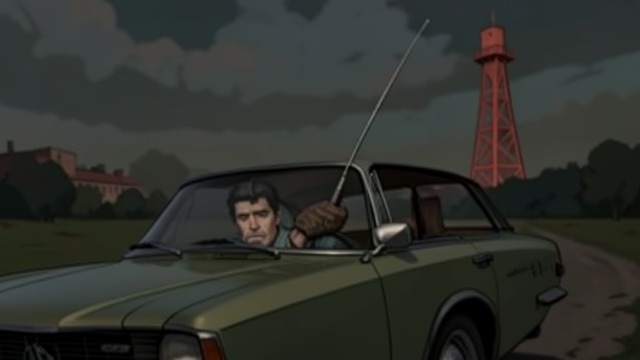
Burt searches the radio dial while Vicky works at the suitcase. Most stations dissolve into distant fragments, but a nearby broadcast suddenly comes through with startling force. Its preacher speaks of atonement and condemns people who defile the corn.
A local signal
The religious language is not merely a strange interruption: Burt notices a red radio tower standing beyond the fields. The signal’s clarity places the source close to their route and gives the corn a place within the town’s public doctrine. Vicky dismisses the sermon, but Burt cannot forget the preacher’s warning about the crop.
The broadcast supplies the first audible indication that the surrounding landscape has a belief system attached to it. Its youthful-sounding voice also troubles Vicky, who recalls child preachers from her own past. The encounter prepares the travelers to read later signs not as eccentric decoration but as expressions of a community’s organizing faith.
Scripture by the Shoulder

Scripture by the Shoulder
A roadside message
Whitewashed posts appear at regular intervals, each bearing a single word. Together they form fragments of biblical language, including an image of a cloud by day and a pillar of fire by night.
The joke gives way
Vicky initially responds with nervous laughter, treating the sequence like a parody of roadside advertising. Another set of signs invokes eating at the Lord’s command, and Burt begins to associate the words with the corn around them. The humor cannot settle the unease because the messages are too deliberate and too close to the fields.
The signs make the road itself feel claimed. Their placement leads travelers through a landscape where religious instructions and ordinary travel markers coexist, and the couple cannot tell whether the posts are an invitation, a warning, or both. The roadside has become a text they are being forced to read as they approach town.
Prices from Another Year
Prices from Another Year
A town with no traffic
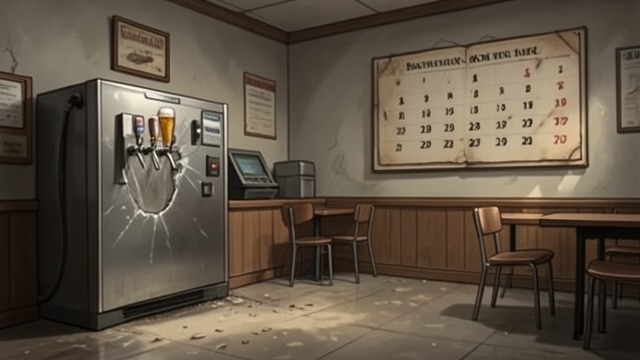
The couple notices that the streets contain no cars and that a nearby gas station advertises fuel at prices several years out of date. Vicky treats the numbers as concrete evidence that the town is not simply quiet at midday; its ordinary public life appears to have stopped.
The calendar confirms the gap
Inside the lunchroom, dust lies across the empty interior and the beer taps have been broken off. A wall calendar remains open to August 1964, establishing a date that conflicts with the travelers’ present. The ordinary objects have not been removed; they have been left behind as if daily life ceased without being cleared away.
The discrepancies make Gatlin’s emptiness more difficult to explain than a temporary closure. The outdated prices and frozen calendar imply an extended rupture between this place and the world beyond it. Burt still wants to find an official, but every detail weakens the assumption that the town’s institutions are functioning normally.
An Empty Main Street
An Empty Main Street
Evidence in plain sight
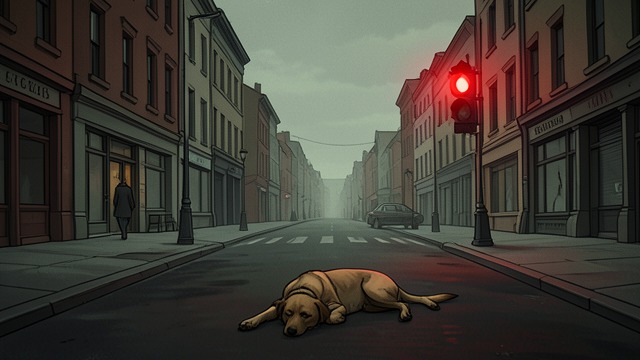
Burt sees familiar signs of a small town—streets, shops, a square, and public buildings—but no residents or moving vehicles. The only animal life offers no reassurance: a dog lies in the road rather than reacting with ordinary alarm to the car.
Hearing life at a distance
Vicky insists that the place feels wholly empty. Burt hears children laughing from a nearby block, a sound that contradicts the deserted streets without identifying who is responsible for it. The laughter makes the silence more unsettling because it suggests that people are close while remaining unseen.
The couple’s different readings of the town expose the uncertainty of their position. Vicky trusts the visible absence; Burt follows the sound and continues toward the center, still expecting an authority or explanation to appear. Gatlin presents activity only as an indirect trace, leaving visitors to infer what its inhabitants are doing.
A Town Without Service
A Town Without Service
Civic signs without civic life
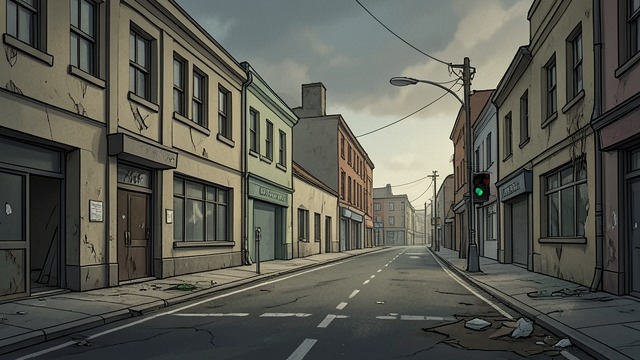
The municipal buildings and the dead stoplight suggest a town whose public systems remain physically present but no longer perform their usual functions. The lunchroom is marked as open, yet its dusty furnishings and damaged fixtures show that the promise of service is deceptive.
No ordinary explanation
Burt’s first instinct is to reconcile the scene with familiar explanations: perhaps residents have gathered elsewhere, or perhaps maintenance crews have simply not arrived. But the old fuel prices, abandoned calendar, and empty streets make those possibilities increasingly strained. There is no obvious public presence to whom the travelers can entrust the body they are carrying.
The town’s abandoned services create the practical trap beneath its mystery. Burt has entered looking for help, but the buildings that should provide help are only shells of civic order. The more he searches for a normal explanation, the more Gatlin appears to have been isolated from the everyday systems that might have interrupted its history.
While the couple drives toward Gatlin
A short distance before Gatlin
During the first minutes inside Gatlin
As Burt drives from the town square toward the civic buildings
During Burt’s first exploration of Gatlin
