
The Church's Hidden Record
Children of the CornThis thread follows Burt's investigation of the church, where altered religious objects and records expose the town's transformed history.
increasing Bearing strength in each event
 decreasing
Bearing strength in each eventdecreasingLetters in the Vestibule
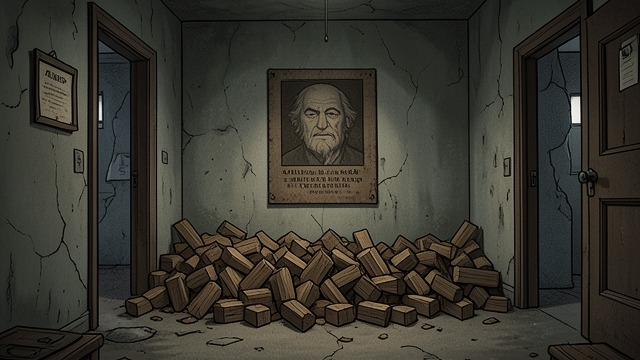
Letters in the Vestibule
A church changed from within
Burt enters Grace Baptist Church expecting an ordinary place of worship. In the vestibule he finds large wooden letters discarded in a dusty pile, unlike the tidy entrance around them.
The former name emerges
By rearranging the letters, Burt recognizes the words “Grace Baptist Church.” Their removal suggests that the building once carried a different identity, one abandoned without being fully erased. The simple puzzle gives him a first material clue that the town’s religious change was deliberate.
Burt’s initial reaction is to treat the discovery as a mundane renovation, but that explanation does not satisfy his growing unease. The letters have not been stored carefully or replaced in a way that would preserve continuity; they have been cast aside. The church’s altered name becomes an invitation to ask what happened here and who now defines its faith.
The Corn-Crowned Christ
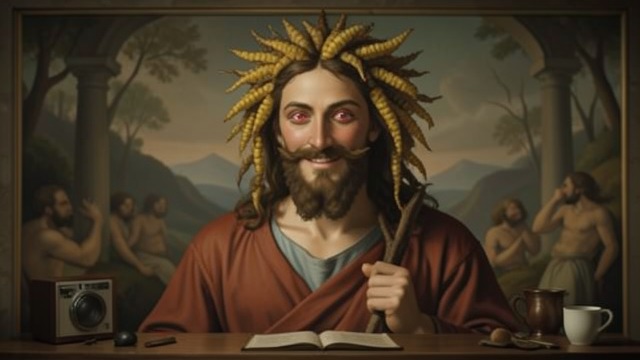
The Corn-Crowned Christ
An unsettling sacred image
The nave contains a huge portrait of Christ with a vulpine grin and corn forming his hair. The eyes are painted as if sinners were drowning within them, turning the familiar image of a savior into a figure that appears threatening and punitive.
Worship redirected
The mural’s crude, childlike style makes it feel like a local devotional object rather than conventional church art. Burt understands that the image is not a harmless eccentricity: it recasts religious authority through the crop that already dominates the surrounding fields.
The painting gives visual form to a belief system that has displaced ordinary Christian imagery. Burt has no explanation for the town’s empty streets, but the mural makes clear that the building’s transformation is ideological as well as physical. The corn has become the organizing symbol through which the community represents the sacred.
Silenced Organ Pipes
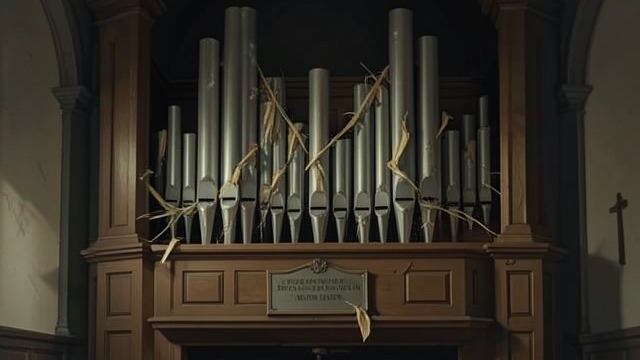
Silenced Organ Pipes
Music dismantled
Burt finds the church organ vandalized: its keys have been torn up, its stops pulled out, and its pipes stuffed with dry cornhusks. The damage is systematic rather than accidental, as if someone has deliberately removed the instrument’s ability to make music.
A rule against instruments
A plaque nearby declares that music should be made only with the human tongue. The instruction turns the organ’s destruction into an act of doctrine. Together, the broken instrument and the message suggest that the congregation’s new order has rejected a customary form of worship.
Burt reads the room as another clue in a pattern of religious revision. Sacred space has not merely been abandoned; it has been actively altered to serve a different theology. The silence of the organ also echoes the larger town, where familiar forms remain visible but ordinary life has been suppressed.
A Cut-Up Bible
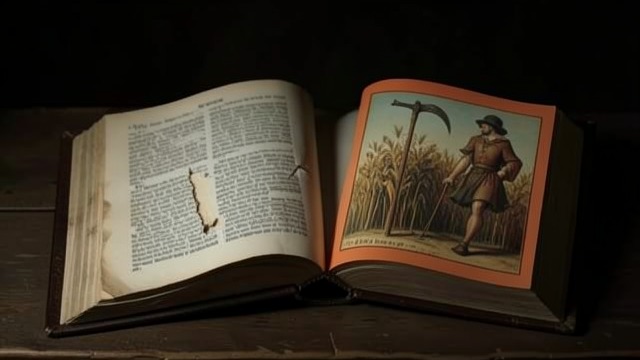
A Cut-Up Bible
Selective scripture
At the pulpit, Burt finds a Bible open to the Book of Job, whose challenge to human understanding resonates with the threatening figure behind him. As he turns through the pages, he sees that sections have been cut from the New Testament while the Old Testament remains intact.
Doctrine made physical
The missing pages show that the community has not simply neglected scripture; someone has edited it according to a purpose. A second volume bears a slogan about cutting down the wicked to make the ground fertile, aligning religious judgment with cultivation and sacrifice.
Burt begins to recognize a coherent pattern: the church has kept the language of divine authority while reshaping its contents around the corn. These books offer no neutral record of belief. They are artifacts of an ideology that has turned spiritual purity into a justification for violence, and they prepare Burt to connect the town’s history with the children’s rule.
Names in the Registers
Names in the Registers
Births in a new order
Burt opens handwritten books that record births in large, childishly formed letters. The entries continue through the period around 1964, then show an abrupt gap before new names appear, including births without the usual second-name notation.
A history Burt reconstructs
The date on the lunchroom calendar and the changed church help Burt interpret the registers. He infers that the town’s children killed the adults around that period and that a new generation continued under the altered religious system. The book does not spell out every detail, but its dates make the apparent rupture in the town’s population legible.
Burt’s reconstruction is a rapid, imperfect act of reasoning rather than a formal investigation, and he knows that the implications are horrifying. The records turn the church from a collection of grotesque objects into evidence of a generational takeover. He is still inside the building when the car horn erupts, abruptly ending his attempt to understand the past before the danger reaches Vicky.
During Burt’s entry into Grace Baptist Church
Moments after Burt passes through the church doors
During Burt’s inspection of the church interior
While Burt examines the pulpit
Near the end of Burt’s church investigation
