
The Mystery of Gatlin
Children of the CornThis thread traces how the abandoned town's signs, empty buildings, and hidden children turn a roadside stop into an unfolding mystery.
increasing Bearing strength in each event
 decreasing
Bearing strength in each eventdecreasingA Strange Roadside Sermon
A Strange Roadside Sermon
A Voice in the Static
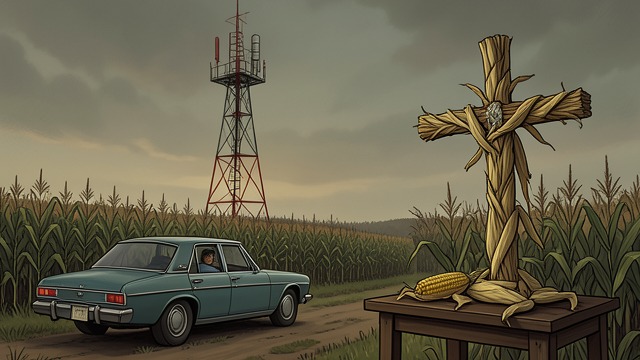
As Burt and Vicky approach Gatlin, their radio catches a nearby preacher denouncing worldly sin and warning against defiling the corn. The sermon is unusually forceful, and its speaker sounds young enough to unsettle Burt.
Vicky dismisses the broadcast as a familiar kind of religious manipulation. Burt, however, notices the specific reference to corn and connects it to the boy's bloody passage out of the fields.
A Signal from the Town
A red radio tower rises above the corn, locating the source of the sermon near their destination. The broadcast makes the town's isolation seem less like an accident: someone is transmitting a coherent belief system from within it.
The language of sin and corn prepares the travelers to read later details as connected clues. What initially sounds like eccentric preaching becomes an early expression of Gatlin's governing faith.
The Corn-Kernel Crucifix
The Corn-Kernel Crucifix
An Object from the Suitcase
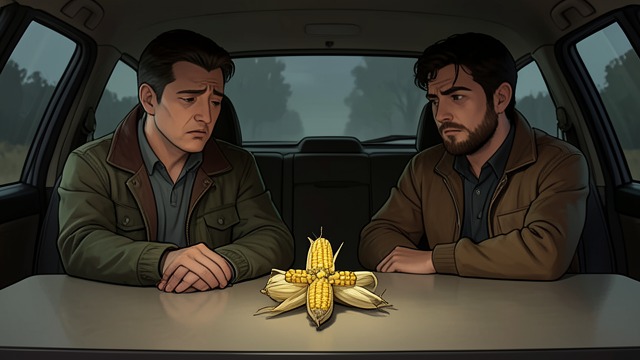
While opening the dead boy's suitcase, Vicky finds a small crucifix made from corn husks and a carved cob. Its carefully arranged kernels form a figure of Christ, combining familiar religious imagery with the crop surrounding the road.
Burt recognizes the object as potentially useful evidence and wants to preserve it for the authorities. Vicky finds it repellent and asks him to throw it away, revealing how strongly it affects her even before either traveler knows what it signifies.
A Portable Clue
Burt puts the object in the car rather than discard it. Its presence links the murdered boy to a religious practice that is both handmade and specific to the fields.
The object is not a complete explanation, but it changes the meaning of the surrounding signs and sermon. Gatlin's relationship to corn is beginning to look ceremonial, not simply agricultural.
The Empty Main Street
The Empty Main Street
A Community without Adults
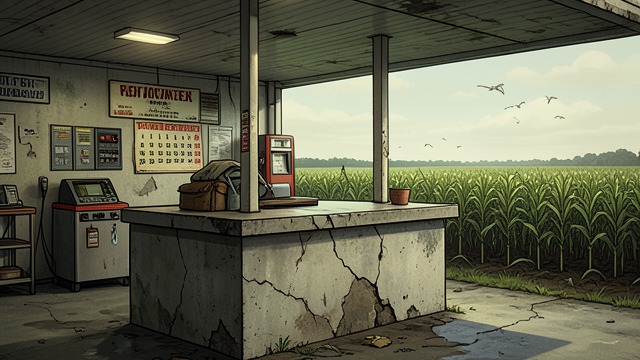
The couple reaches Gatlin and finds no traffic, no visible residents, and no ordinary activity at its gas station or town square. Vicky argues that the emptiness is real, while Burt tries to explain it as a temporary gathering or a local event.
The discrepancy between their interpretations sharpens the emotional conflict between them. Burt's habit of trusting routine and Vicky's alarm are now tested by a place that looks familiar in form but refuses to behave like a functioning town.
Dated Objects
The prices at the gas station and the lunchroom calendar point to 1964, years before the present journey. The undisturbed old date suggests that the town has been left behind or deliberately preserved in a state outsiders might mistake for ordinary neglect.
Children's laughter eventually breaks the silence, confirming that the town is not wholly empty. The mystery shifts from absence to concealment: children are present, but adults remain nowhere to be seen.
The Altered Church
The Altered Church
A Changed Identity
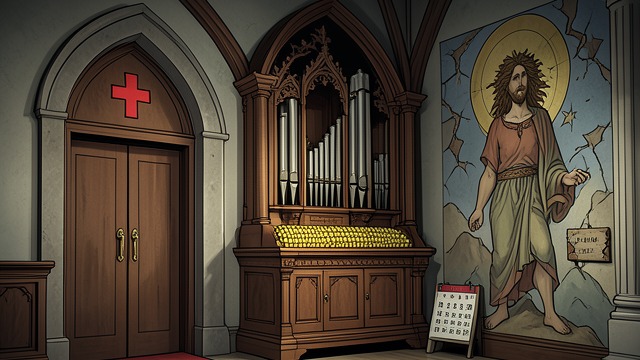
Burt notices that the church's former name has been removed and its interior rearranged around an unfamiliar theology. The corn-filled organ and the mural of a corn-haired Christ give physical form to a faith that has displaced the building's earlier use.
The details make Gatlin's religious transformation visible rather than speculative. Burt cannot yet explain who changed the church or why, but he understands that the town's odd signs and radio sermon belong to a larger order.
A History in the Records
The church records show births across years, then a sharp discontinuity around 1964. Burt connects the break to the disappearance of the town's adults and to the children's apparent control of Gatlin.
The age pattern suggests a repeated danger for older members of the group. His conjecture is incomplete, but it gives the town's eerie quiet a historical dimension: this is the aftermath of a generational overthrow maintained through ritual.
A Mystery That Continues
A Mystery That Continues
A Child's Explanation
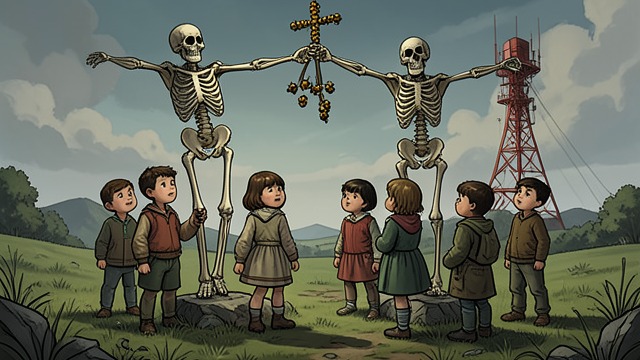
Isaac tells the gathered children that He Who Walks Behind the Rows appeared in a dream and personally completed the sacrifice of Burt. His account names earlier victims and places Burt's death within Gatlin's established sacred geography.
The speech answers one question about the immediate violence: the children believe the corn's god has the final authority over sacrifice. It also confirms that the clearing is a recognized place of killing, not an accidental discovery by Burt.
An Unresolved Order
Isaac announces that the age limit has fallen from nineteen to eighteen. The rule changes in response to the god's displeasure, while the children accept the revision rather than challenge the authority behind it.
The account closes the mystery of Gatlin's present order without resolving the origin or limits of its supernatural power. The town remains governed by secrecy, fear, and a faith whose consequences continue beyond the deaths of its adult intruders.
After Burt and Vicky find the boy, while driving toward Gatlin
On the approach to Gatlin, shortly after the radio sermon
Around midday, during the first drive through Gatlin
Early afternoon, as Burt searches the church
The morning after Burt's death, in the corn clearing
