1964 Gatlin massacre and takeover
Children of the CornThe 1964 Gatlin massacre and takeover began when children in Gatlin, convinced that their community’s survival depended on religious obedience and sacrifice, killed the adults and assumed control of the town. Its consequences lasted well beyond the killings: worship of He Who Walks Behind the Rows governed the community, while an age-based sacrificial rule placed a limit on how long any child could remain outside the corn. Burt Robeson’s investigation reconstructs the upheaval from altered church signs, religious objects, and a child-written record; the later actions of Isaac and Malachi reveal that the takeover became not a single break with the past but an enduring system of belief, authority, and violence.
Evidence and Reconstruction
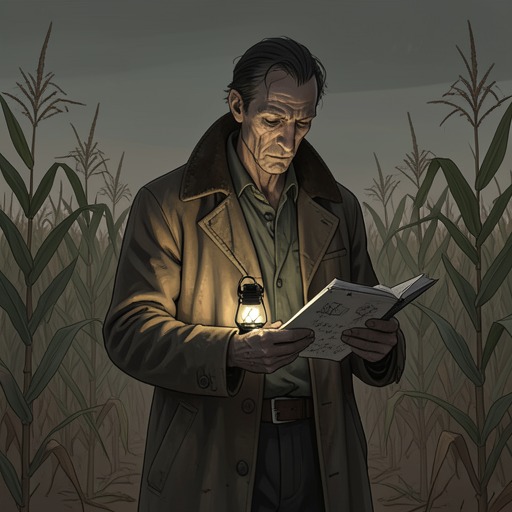
The event is not presented through a complete account of the killings as they happened. Instead, Burt pieces it together in the town years later. In the vestibule of the church, eighteen large wooden letters lie neglected in a dusty pile. Reordering them, Burt discovers that they once spelled Grace Baptist Church. Their removal, and the church’s changed appearance, suggest that the institution has been replaced rather than simply abandoned. He senses that the change is connected to something that happened in 1964, involving religion, corn, and children.
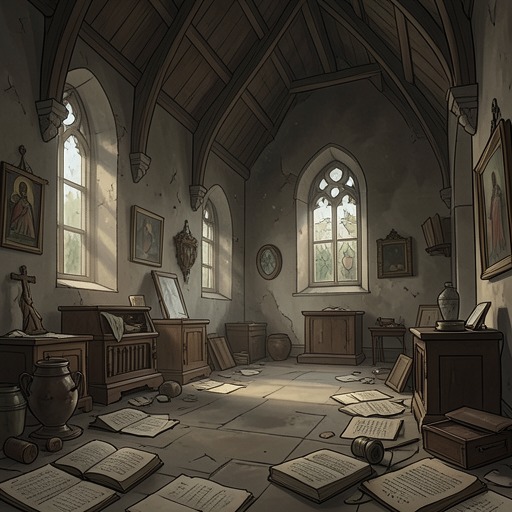
Other remnants point to how the town’s faith took shape. A sermon board announces The Power and Grace of He Who Walks Behind the Rows and bears the date July 24, 1976. In a suitcase, Burt and Vicky find a distinctive devotional object: a crucifix made from dried corn husk, with a miniature cob attached and its remaining kernels arranged as a figure on a cross. In the church, Burt also finds a religious book whose cover declares that the unrighteous must be cut down so that the ground may again be fertile. The object and inscription join Christian forms and language to the agricultural setting, making the corn both the focus of worship and the justification for violent sacrifice.
The evidence is suggestive rather than a neutral chronicle. Burt’s reconstruction draws on the church’s altered identity and a child’s hand in the records, but he frames the origins of the killings as a theory: perhaps the corn was dying, and the children decided that sin and insufficient sacrifice explained its condition. The text supports that proposed connection without establishing every detail of how the children came to believe it. The change is nevertheless clear in its consequences: Gatlin’s religious life becomes centered on a corn god and on the belief that human sacrifice can preserve the community’s favor.
The Children’s Revolt
Burt identifies Richard Deigan, later known as Amos Deigan, as a central figure in his account of the takeover. Born on September 4, 1945, Deigan took the biblical name Amos in 1964. Burt names Billy Renfrew, George Kirk, Roberta Wells, and Eddie Hollis among Deigan’s friends, along with others, and says that they embraced religion and killed their parents. He describes the killings as having been carried out in different ways, but the underlying fact is the collective destruction of the adult population: the children did not merely change the church’s name or teaching; they removed the adults who had governed their lives.
The age limit was part of Burt’s explanation for what happened next. He links Deigan’s nineteenth birthday, September 4, 1964, to a date recorded in the church book and reasons that Deigan may have been killed as a sacrifice in the corn. Burt also points to Rachel Stigman, formerly Donna Stigman, who had turned nineteen in June, and Moses Richardson, who was about to reach that age. His account suggests that the children’s new order treated nineteen as the end of a person’s permitted life, with the birthday marking a transition from membership in the community to sacrifice. The record does not make every step of that system’s beginnings certain, but its later operation confirms that the prescribed age carried mortal consequences.
A Takeover Made Visible
When Burt later enters the church, he encounters signs that the new order has become ordinary and public. The church’s sermon board bears the name of He Who Walks Behind the Rows, and the religious writing inside connects the cutting down of the unrighteous with the fertility of the ground. The message makes agricultural prosperity inseparable from moral judgment: in Gatlin’s belief, the condition of the crop and the conduct of the community belong to the same sacred order.
The transformed faith also appears in its material practices. The corn-kernel crucifix gives a familiar Christian image a local substance and a changed emphasis: the body of the figure is made from the crop, while the cross is assembled from husk. Later, when Isaac announces that the sacrificial age has been lowered, the girls make many more corncob crucifixes to ward off further evil. The objects recur across the history of the takeover, first as a sign of the community’s distinctive worship and later as a response to a crisis within it. They do not undo the violence; they show how the children use religious craft and ritual to seek protection under the same faith that demands sacrifice.
Burt’s discovery of the discarded church letters sharpens the contrast between institutional continuity and radical change. The old church has not simply vanished: its vocabulary, books, and forms remain, but they have been reorganized around a different god and a different relation between sin, land, and death. The letters spelling Grace Baptist Church are literally present, yet displaced and forgotten. The children’s takeover thus registers in both doctrine and space: the old name survives as an archaeological trace inside a building whose current religious identity has changed.
The Age Rule and Its Aftermath
The later revelation about the age limit shows the takeover’s system adapting rather than fading. Isaac, a nine-year-old regarded by the children as a seer, announces that the Age of Favor is being lowered from nineteen plantings and harvestings to eighteen. His pronouncement is presented as the word of He Who Walks Behind the Rows and follows a sacrifice the god has supposedly completed himself. The new limit therefore does not arise as a mere administrative adjustment: it is delivered as divine instruction and changes who is now at risk.
Malachi’s response makes the force of the rule concrete. He has led the hunt for Japheth, who is thereafter known as Ahaz, cursed of God; Malachi killed him and cast his body out of the corn so that it would not pollute or blight the crop. When Isaac announces the lowered age, the group looks to Malachi and Joseph, the only two among those present who are eighteen. Malachi answers that he obeys the word of God. That response places personal submission inside a collective structure: the group waits for his reaction, and the religious decree has immediate bearing on his own future.
The rule’s consequences extend to the rest of the community as well. There are other eighteen-year-olds back in town, perhaps twenty in all. That night, everyone now above the newly lowered Age of Favor walks silently into the corn and goes to the clearing to seek the continued favor of He Who Walks Behind the Rows. Ruth calls goodbye to Malachi; she is carrying his child and weeps as he leaves without turning back. The scene makes the new limit more than a doctrine: it separates a pregnant woman from the father of her child and sends those who have crossed the threshold toward the place of sacrifice.
Continuing Violence and Narrative Significance
The takeover’s legacy is also visible in the attack on Burt and Vicky. As children converge on their car, they carry knives, hatchets, pipes, rocks, and hammers; the group’s assault damages the vehicle and leaves Vicky exposed. One boy tells Burt to prepare his soul to stand before God. The religious language that once helped organize the children’s revolt now accompanies another collective act of violence against outsiders. The scene does not repeat the adult killings, but it shows that the community’s inherited boundary between believers and those who enter its space remains enforced through force.
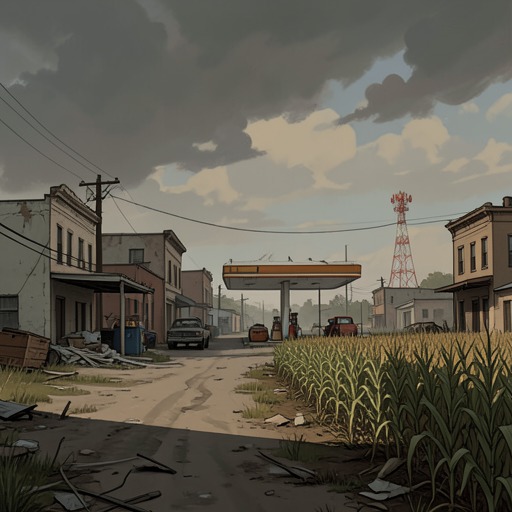
At the story’s end, the children stand in a clearing before two crucified skeletons and two bodies that have not yet become skeletons. Isaac presents this sight as something shown to him in a dream, and the group listens with dread and wonder. The juxtaposition of the bodies with the later revelation of the lowered age limit clarifies the cost of the order established after 1964: the corn’s claim on the community continues, even as the age at which a child must enter it falls. The setting in Nebraska’s corn country supplies the religious system with its central image and its purported source of authority. In the takeover’s lasting logic, the crop is simultaneously livelihood, sacred presence, and the ground on which the children’s rule of sacrifice is enforced.