Gatlin
Children of the CornGatlin is a small Nebraska town whose familiar rural features mask a community ordered by its devotion to the corn. As Burt Robeson and Vicky approach, outdated signs and deserted streets make the place feel suspended in time; its church and surrounding fields disclose a faith that governs local life through sacred objects, prophecy, and sacrifice. The town’s outward quiet is not an absence of order but the sign of a different, concealed one.
Setting and First Impressions
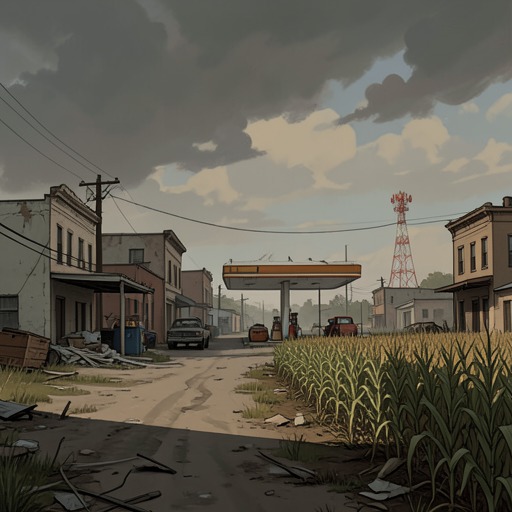
From a rise, Gatlin appears to comprise only three blocks, like a Depression-era movie set. An entering sign calls it the nicest little town in Nebraska—or anywhere else—and gives its population as 5,431. The approach passes dusty, diseased elms, the Gatlin Lumberyard, and a 76 gas station whose displayed prices are thirty-five cents and nine tenths for regular fuel and thirty-eight cents and nine tenths for high-test. Those figures are several years out of date, a discrepancy Vicky recognizes as evidence that the town is not functioning like an ordinary, inhabited place.
The roads and buildings initially offer the reassuring outlines of small-town routine: named streets, plain wooden houses with screened porches, a town square, a café, and a gas station. But the streets are empty of cars and people. When Vicky says that the town is empty, Burt resists the conclusion, imagining residents gathered for a bake sale or bingo. The contrast between that familiar explanation and the deserted center makes the town’s quiet increasingly ominous.
Signs and Religious Landscape
Religious language marks the approach well before Burt and Vicky reach the center. A roadside billboard announces that only Jesus saves; farther along, separate words on weathered whitewashed stakes spell out a biblical image of a cloud by day and a pillar of fire by night. The signs make the road itself read like a religious message, though their fragmented, widely spaced arrangement also gives the landscape an uncanny quality.
The town’s church makes the local faith more explicit. Its sermon board advertises a service on the power and grace of He Who Walks Behind the Rows, dated July 24, 1976, the previous Sunday. Burt treats the unfamiliar divine name skeptically, but the phrasing connects the community’s religion directly to the corn. Inside, a book bears the inscription that the iniquitous should be cut down so the ground may again be fertile. The wording links religious judgment with the productivity of the land, making the town’s agricultural setting part of its moral and sacred order.
A corn-made crucifix offers another material expression of that faith. Found among the contents of a suitcase, it combines twisted corn husk with a small cob whose remaining kernels form a crude human figure; the letters INRI appear above it. The object turns the crop itself into a Christian symbol. Later, after the children have witnessed the consequences of sacrifice, girls make many such corncob crucifixes in an effort to ward off further evil. The object thus recurs as both a sign of the town’s religious practice and a response to its dangers.
The Town and the Corn
Gatlin’s agricultural surroundings are not simply a backdrop. Burt notices that the fertilizer smell differs from the familiar scent of rural upstate New York: here, he associates it with a sickly, deathlike undertone. His impression connects the town’s productive farmland to a threat that ordinary rural associations cannot explain.
The cornfield intensifies that unease through its unnatural perfection. In the field, Burt finds no insects or crows and sees that every stalk and leaf is flawless: there is no blight, damaged foliage, or sign of pests. Most strikingly, there are no weeds. The apparent abundance of the corn is therefore not just agricultural good fortune; its immaculate condition marks the field as something beyond ordinary cultivation and suggests the reach of the power the town worships.
Sacrifice and the Changing Rule
The clearing in the corn becomes the central ritual space of Gatlin’s faith. The children gather there and look at two crucified skeletons and two bodies that have not yet become skeletons. In this setting, death is framed as sacrifice, and time itself is presented as belonging to the corn and to the community’s religious order.
Isaac, who is nine, speaks as the Seer. He has held that position since the corn took David a year earlier: David was nineteen and entered the corn on his birthday at dusk. Isaac announces that the Age of Favor has been lowered from nineteen plantings and harvestings to eighteen. The change turns a religious proclamation into an immediate alteration of the town’s rule, bringing those who are eighteen within its reach.
The gathered children look toward Malachi and Joseph, the two eighteen-year-olds among them. Malachi says that he obeys the word of God, and the corn appears to approve. That night, those now above the Age of Favor walk silently to the clearing to seek the continued favor of He Who Walks Behind the Rows. Ruth, pregnant with Malachi’s child, calls goodbye and weeps as he leaves without turning back; the corn swallows him. The scene makes the town’s governing belief visible in its consequences: communal obedience is maintained through a sacrifice whose age limit can change by prophetic decree.
Meaning and Significance
Gatlin’s spaces form a progression from public road to town center, from church to cornfield clearing. Signs and sermon boards announce the belief; the church gives it an institutional setting; the field enforces it through ritual and sacrifice. What first looks like an isolated agricultural town is revealed as a community whose streets, crops, religious symbols, and rules belong to one system.
The town’s central contradiction is that the corn appears extraordinarily fertile while the human cost of preserving its favor is severe. Corn husks and kernels become religious objects, the harvest supplies the language of the community’s age rule, and the field becomes both sacred ground and place of sacrifice. Gatlin’s quiet streets conceal a society in which devotion is not merely a matter of belief: it determines who must enter the corn, and when.