Gatlin's corn religion
Children of the CornGatlin's corn religion organizes the town around a deity believed to dwell in the corn and to demand sacrifice in return for favor. Its reach extends from church sermons and homemade religious objects to a rule that sends people into the fields at a prescribed age. The faith’s most decisive feature is its fusion of agricultural dependence, community discipline, and violence: the corn is at once crop, sacred landscape, and the power that determines who may remain in Gatlin.
The deity and its doctrine
The religion names its god He Who Walks Behind the Rows. Burt Robeson first encounters the name on a church sermon board, where a recent sermon is titled “THE POWER AND GRACE OF HE WHO WALKS BEHIND THE ROWS.” A radio preacher nearby speaks of atonement and warns against becoming “smirched by the world”; the sermon’s conventional language of sin and salvation belongs to a setting whose religious authority is tied to the surrounding fields. Later, the doctrine’s defining image is reported more directly: in a dream, the deity appears to Isaac as a shadow walking behind the rows and speaks in words once given to the older children.
The faith offers a religious explanation for the corn’s condition and the town’s obligations. Burt’s account of Gatlin’s history proposes that the young converts believed the crop might be dying because the community had sinned and had not offered enough sacrifice. That explanation appears as Burt’s reconstruction rather than a complete record of the children’s original beliefs, but it establishes the doctrine’s central exchange: sacrifice is represented as the means of securing the crop and maintaining divine favor. In the fields, the god is not simply a distant object of worship. Its presence is treated as a continuing authority capable of judging conduct and enforcing the community’s rules.
Signs, objects, and sacred space
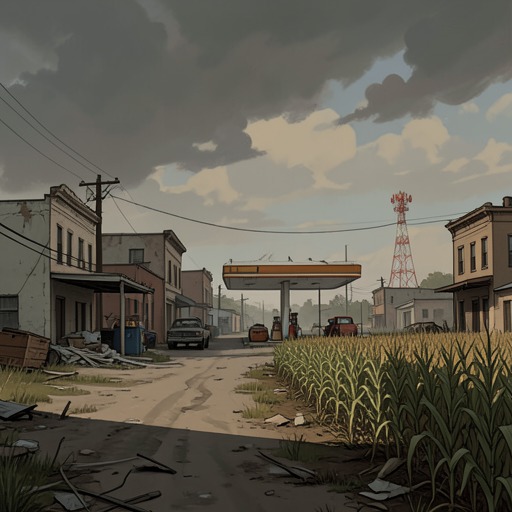
The religion marks ordinary routes through Gatlin with biblical language. Burt and Vicky pass a billboard declaring “ONLY JESUS SAVES,” followed by separate roadside signs spaced roughly eighty feet apart that spell out “A…CLOUD…BY…DAY…A…PILLAR…OF…FIRE…BY…NIGHT.” Another sequence invokes eating at the Lord God’s command. These public messages turn the road into a procession of religious statements; they also make the surrounding landscape difficult to separate from the town’s belief system. Gatlin itself appears below a rise as a small, three-block town, while cornfields press close to the road beyond its edge.
A church gives the faith an institutional setting, but its Christian appearance does not make its doctrine conventional. Burt finds a book whose cover bears the injunction “THUS LET THE INIQUITOUS BE CUT DOWN SO THAT THE GROUND MAY BE FERTILE AGAIN SAITH THE LORD GOD OF HOSTS.” The words connect religious punishment to the fertility of the land, making the faith’s agricultural logic explicit. The church is therefore not merely a sign of ordinary civic worship: its texts point toward the same crop-centered system that Burt is beginning to uncover.
A corn-kernel crucifix makes that system portable. Vicky finds it in a suitcase: a dry corn-husk cross supports a small cob, most of whose kernels have been removed so that the remaining yellow kernels form a human figure. Four raised letters, INRI, appear above it. The object combines Christian iconography with corn as its material and sacred medium. After Isaac’s pronouncement, the girls make many such crucifixes to ward off further evil, so the object’s significance shifts from a curious artifact to a repeated practice of protection within Gatlin’s belief system.
Sacrifice and the age rule
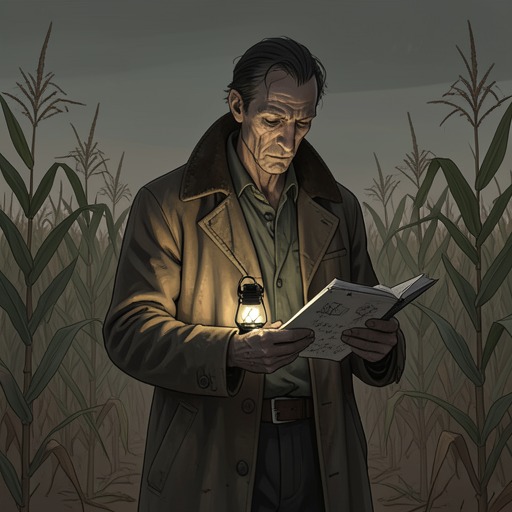
Burt pieces together the religion’s violent origin while examining a child-written record in the church. He reasons that in 1964 Richard Deigan, who took the name Amos, and other young people became religious and killed their parents. He further supposes that Amos and his companions connected the possibility of a dying crop with sin and insufficient sacrifice. The record’s dates lead Burt to suspect that Amos himself was sacrificed on his nineteenth birthday, September 4, 1964. These conclusions are presented as Burt’s interpretation of the evidence, but they explain how an act of rebellion against the adults could become the basis of a continuing religious order.
The resulting Age of Favor requires people to enter the corn when they reach nineteen. Burt’s account links that limit to Amos’s nineteenth birthday and to the later dates of other Gatlin residents approaching the same age. The rule makes a calendar milestone a sentence of religious obligation: members of the community are expected to surrender their lives to preserve the deity’s favor. The cornfield’s ritual clearing is the designated place of killing, distinct from the surrounding rows but enclosed within the same sacred landscape.
The rule changes after Burt’s arrival. Isaac, a nine-year-old serving as the Seer since the corn took David a year earlier, reports a dream in which the deity condemns the sacrifice being attempted and declares that it has completed the sacrifice itself. Isaac compares the judgment to the Blue Man and a false minister who escaped many years before. He then announces that the Age of Favor is lowered from nineteen plantings and harvestings to eighteen. The change is not a repudiation of sacrifice: it tightens the rule, bringing younger people within its reach and extending the faith’s authority over the town.
Community and aftermath
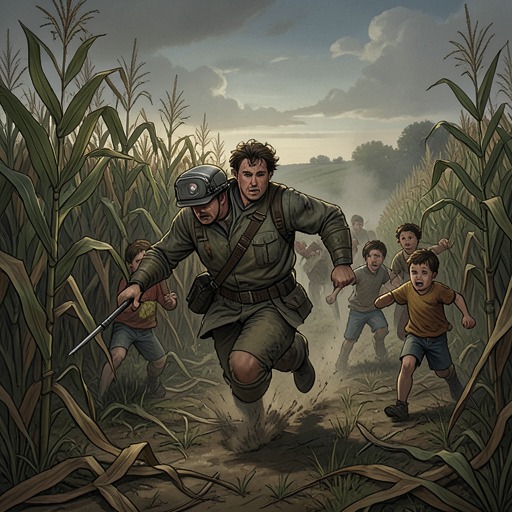
Isaac’s revelation is treated as binding. The assembled children respond with dread, and attention turns to Malachi and Joseph, the two eighteen-year-olds present. Malachi says that he obeys the word of God. That night, everyone now above the newly lowered age walks silently into the corn and toward the clearing to seek the continuing favor of He Who Walks Behind the Rows. The rule’s enforcement thus appears not as an isolated ceremony but as a collective movement from town into the fields.
The departure also exposes the human cost of the system through Ruth’s farewell to Malachi. Pregnant with his child, she calls goodbye as he walks into the corn without turning. Her grief coexists with fear of the fields and a private hatred of the crop that governs her community. She sometimes dreams of returning with torches when the stalks are dry in September, yet fears the being that watches from within the corn. Her response shows that the faith’s power does not depend on universal devotion: fear and resentment remain, but neither frees her from its reach.
The ending gives the landscape the last word. As night deepens around Gatlin, the corn rustles and whispers, and the narration describes it as well pleased. That closing image places the deity’s apparent satisfaction alongside the community’s submission, leaving the crop not as a passive object of worship but as the story’s final presence. Gatlin's corn religion has transformed the fields into a system of belief and rule whose claims extend from the highway signs to the clearing, and whose changing age limit ensures that its demands continue.