Abandoned Threewells
Cinnamon BunAbandoned Threewells describes the ghost-town condition of Threewells after its human-sized population vanished without leaving bodies or a clear explanation. The settlement remains materially legible—fifteen roofs, chimneys, homes, workshops, and a wall enclosing the town—but socially empty, fire-scarred, water-damaged, and haunted by violent spirits. Its abandonment is therefore not simple absence: it is a crisis of missing history, preserved in buildings that still suggest everyday lives while undead guardians make investigation dangerous.
A Small, Damaged Human Settlement
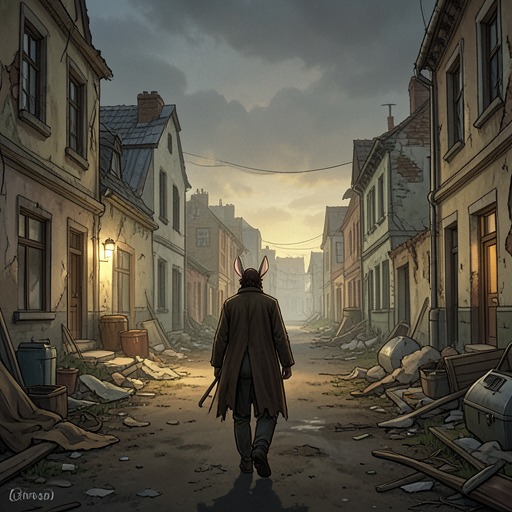
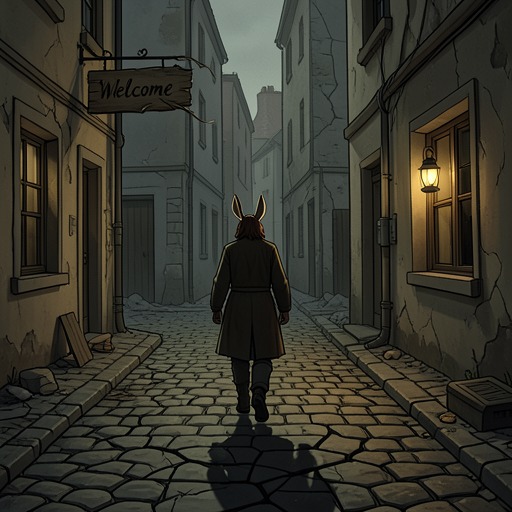
Threewells is first seen from above as a modest town of roughly fifteen roofs. Most buildings stand slightly below the narrator’s position and require patchwork; several bear the marks of an old fire, with exposed timbers showing through missing roof tiles. A tall wall circles the settlement, and another tower stands at the opposite end, giving the place the character of a fortified outpost rather than an entirely open village. The architecture also establishes its former inhabitants as human-sized. Clay-red shingles, chimneys, and the absence of wires between homes place the town within a comparatively old, pre-modern material culture.
The lower level of the surrounding structure intensifies the impression of arrested decline. Soggy papers have decomposed into mulch, stains may be blood, and fire damage appears throughout the interior. An arched exit that once opened toward the village has collapsed, sealing the route beneath rubble. The ruin is not an empty scenic backdrop: its blocked passage physically joins the town’s failed infrastructure to the supernatural threat trapped inside it.
Evidence of Sudden Departure
The abandoned homes preserve fragments of ordinary life without offering a final account of what happened. Threewell’s houses contain small dining rooms, fireplaces, and quaint furniture. One holds a delicately twisted wooden cradle that has survived the passage of time; another contains a little library whose leather bindings may once have belonged to books. A blacksmith’s house retains scattered hammer heads and a cracked anvil repurposed as a coffee table. These details make the disappearance intimate without making it explainable: domestic routines are visible, but the people who performed them are gone.
No bodies are found. Instead, the town displays signs that its residents left in a hurry, while valuable objects remain behind—items too heavy or complicated to carry during a hurried evacuation. Possible explanations include sickness or the exhaustion of a local mine, but the physical evidence supports neither conclusion decisively. The absence of bodies and the survival of possessions turn Threewells into an unresolved historical problem. Its strongest testimony is negative: whatever forced the inhabitants away did not leave a conventional massacre scene, and the settlement’s emptiness cannot be reduced to ordinary economic decline.
The Ghosts and the Threat Beneath the Ruins
The town’s most immediate inhabitants are ghosts. A skeleton trapped beneath stones in the collapsed entrance makes the first uncanny encounter especially concentrated: the stranger’s glowing eyes, wavering head and neck, and futile movement reveal both helplessness and menace. Elsewhere, the narrator encounters repeated attacks from spirits. One ghost seizes the narrator’s face, claws digging into the back of the head and cheek, before cleaning magic shoots into it and causes it to burst apart.
The violence becomes a pattern rather than an isolated haunting. After killing a third ghost, the narrator holds Bonesy close and reacts with distress that three attempts at a friendly request have been answered only with murder and hostility. This contrast between the narrator’s desire for communication and the ghosts’ automatic aggression defines Threewells as a place where social contact has broken down completely. The residents are absent, but their hostile remnants still police the streets, homes, and thresholds.
The narrator gradually adapts by circling each house with a Bonesy-maul and a fire poker before attempting entry. Unlocked doors suggest that the former residents had been unusually trusting, while locked doors yield to a kick near the handle. After several cautious explorations without seeing a ghost, the narrator walks more upright and finds that the remaining spirits no longer inspire the same fear. Threewells thus transforms danger into routine: repeated exposure and cleaning magic make the haunted town investigable, though never fully safe.
Dungeon Context and Wider Borderlands
Threewells is connected to a larger supernatural geography. Reports mention major mana shifts, concern that a dungeon core may have been damaged, and a possible sighting of Imperials in the surrounding forests. The narrator’s account of an “evil hole” is later identified by Leonard Chand’nuit as likely the entrance to a young dungeon, and Arianne confirms that a mana surge was felt. Leonard also raises the possibility that the dungeon may have been destroyed after the narrator’s departure, though he stresses that such a feat would not be easy. The town’s abandonment therefore intersects with dungeon activity, unstable mana, military suspicion, and competing attempts to interpret the frontier.
The surrounding landscape places the settlement within a layered borderland rather than an isolated ruin. From a later plateau, the narrator can look over Darkwoods, marshes to the east, mountains to the north, and what may be a huge lake to the south. Other fortified or abandoned sites echo Threewells’s condition: Fort Frogger contains undead, including grenoil skeletons and a skeleton knight, while regional politics are shaped by the United Republic of the Trenten Flats’ attempted invasion of Deepmarsh and by the military use of primitive weapons and fortified cities. In this setting, a deserted human town can be read simultaneously as a failed community, a strategic position, a resource frontier, and a warning about forces that exceed ordinary settlement control.
Narrative Significance
Abandoned Threewells makes history visible through domestic remnants and damaged architecture while withholding the single explanation that would organize them. The cradle, library, blacksmith’s tools, collapsed gate, burnt roofs, and absent corpses all preserve different scales of time: personal life, local labor, civic defense, sudden flight, and supernatural aftermath. The town’s physical structure promises that it can be read, but its ghosts interrupt every attempt to treat it as a passive archaeological site.
The state also establishes cleaning as more than a practical skill. Cleaning is explicitly defined as the ability to clean, with improvement tied to rising skill rank, yet cleaning magic becomes the force that destroys attacking ghosts. In Threewells, the language of maintenance and the violence of purification overlap. The settlement is dirty, ruined, and contaminated by undead presence, but restoring order requires confronting and annihilating what remains of its former population. That tension gives the ghost town its decisive significance: Threewells is both a place awaiting exploration and a community whose unresolved disappearance has been converted into a dangerous, repeatedly cleared frontier.