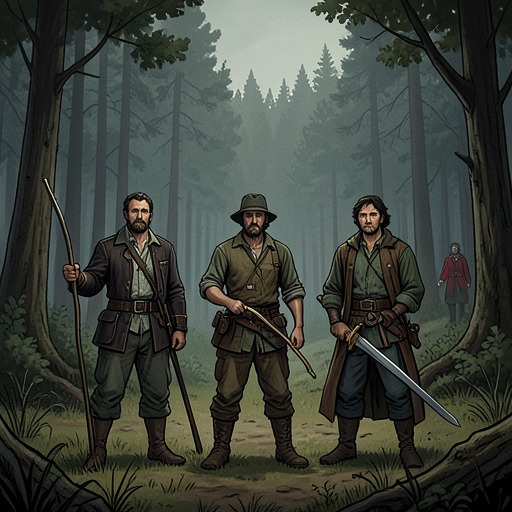
Appeal to Gunther
Cinnamon BunAppeal to Gunther is the decisive rescue action that transforms Broccoli Bunch’s failed pursuit of Amaryllis into a coordinated mission. Arriving at Fort Frogger injured and unable to track the abductors, Broccoli does not ask for safety or an escort home; the request is specifically for Amaryllis’s rescue. Gunther’s reluctant agreement brings Throat Ripper into the pursuit, but the bargain also leaves Broccoli indebted and forces the rescue to proceed through an uneasy exchange of obligation, loyalty, and violence.
Crisis Before the Appeal
The appeal begins after the attack at the bridge has reduced Broccoli’s options almost to nothing. The tracks suddenly end between muddy hoofprints, while Broccoli’s broken wrist sends pain through the body with every movement. The physical damage is severe enough to make returning difficult, yet the more urgent fact is that Amaryllis has been taken and the kidnappers have vanished. Broccoli turns back toward the still-visible bridge rather than abandoning the search, making the decision to seek outside help an act of necessity rather than convenience.
Broccoli reaches the fort in the company of skeletal knights who remain unmoved by the arrival. The journey has left the body covered in aches that two healing potions have not cured, and the final potion is being reserved for Amaryllis. This detail gives the appeal its practical stakes: Broccoli arrives without full physical strength, without a usable trail, and without treating personal recovery as the priority. The rescue demand is made from a position of vulnerability, but it is also shaped by a clear refusal to leave a friend behind.
The Request at Fort Frogger
At the door, Broccoli calls for Gunther and asks for help. Gunther initially appears unamused, standing beside Throat Ripper, but his expression changes when he sees Broccoli’s condition and invites the injured visitor inside. Broccoli explains that Amaryllis was taken during the attack at the bridge. Gunther first interprets the possible request as an escort back to Green Hold and offers a pair of skeletons as a deterrent, but Broccoli corrects him: the purpose is to find and save Amaryllis, not merely to return safely.
Gunther challenges the request by pointing out that Broccoli has already lost against the attackers and asking what could make a second attempt different. Broccoli has no tactical answer. The justification is emotional and relational: Amaryllis is a friend, and Broccoli has to save her despite not knowing where the abductors went. The absence of certainty makes the appeal more revealing, not less. Broccoli is acting without a reliable plan because the bond itself has become the necessary reason to continue.
Gunther eventually agrees that they can assist. Broccoli responds with immediate relief, embracing him and repeating thanks, while Gunther handles the sudden intimacy awkwardly and pats Broccoli’s head as though Broccoli were Throat Ripper. The response briefly changes the scene from negotiation to trust, but Gunther immediately restores its transactional structure by clarifying that Throat Ripper will do the assisting and that the help will not be free.
The Rescue Pact and Its Cost
Gunther warns Broccoli not to make open-ended promises and defines the arrangement as a favor in return for assistance. He does not specify the favor immediately, saying only that Broccoli must return to Fort Frogger to learn what will be required. Broccoli accepts without hesitation because the possibility of Throat Ripper’s help makes finding Amaryllis seem attainable. The pact therefore carries two simultaneous meanings: it is a practical rescue agreement, and it is a new obligation whose terms remain concealed.
The arrangement also establishes Gunther’s role as a gatekeeper to force Broccoli cannot provide alone. Broccoli cannot track the abductors, cannot rely on the injured body, and has already been defeated by them. Throat Ripper’s participation supplies the missing capacity, while Gunther retains control over the price. The rescue is consequently neither a simple gift nor a purely heroic solo act. It is a relationship forged under pressure, with gratitude immediately bound to debt.
Pursuit, Killing, and Moral Consequences
The agreement leads to the pursuit of the cervid kidnappers. The movement toward them is deliberately slowed, giving the adversaries time to prepare an attack while also giving Broccoli time to breathe and to bury, temporarily, what has already happened. During the encounter, the system announces that Titan and Rex have been killed. Titan is identified as a level-twelve Wind Runner with a level-four Wind Tear, while Rex is a level-ten Flaming Lancer; because Broccoli was not the primary combatant, the experience reward is reduced, although a bonus is granted for killing someone above Broccoli’s level.
The mechanical announcement clashes with Broccoli’s moral response. The prompt disappears, but the deaths do not. Broccoli thinks of Titan and Rex as two people who will not return home, see their families, or spend more time with their friends, and understands the deaths as something Broccoli caused. The body reacts with difficulty breathing and a heart that seems unable either to race normally or to settle. The rescue action thus produces a second crisis: the external danger is being answered, but the victory converts Broccoli’s determination into guilt and self-condemnation.
Broccoli asks to speak when the group arrives and hopes there may still be a chance to negotiate, apologize, or offer something to the dead men’s friends. The request shows that Broccoli has not assimilated the system’s language of experience, levels, and rewards as an adequate account of killing. The slow approach gives the cervids time to prepare, but it also allows Broccoli to mourn two men whose names are known while their faces remain unknown. The rescue pact succeeds in moving the plot forward, yet it leaves a permanent moral burden in its wake.
Amaryllis’s Reframing and the Result
After Amaryllis is recovered, Broccoli confesses that people were killed. The admission is not presented as a triumph over the mercenaries but as an accusation directed inward. Broccoli pulls away from Amaryllis’s hug, believing that someone who has killed does not deserve comfort. This reaction makes the appeal’s deepest consequence psychological: saving a friend has forced Broccoli to confront a self-image that no longer fits the earlier insistence that no one should die.
Amaryllis rejects Broccoli’s condemnation. She identifies Titan and Rex as mercenaries who attempted to kidnap her and describes the act of killing them as removing weeds rather than committing an unforgivable wrong. Her reasoning is bluntly practical and grounded in the targeted nature of the attack; Broccoli’s moral reasoning is absolute, insisting that wrongdoing by the victims does not make killing acceptable. The disagreement does not erase Broccoli’s grief, but it prevents guilt from becoming the final interpretation of the rescue.
Amaryllis finally calls Broccoli an idiot and embraces the friend who compromised personal convictions to save her, even suggesting through her tightened grip and possible sob that the sacrifice has affected her deeply. Broccoli falls back into the hug, and the physical contact supplies a form of immediate repair that argument alone cannot provide. The rescue ends not with a clean heroic reward but with a damaged return toward Green Hold: Amaryllis is alive, Broccoli has secured an unresolved debt to Gunther, and the experience of killing remains something Broccoli will have to mourn and process. In that combination of successful rescue, concealed obligation, and moral injury, Appeal to Gunther marks the point where friendship becomes both Broccoli’s strongest motive and the source of the heaviest cost.