Bonesy
Cinnamon BunBonesy is an unnamed skeleton found trapped beneath the rubble of a collapsed archway in abandoned Threewells. Initially a frightening and apparently helpless undead creature, he becomes Broccoli Bunch’s first unmistakable magical companion: his severed head can bite a ghost, his remains can be carried and buried, and his final ghostly appearance identifies him as Bonesy, Skeletal Bard, level 3. His story turns cleansing from a mechanical combat technique into a personal promise of recognition, dignity, and release.
Identity and Introduction
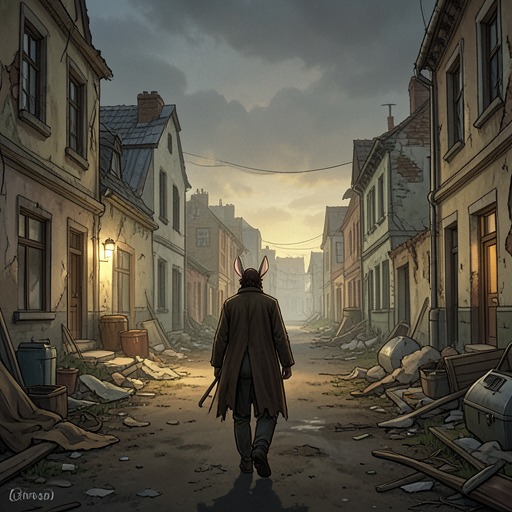
Bonesy is discovered on the lowest floor of a ruined building whose old exit once led into the village. The room is marked by soggy papers, stains, evidence of fire, a damaged flag, and a hole opening onto rows of beds and chests. Beneath the collapsed doorway, the skeleton is pinned by several stones. One arm is free but cannot help him escape; his glowing eyes remain fixed on Broccoli Bunch, while his head and neck wobble and his speech consists of rough undead sounds.
The encounter is frightening, but Broccoli does not leave the skeleton as an anonymous threat. After asking whether the creature is “mister or miss skeleton,” Broccoli chooses the name Bonesy, explicitly valuing it for being neutral with regard to both gender and life. The naming is an important change in status. The pinned body is no longer only part of the ruin or another hostile monster; it is an individual with whom Broccoli can speak, make promises, and later mourn.
From Trapped Skeleton to Ally
When a ghost attacks, Broccoli first tries ordinary objects from the ruined office. A bottle of wine passes harmlessly through the ghost and shatters against a wall, while a thrown chair leg is equally useless. The pinned skeleton appears unable to contribute until Broccoli picks up Bonesy’s head and throws it at the adversary with the command, “Bite him!” Bonesy’s skull flies through the air, clamps onto the ghost’s face, and begins chewing while producing his characteristic rawring sounds.
The improvised attack reveals that Bonesy is magical and that magic can affect ghosts. This discovery changes the immediate balance of the fight and also changes Broccoli’s understanding of the skeleton. Bonesy is not merely an obstacle to be rescued or a corpse to be avoided; his body itself is an enchanted instrument. The severed head, normally a sign of vulnerability and death, becomes a weapon precisely because Bonesy exists across the boundary between object and living companion.
Broccoli later continues working through the ruins with Cleaning, a skill described as the ability to clean and improve as its rank rises. The skill is not limited to household maintenance. Cleaning magic can strike undead enemies directly: when a ghost seizes Broccoli’s face, the spell shoots into it and causes the ghost to burst apart. This broader function places Bonesy within the same strange system that makes cleanliness both practical support and supernatural force, although Bonesy himself is not destroyed by Broccoli’s cleansing in the manner of an enemy.
Bardic Past and Cleansing
Evidence from the records of Well Inn Good suggests that Bonesy had once been a bard. One report describes an unnamed drunk bard being apprehended after beginning a brawl with local musicians over the quality of the music, with minor property damage assessed at two sil and three cop. The bard was confined overnight until sober. Broccoli wonders whether this recorded troublemaker might have been Bonesy long ago, connecting the skeleton’s crude vocalizations and later title to a social identity that predates his undeath.
Bonesy’s final release occurs when Broccoli uses magic to send “Bonesy. Skeletal Bard,” level 3, beyond the veil. The act grants bonus experience because the monster is above Broccoli’s level, but the numerical reward is immediately overshadowed by the personal farewell. A ghostly form emerges from the skull, first as a head and suggestion of shoulders and then as a man’s face. The apparition thanks Broccoli in a whisper before fading away.
The release is followed by deliberate burial. Broccoli lowers Bonesy’s remains into a grave wrapped in the cloth of a banner found in the guard tower. Dirt fills the hole, the grave is patted down, and a gravestone is made from a piece of a door, supported by a stick that had once been a spear and had saved Broccoli’s life. The reused materials join Bonesy’s death to the history of the ruined settlement: public insignia, shelter, weapon, and burial marker are transformed into a modest memorial for an individual who had otherwise been left beneath rubble.
Relationships and Boundaries
Bonesy’s central relationship is with Broccoli Bunch, beginning with Broccoli’s decision to name him and continuing through rescue, combat, companionship, cleansing, and burial. Broccoli promises to return after leaving the pinned skeleton and later fulfills that promise. Their connection is reciprocal even though Bonesy communicates mainly through variations of “Rr” and “Rarr.” Broccoli interprets those sounds as agreement, and Bonesy responds physically and magically when the danger becomes immediate.
Their relationship also complicates the boundary between friend and monster. Broccoli’s Cinnamon Bun class defines its bearer as a supportive and friendly presence who should cleanse the world’s impurities in the name of love and justice. Bonesy’s body appears to embody the contradiction within that mission: he is visibly skeletal and undead, yet he acts as an ally, responds to a chosen name, and possesses a history as a bard. The same cleansing power that destroys hostile ghosts can instead become the means of granting Bonesy peace.
The broader world treats undead with suspicion, although Bonesy’s own fate is shown before that social judgment is fully articulated. Later, Gunther explains that classes associated with undeath are poorly regarded because of superstition or because death mana can damage a region if left too long. Gunther and Throat Ripper travel from place to place, finding quiet areas in which to settle for roughly a decade before moving on; skeletons are easy for Throat Ripper to dig up. This context makes Bonesy’s treatment especially significant. Broccoli does not reduce an undead being to contamination or utility, even while using the magical properties of his bones.
Change and Narrative Significance
Bonesy’s arc moves through four distinct states: anonymous obstruction beneath the rubble, named companion, magical combatant, and released bard. His physical condition never becomes conventionally whole; instead, the narrative changes the meaning of his fragmentation. A pinned skeleton becomes a speaking presence, a detached skull becomes a successful weapon, and a skull containing a fading face becomes the vessel of a final human acknowledgment.
His story also establishes several rules of the world through concrete action. Magic works on ghosts, Cleaning can function offensively, a monster can possess a class and level, cleansing can send an undead being beyond the veil, and doing so can award experience even when the act is framed as mercy. Bonesy therefore links system mechanics to ethical choice. The experience reward is real, but the scene’s emotional resolution lies in the whispered thanks and the grave that follows.
As a character, Bonesy gives Broccoli’s ideal of friendship a material test. The Cinnamon Bun class presents purity in exaggerated, almost smug terms, and Broccoli is aware of being naive, yet the Bonesy encounter shows that this naivety can become attentiveness rather than weakness. Broccoli asks who the skeleton is, gives him a name, returns for him, recognizes his usefulness without reducing him to it, and makes certain that his ending includes remembrance. Bonesy’s decisive role is thus not only to help defeat a ghost: he teaches the protagonist that cleansing can preserve a person’s dignity while ending the condition that has trapped them.