Cervid Ambush
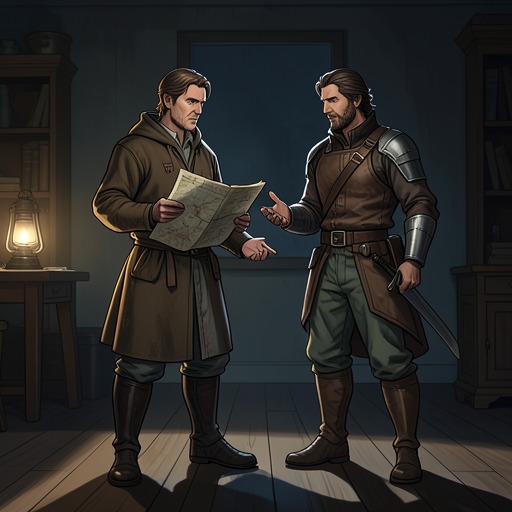
Cinnamon BunThe Cervid Ambush is a planned attack on a small stone bridge during Broccoli Bunch and Amaryllis’s journey away from Fort Frogger. Six armed Cervids surround the travelers, demand their surrender, and reveal that Amaryllis—not merely their equipment—is the true target. Broccoli refuses to abandon her, and the confrontation becomes a rescue battle whose immediate victory carries an unexpected cost: the deaths of Titan and Rex leave Broccoli convinced that saving a friend has made him morally culpable. The event therefore joins an external kidnapping attempt to an internal crisis about violence, responsibility, and friendship.
Causes and Setting
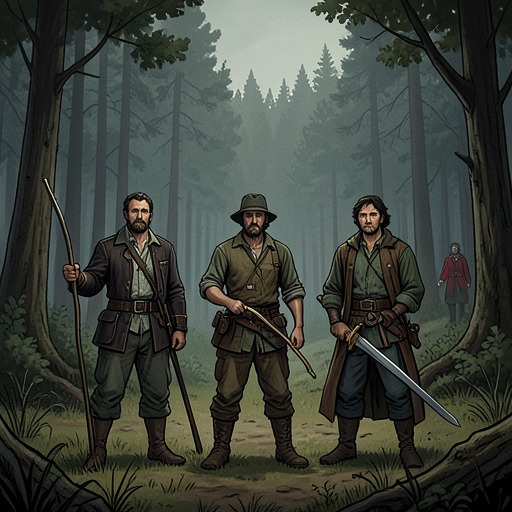
The ambush occurs after Broccoli Bunch and Amaryllis leave the fort and travel downhill through wet, difficult country. The fort stands at the end of a chain of hillocks, while mud and swampland spread around it; the terrain is so unsuitable for conventional fighting that Broccoli cannot imagine an army campaigning there. Their route reaches a shallow river crossed by a small stone bridge. Marks on the banks suggest that the river is unusually dry, yet the parched trees and surrounding marsh make the prospect of a wet season threatening. The bridge consequently functions as a natural choke point: a confined crossing in a landscape where movement is already difficult. The attack begins while Amaryllis is answering Broccoli’s questions about growing up as a harpy. The deadened trees’ shadows shift, and three deerlike humanoids step onto the path ahead. Amaryllis identifies them as Cervids; when the pair look behind them, three more are visible. The attackers have therefore used the bridge and the surrounding trees to close both directions of retreat before announcing themselves. Their appearance is not that of improvised bandits. They are tall, horse-shaped beings with long bodies and humanlike torsos, dressed in loose clothing, helmets, and padded garments that cover their bodies. Their equipment is uniform, with matching materials and cuts, and thin orange lines mark their shoulders.
Demand and Participants
The middle Cervid in the group ahead orders Broccoli Bunch and Amaryllis to drop all weapons and equipment and kneel. Amaryllis immediately understands the danger. She produces her knife-wand, which crackles with an electric hum, and instructs Broccoli to cover the rear. Broccoli removes his backpack, draws his shovel, and uses Insight to assess the three Cervids behind them. The revealed opponents include a confident Cervid Lancer, a confident Cervid Runner, and a bored Cervid Plains Speaker; Broccoli judges them strong and suspects that the leader in front is stronger still. The attackers’ coordination makes their military character increasingly apparent. The leader assigns them by numbers, ordering “Five, Six” to take the secondary target and “Two, Three, Four” to accompany the leader against the primary. The numbers appear to be names or code names, while the matching armor and equipment suggest a disciplined unit rather than a random gang. Broccoli wonders whether they are soldiers, but the attack gives no time for a civil inquiry. Amaryllis tells him that he should run because she is the person the Cervids want. Her warning identifies the central stake: the encounter is a targeted attempt to seize Amaryllis, with Broccoli caught beside her. Broccoli refuses. He has Orange emerge from Amaryllis’s shirt, floating at shoulder height beside him, and then addresses the assembled Cervids by name, explaining that he and his friend are traveling through the area and apologizing if the bridge belongs to them. The gesture briefly offers a peaceful alternative, but the leader responds by ordering the group to break formation and attack. Broccoli’s decision converts the ambush from a possible surrender or negotiation into a deliberate act of resistance on Amaryllis’s behalf.
Course and Immediate Outcome
The ambush follows the structure of a rescue conflict: the Cervids are the aggressors, Amaryllis is the intended captive, and Broccoli, Orange, and their allies become the force preventing her abduction. The six attackers divide their attention between a primary and a secondary target, while Amaryllis prepares to fight with her electrically charged knife-wand and Broccoli stands between the threat and the route of escape. The bridge, the river, and the marsh restrict the field, making the Cervids’ numerical advantage and coordinated positioning especially dangerous. The fighting eventually produces a result that the system records in starkly mechanical terms. Broccoli receives a notification that Titan, identified as a Wind Runner at level 12 with Wind Tear at level 4, and Rex, identified as a Flaming Lancer at level 10, have been killed. The notification grants bonus experience because they were above Broccoli’s level, but reduces his reward because he was not the primary combatant. The advancement language clashes with the human consequence: the same event that registers experience and class-related progress also confirms that two people will not return home.
Moral Injury and Aftermath
Broccoli’s first response to the notification is a whispered denial. The accusation attached to the prompt disappears, but its disappearance does not relieve him. He imagines Titan and Rex as men with families and friends, even though he never knew their faces, and understands their deaths as something he caused and something that took everything from them. His breathing becomes difficult, his heart seems unable to settle, and his sense of self turns against him. The battle’s danger has passed, but its psychological consequences begin only afterward. Broccoli asks to speak when they arrive, hoping for a chance to negotiate, apologize, or at least offer an apology to the attackers’ friends. The skeletons allow him to set the pace while moving in a wedge behind him, giving the Cervids time to prepare another attack. That delay becomes a form of recovery. Broccoli uses the journey to breathe and to bury, if only shallowly, what he believes he has caused. He remembers his mother’s instruction not to hide his feelings about the world, so he openly mourns two men whose names he knows but whose faces will probably remain unknown to him. The ambush thus produces grief without familiarity: mourning is grounded not in personal history with the dead, but in recognition of their humanity. The crisis is finally spoken aloud when Broccoli tells Amaryllis, “I killed people.” He has difficulty organizing the account, recounting his search for her, his appeal to Gunther, and the deal that led to the confrontation in a rush rather than a cleanly linear narrative. His confession exposes how the event has altered his moral understanding of himself. Even after Amaryllis embraces him, he pulls away because he believes he does not deserve comfort. Amaryllis challenges that condemnation. She identifies the attackers as mercenaries who tried to kidnap her and argues that Broccoli’s act was not senseless murder but the removal of a threat. Her language reduces the mercenaries to weeds and points to the system’s confirmation that Broccoli gained a level. Broccoli rejects that justification, insisting that the fact that the attackers were doing something wrong does not make killing acceptable; for him, no one should die, and killing people remains wrong. The disagreement preserves the seriousness of his moral position rather than allowing the victory to become uncomplicated. Amaryllis nevertheless kneels to meet Broccoli’s eyes, calls him an idiot, and hugs him. She describes his willingness to compromise himself for someone like her as both foolish and deeply meaningful, tightening the embrace so that she may be sobbing as well. Broccoli cannot immediately decide what he feels, but he falls into the hug and holds his friend close. The embrace does not erase his grief—he still expects to cry properly later—but it makes functioning possible. Amaryllis then ends the hug and redirects them toward Green Hold, restoring a practical objective without denying the wound.
Narrative Significance
The Cervid Ambush combines a classic rescue plot with a reversal in which success becomes a source of suffering. Broccoli’s refusal to leave Amaryllis behind is the decisive moral action: he chooses loyalty over safety, and that choice helps defeat the immediate threat but forces him to confront the consequences of lethal violence. The event also clarifies the Cervids as an organized, uniformed force and establishes that Amaryllis’s presence is connected to a deliberate kidnapping attempt rather than incidental roadside danger. Its deepest significance lies in the contrast between external judgment and internal judgment. The system treats Titan and Rex’s deaths as an experience-bearing combat result, even awarding bonus experience for defeating higher-level opponents. Broccoli experiences the same outcome as a condemnation of his identity. Amaryllis’s response does not simply declare him innocent; it recognizes the attackers’ culpability while offering relational support against his self-destruction. The ambush therefore changes the value of friendship without making it sentimental: friendship is what Broccoli refuses to abandon, what places him in danger, and what ultimately gives him enough support to continue toward Green Hold while carrying the knowledge of what happened.