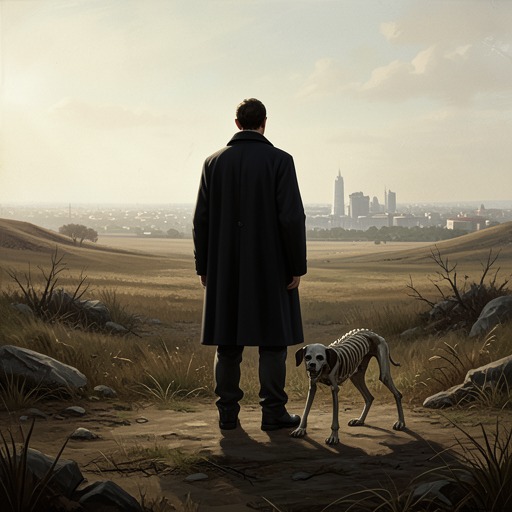
Cinderrun
Cinnamon BunCinderrun is the city where Gunther once lived as a well-regarded arts dealer before abandoning that identity to pursue the class change that produced his later existence and allowed him to bring back Throat Ripper, his one true companion. In the available evidence, Cinderrun is therefore less a mapped setting than a point of origin: it marks the respectable life Gunther relinquished and the personal loss that redirected him toward undeath, travel, and permanent social marginality.
Gunther’s Former Life
Cinderrun is identified through Gunther’s account of his past. Before becoming the figure encountered at Fort Frogger, he was an arts dealer with a good reputation there. That detail gives the city a civic and cultural dimension without specifying its streets, government, or architecture: Cinderrun is the place associated with Gunther’s standing among ordinary society and with the professional identity he had already established.
His departure from that life was deliberate. Gunther gave up his career in order to change his class, not because the evidence presents Cinderrun as destroyed or physically uninhabitable, but because his objective lay beyond the accepted limits of his former social world. The contrast between a respected dealer and a practitioner connected with undeath makes Cinderrun the clearest measure of what he sacrificed.
The Decision That Recast Its Meaning
The decisive motive behind Gunther’s transformation was the death of Throat Ripper. Gunther described Throat Ripper as his one true companion and said that he could not accept the cruelty of losing him. The class change undertaken after that loss enabled Gunther to bring Throat Ripper back, turning a private bereavement into the foundation of a new life.
This history gives Cinderrun a retrospective significance. It stands behind the pair’s later travels as the place from which Gunther’s self-imposed quest began, even though the quest itself carried him away from the city. The evidence does not establish that Cinderrun accepted or condemned his decision directly; instead, it shows the scale of the break through Gunther’s abandonment of his profession, his neighbours, and the family connections he did not value.
From Respectability to Exile
Gunther explained that classes with a penchant for undeath were generally poorly regarded. The reasons ranged from superstition to practical fear of what death mana could do to a region if it remained too long. His new identity consequently made settled social acceptance difficult, and he and Throat Ripper adopted a pattern of moving from place to place, staying in quiet areas for roughly a decade before leaving again.
Cinderrun thus functions as the opposite pole of the wandering existence associated with Gunther and Throat Ripper. The city belongs to the period before the pair became itinerant, while Fort Frogger represents only one temporary settlement in a continuing cycle. Gunther had been there for a year and change when the account was given, and the skeletons around the fort were easy for Throat Ripper to find and dig up; these later circumstances sharpen the distance between his former urban profession and his present life among the undead.
Narrative Significance
Cinderrun’s importance comes from what its brief mention reveals rather than from a developed local episode. The city supplies the lost background against which Gunther’s present character becomes legible: his polished past as an arts dealer coexists with his willingness to abandon status, livelihood, and stability for the sake of one companion. The location also connects personal grief to the wider social politics of mana and class reputation, since the act that restored Throat Ripper created a form of life regarded with suspicion wherever the pair settled.
The surrounding journey places Cinderrun within a broader frontier geography of abandoned towns, dungeons, forts, forests, marshes, and contested nations. Reports of large mana shifts and possible damage to a dungeon core, the description of a plateau overlooking the Darkwoods, marshes, mountains, and a distant lake, and the approach to the undead-held Fort Frogger all belong to the world through which the protagonists travel. Cinderrun itself remains offstage, but its remembered role is concrete: it is the city of Gunther’s former respectability and the starting point of the choice that made his later wandering life possible.