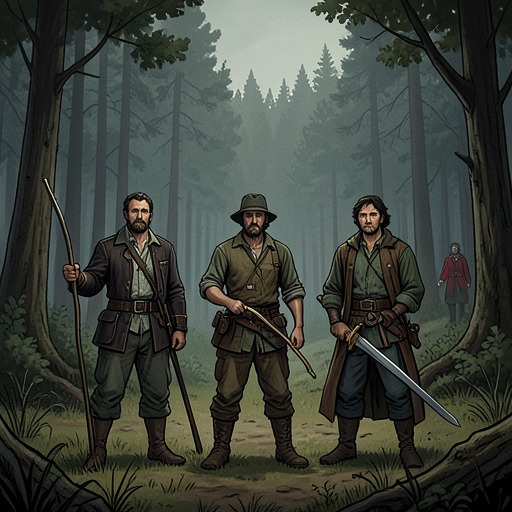
Deepmarsh
Cinnamon BunDeepmarsh is both a kingdom and the political landscape through which much of the journey is organized. It is introduced indirectly, first as the homeland of Severin and later as the state whose capital, borders, roads, ports, military history, and relations with neighboring powers shape the characters’ movements. Although the protagonist initially treats the name as another unfamiliar place on a badly understood map, Deepmarsh gradually becomes the setting’s central regional power: a kingdom of marshes, fortified settlements, contested borders, and interconnected systems of travel.
Definition and Geographic Frame
Deepmarsh is identified by Severin as the capital of the kingdom in which the travelers are currently situated. The revelation corrects the protagonist’s assumption that Deepmarsh might be merely a nearby town: it is the name of the kingdom itself, while the capital shares the kingdom’s name. Severin, an older Grenoil, states that he comes from Deepmarsh, making the place both a political center and a personal point of origin within the traveling group.
The kingdom’s territory reaches Port Royal, although Port Royal lies at the foot of the Harpy Mountains and is explicitly described as Deepmarsh territory rather than part of the Nesting Kingdom. This placement gives Deepmarsh access to a major commercial and transportation center at the edge of another people’s mountainous region. Port Royal receives expensive goods from Deepmarsh before they are shipped elsewhere and also takes in merchandise arriving from across the world, so Deepmarsh participates in a wider network of exchange through the port.
The surrounding landscape reinforces the kingdom’s name and character. From the plateau near the ruined settlement explored during the journey, the Darkwoods extend like a sea of trees, marshes lie to the east, mountains rise to the north, and a possible great lake can be seen far to the south. The protagonist does not establish that every one of these features belongs administratively to Deepmarsh, but the geography places the kingdom within a region where forest, marsh, mountain, and water constrain movement and make roads, escorts, and fortified crossings especially important.
Travel, Infrastructure, and Reach
Deepmarsh is experienced through movement rather than through a single prolonged visit to its capital. Milread works as a courier on a regular circuit from Port Royal to a frontier outpost, then to Fort Tempete and Deepmarsh, before returning to Port Royal. A round trip takes about two weeks. Her route shows that Deepmarsh is not an isolated swamp kingdom but part of a maintained circulation of messages, people, goods, and professional services.
The journey toward Port Royal also displays the unequal costs of access. Travelers can climb the entire switchback path on foot, pay three copper to ride in a carriage pulled by oxen with other passengers and cargo, or pay one silver, described as half a day’s work for an ordinary person, to use a cable car that ascends towers to the city proper. Port Royal itself is built across three large plateaus ending in sheer cliffs, with walls around them, towers cut into the eastern mountainside, and an actual port suspended over a chasm where bridges and airships occupy the space below.
Inside the city, narrow roads, overhead lines, cable cars, and extensive pipes produce a dense and noisy infrastructure. Some pipes carry water while others vent hot steam; clanking machinery and shrill whistles are part of the urban soundscape. These details make Deepmarsh’s territory legible as a place where magical or industrial systems do practical political work. Travel is not simply a matter of walking through wilderness: it is governed by roads, fares, vehicles, walls, air routes, and the infrastructure that links a frontier to a kingdom’s commercial centers.
A banking ring provides another example of this reach. Amaryllis explains that, for a transaction fee, a person can store possessions at a bank in any proper city, send a mana burst requesting free pen and paper, and have stored objects teleported to the ring. The device is not personal dimensional storage, but a beacon connected to an urban banking system. Deepmarsh’s cities therefore possess institutions capable of coordinating long-distance exchange, even though access to those systems is mediated by fees and the high markups charged on items sold through the ring.
Borders, War, and Political Tension
Deepmarsh’s most consequential historical relationship is with the United Republic of the Trenten Flats, described by Gunther as the largest nation on the continent. The republic is fiercely expansionist and regarded as a troublesome neighbor. Its attempted invasion of Deepmarsh occurred decades earlier, when a Trenten force entered the kingdom in numbers that outnumbered any army Deepmarsh could bring by three to one.
Gunther rejects the simple patriotic version of the conflict. The United Republic of the Trenten Flats can claim that Deepmarsh stopped the invasion, but Gunther considers the truth more complicated. The invading army was led by an inexperienced general, had too few scouts, and consisted largely of inexperienced soldiers. The marsh itself became a decisive force: swamps, untreated water, and insects weakened the army more severely than the organized resistance raised by Deepmarsh to defend its borders. Gunther still encounters bodies from that campaign, turning an old war from an abstract claim of national victory into a physical presence that remains in the landscape.
This history explains the hostility toward cervids and other people from the United Republic of the Trenten Flats. Gunther tells Broccoli Bunch that cervids are not welcome in Green Hold and advises that any rescue mission should return there rather than move toward the Trenten side. The prohibition is therefore connected to a remembered invasion and to current security concerns, even as the protagonist questions whether the treatment amounts to species-based prejudice. Deepmarsh’s border policy emerges as both a response to military history and a source of ethical discomfort.
The danger is not confined to official armies. When Amaryllis reveals that cervid mercenaries specifically targeted her, Gabriel recognizes the intrusion of cervids into this side of the border as evidence that they have found a way to cross without detection. The border patrols have not been especially effective, but the breach is still treated as serious news. Deepmarsh is consequently shown as a kingdom whose territorial boundaries are politically charged yet practically permeable, vulnerable to clandestine movement even when formal hostility remains intense.
Frontier Settlements and Dungeon Anxiety
Deepmarsh’s frontier contains settlements that are exposed to both supernatural danger and political uncertainty. At Threewells, Overseer Hardy records large shifts in local mana and worries that someone may have damaged the dungeon core. A guard rotation reports a person dressed in green moving through the forest, raising the possibility that the Imperials have reached this remote area. Hardy responds by doubling the guards and sending a scout to the Dunwich Dungeon. The report presents frontier governance as a continuous effort to distinguish local magical instability from outside interference.
The same anxiety later becomes part of the information exchanged around Threewells. Leonard identifies the so-called evil hole as the entrance to a young dungeon, while Arianne recalls that the group felt a mana surge. Leonard warns that someone may have destroyed the dungeon after the protagonist left, though he emphasizes that such an act would not be easy. Deepmarsh’s unsettled outskirts therefore connect national security to the condition of dungeon cores: shifts in mana may signal sabotage, destruction, or an alteration in the balance of power.
Fort Frogger provides a harsher image of the frontier. The fortress stands with its large wooden doors open, one door broken free from its metal hinges, while the courtyard is occupied by undead creatures, chiefly Grenoil skeletons, along with horse-bodied monsters and two armored Skeleton Knights guarding the entrance. The ruined or captured fort illustrates how quickly a defensive structure can become a hostile threshold. It also places Deepmarsh’s political geography beside the supernatural dangers that make ordinary travel resemble military reconnaissance.
Narrative Significance
Deepmarsh is revealed through accumulated corrections, routes, warnings, and infrastructure rather than through a single explanatory description. The protagonist repeatedly discovers that an apparently local reference points to a larger system: Deepmarsh is not a nearby town but a kingdom; Port Royal is not simply a port but a Deepmarsh possession at the foot of the Harpy Mountains; a courier’s itinerary is also a map of regional integration; and a border dispute is also the afterlife of an invasion.
The kingdom’s significance lies in this tension between connection and exposure. Cable cars, airships, banking rings, couriers, and guild routes bind Deepmarsh to distant places, while marshes, forests, ruined forts, dungeons, and porous borders make that connected territory difficult to secure. Even the airship journey expresses the same instability: an engine failure leaves the Shady Lady drifting after its motor explodes, sends the propeller away, and opens a hole in the cabin. Deepmarsh is thus not merely a backdrop for travel. It is a landscape in which movement depends on elaborate systems, while every system remains vulnerable to terrain, conflict, magical disruption, and the failures of those charged with maintaining it.