Dunwich
Cinnamon BunDunwich is the site of a dungeon that was destroyed long before Broccoli Bunch reaches it, yet its destruction does not make the place empty or harmless. The ruined settlement remains marked by negative mana, damaged buildings, a scorched underground entrance, and a level-eight Dunwich Abomination that emerges from the former dungeon. Dunwich therefore functions as both a historical absence and an active threat: a place where exploration, resource gathering, military suspicion, and the unfinished consequences of dungeon destruction meet.
History and Frontier Setting
Dunwich is introduced as a former dungeon near Rockstack that had been rediscovered by the people living in the region. According to the account given to Broccoli Bunch, the dungeon had been destroyed long ago, but negative mana still lingered around the area, making it unwelcoming to most travelers. Apparitions remained among the ruins, and the site was considered dangerous even though it was not thought to be overwhelmingly hazardous. The area nevertheless offered a valuable resource: the Two-Lipped Tulip grew there, giving the ruined place a practical role in local gathering and expedition work.
The site also belongs to a broader landscape rather than standing apart from it. From the plateau, Broccoli Bunch can see the Darkwoods spreading like a sea of trees, marshes to the east, mountains to the north, and what may be a huge lake far to the south. This elevated view makes Dunwich legible as a frontier position: a place from which distant regions, routes, and possible territories can be surveyed, even while the ruins themselves remain isolated and unstable.
Dunwich is also connected to the political tensions of the wider continent. Reports from Threewells describe major mana shifts and concern that someone may have damaged a dungeon core; the possibility of Imperials moving through the nearby forests raises the fear that military activity is responsible. Later discussion places these anxieties against the expansionist United Republic of the Trenten Flats and its failed invasion of Deepmarsh. Dunwich is not explicitly identified as a battlefield in that history, but its position amid contested borders and suspected military movements gives the ruined dungeon a significance beyond local haunting.
The Ruined Settlement
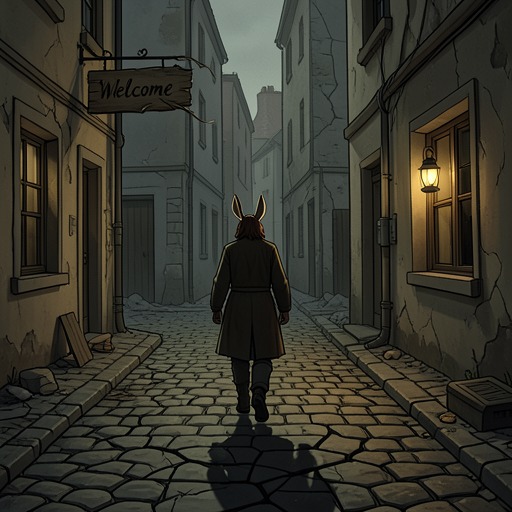
Broccoli Bunch approaches Dunwich through a group of surviving structures. Several buildings still stand despite the passage of time, including wooden shacks with tiled roofs resembling the buildings of Threewells and a much larger corrugated-tin construction with a rusty metal roof and heavy streaks of grime on its sides. The remains suggest that Dunwich was once an inhabited and organized settlement rather than merely an entrance in the wilderness.
One damaged building contains two offices at the front and a small clinic farther inside. A tall bed, rusty tools, broken tables, desks, and chairs remain scattered through the interior. Footprints across the dusty floor imply that the destruction may have occurred more recently than the apparent age of the ruins suggests, and Broccoli Bunch considers whether adventurers from Rockstack might have been responsible. The clinic is especially revealing: it turns the ruins into evidence of former civilian or expeditionary life, while its abandoned equipment records the material cost of whatever ended Dunwich’s functioning community.
The upper floor leads to the tower proper and provides Broccoli Bunch’s first view of the former dungeon. Its entrance resembles a mining shaft, a deep, dark opening cut into a rocky outcropping and framed by rough wooden beams. The beams are scorched black, as though something exploded outward from the hole. Fire has blackened the ground around the entrance, and the sparse vegetation nearby has become skeletal and dead. The dungeon is therefore represented not by a sealed, inert ruin but by a wound in the landscape whose effects remain visible in architecture, soil, and plant life.
The Dungeon and Its Monster
The apparent safety of the site collapses when a monster waddles out from behind a rock near the dungeon entrance. It is roughly the size of a large dog, but its body has seven feet, three arms ending in long-fingered hands, and a mouth extending from the place where a nose should be to the upper chest. Long tentacles emerge from that opening, while the creature’s pale skin peels away as it rubs against stone.
The creature is identified as a hungry level-eight Dunwich Abomination. Its physical form makes the former dungeon’s corruption visible: it is assembled from distorted animal resemblance, exposed appetite, damaged flesh, and unstable anatomy. The threat becomes greater when it notices Broccoli Bunch. Its skin shifts to match the stones behind it, making it nearly impossible to see from a distance before it begins wobbling toward its prey. Dunwich’s danger thus depends not only on what remains inside the ruined entrance, but also on the site’s capacity to conceal and release what the destruction failed to eliminate.
The encounter also clarifies why Broccoli Bunch refuses to enter the shaft. The scorched entrance and dead vegetation have already made the location an image of catastrophe; the appearance of the abomination confirms that the ruin is still functionally connected to a monster-producing dungeon environment. The destruction of the dungeon has removed its former stability without removing its consequences.
Exploration, Cleansing, and Survival
Dunwich attracts explorers because it combines danger with recoverable value. The Two-Lipped Tulip provides the immediate expedition objective, while the ruined buildings and former dungeon invite investigation into what happened there. Yet the site resists being reduced to a simple resource location. Its negative mana, apparitions, dead vegetation, and abomination mean that every act of collection or mapping is also an encounter with residual damage.
Broccoli Bunch’s abilities give this danger an unusual counterpoint. Cleaning is not merely a domestic skill: it can become an offensive form of cleaning magic, capable of striking a ghost hard enough to make it burst apart. The same moral and mechanical framework that defines Broccoli Bunch as a Cinnamon Bun—someone associated with purity, friendship, and cleansing the world of impurities—therefore meets a place where impurity is architectural, environmental, magical, and bodily at once. Dunwich turns cleanliness into an active negotiation with contamination rather than a simple restoration of order.
That contrast is complicated by the surrounding expedition culture. Local adventurers treat the ruined dungeon as a site whose risks can be assessed, traded, and managed, while Broccoli Bunch responds to its dark shaft and grotesque inhabitant with immediate refusal and caution. Dunwich consequently exposes the gap between an expedition report’s practical language and the lived reality of entering a landscape where the old danger has not disappeared, only changed form.
Narrative Significance
Dunwich embodies the book’s recurring tension between discovery and aftermath. A dungeon is expected to be an object of exploration, but Dunwich first appears as a place that has already been destroyed. Its continued negative mana and surviving apparition activity show that destruction is not equivalent to cleansing, and the emergence of a level-eight Dunwich Abomination demonstrates that the former dungeon remains capable of producing immediate violence.
The ruins also connect intimate observation with large-scale political geography. Broccoli Bunch notices rusty tools, footprints, dead plants, and damaged buildings, while reports and later conversations place the surrounding region within concerns about dungeon-core damage, Imperial movement, border conflict, and the expansionism of the United Republic of the Trenten Flats. Dunwich is therefore both a close, physical mystery and a node in a wider system of military and magical power.
Most importantly, the site resists the comforting idea that abandoned places belong to the past. Dunwich is a destroyed town, a former dungeon, a source of rare plants, a contaminated landscape, and a hiding place for a living monster at the same time. Its narrative force comes from that overlap: the past survives as terrain, mana, architecture, and appetite, making every attempt to pass through the ruins an encounter with history that has not finished acting.