Exploration Guild Probation and Admission Policy
Cinnamon BunThe Exploration Guild Probation and Admission Policy defines entry to the Exploration Guild as a staged and selective process rather than an automatic service available to anyone who enjoys adventure. Applicants are assessed for experience, referrals, equipment, and suitable classes; inexperienced entrants may receive temporary status, training, protection, and access to missions, but they remain subject to the guild’s judgment about whether they are useful and safe. The policy therefore converts exploration into an institutional relationship: the applicant supplies labor and potential, while the guild supplies credentials, infrastructure, reduced costs, and a path toward recognized fieldwork.
Eligibility and the Guild’s Social Structure
The policy begins from an explicit distinction between applicants. Mister Rainnewt explains that many people who seek membership come from places like the Scumways without field experience, referrals, adequate equipment, or a class suited to guild work. Such applicants are not rejected solely because they are poor or inexperienced, but their lack of preparation makes ordinary admission inappropriate. The guild ordinarily responds by giving new members several rapid training sessions with veterans before assigning them simple, low-risk missions.
Admission is also shaped by the Exploration Guild’s unusual social composition. The guild contains adventurers seeking prestige, people genuinely interested in exploration, architecture, archaeology, and ancient secrets, and members motivated primarily by gold or the relatively low mortality associated with work outside city walls. A full third of its membership consists of people of good blood. This mixture makes the guild less like a neutral association of scouts than a socially stratified institution in which noble status, practical talent, reputation, and economic resources are continuously compared.
The policy’s immediate difficulty in Broccoli Bunch’s case exposes that structure. New applicants are usually sent out in pairs, often combining a noble member with a talented recruit. The branch has a new noble applicant but no obvious talented recruit to accompany her, so Broccoli Bunch’s arrival becomes administratively convenient. Her admission is not simply the result of proving herself through a completed expedition; it also resolves the guild’s problem of an odd number of applicants and prevents the noble newcomer’s first mission from being delayed.
Temporary Membership and Financial Terms
For an entrant who does not pay the first year’s fee immediately, the policy establishes temporary membership lasting one month or until specified requirements are fulfilled. Broccoli Bunch’s contract also grants practical protections, including discounts through certain other guilds, reduced travel costs, and possible reimbursement for expenses such as food and special equipment. These provisions make probation more than a label: they give an applicant enough institutional support to undertake the trial on which continued membership depends.
The financial arrangement is deliberately flexible but not charitable. Ordinary membership costs five lesser gold per year, while missions commonly pay one or two silver per day in the field; more senior missions pay twice as much, and discoveries receive substantial additional rewards. An applicant may pay the yearly fee up front or accept a temporary arrangement under which the guild takes fifty percent of all profits for three years to recover the admission cost. The contract defines the first year as running from the present until the beginning of the next calendar year rather than from the joining date to the same date one year later.
Broccoli Bunch notices that this calendar definition could make the fee unfair if much of the year has already passed, and Mister Rainnewt agrees to see what adjustment might be possible. The contract also includes a grace period for paying the admission fee and does not prevent her from quitting if the guild proves unsuitable. Her signature therefore creates a reversible commitment, but one structured by asymmetrical information and economic pressure: the guild can recover its investment from future earnings, while the applicant must decide whether the access and protection are worth surrendering half of her profits.
Entry Procedure and Expedition Obligations
The policy is enacted through paperwork, credentials, and controlled deployment. Mister Rainnewt asks whether Broccoli Bunch knows how to write her name, then presents a contract that she reads before signing. Once she writes “Broccoli Bunch,” he records her as a temporary member, returns the documents to the side of the desk, and provides a guild badge. Members commonly wear a bandoleer, while pins and medals indicate rank and accomplishments; Rainnewt’s own lapel displays a compass rose surrounded by pins. The badge and insignia make membership visible, turning administrative status into a portable sign of identity and standing.
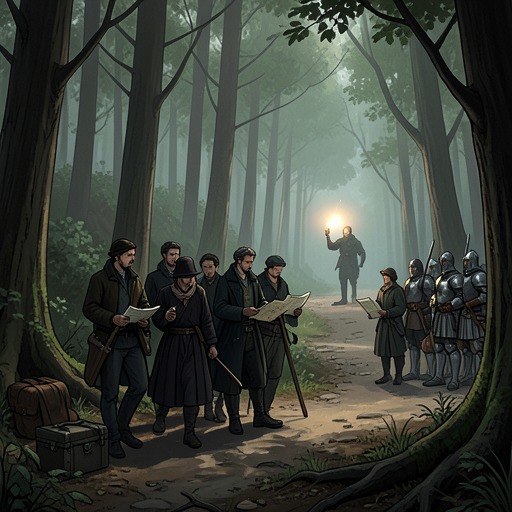
The first assignment is designed as a low-risk test but is still a genuine operational commitment. Rainnewt instructs Broccoli Bunch to report to the lobby two hours before noon the next day with whatever equipment she would need for a week-long voyage. The expedition summary identifies the assignment as Expedition No. 124 of Year 398PC from the Port-Royal Branch, with the mission of exploring, scouting, and mapping the region around decommissioned Fort Froger before returning to the meeting point. The policy thus moves the applicant rapidly from signature to fieldwork, leaving little time between institutional recognition and proof under practical conditions.
The guild’s surrounding infrastructure reinforces this procedural order. At Royal Outpost Seven, a Grenoil Fencer and a Grenoil Hunter regulate entry by asking travelers their business, while a city guard directs Broccoli Bunch toward the Exploration Guild headquarters in Port Royal. Elsewhere, Dylan’s payment for gathered plants and the guild’s ability to reimburse expedition expenses show how local commerce, quests, transport, and professional exploration connect to the same wider system of prices and obligations. The policy is therefore not confined to the guild office; it is encountered through guards, shops, missions, badges, contracts, and the exchange of money for labor.
Discretion, Risk, and the Limits of Protection
Although the policy promises protections to members, it preserves substantial discretion for guild officials. The normal rule of pairing new applicants with veterans can be altered when administrative circumstances require it, and the classification of an entrant as suitable or unsuitable remains dependent on the guild’s assessment. Broccoli Bunch enters partly because her skills appear potentially useful and partly because her presence solves an immediate staffing problem. Rainnewt even suggests that, after her first expedition, he may place her on a team better able to use those skills, implying that probation is also a period of institutional sorting.
The policy’s protective language is ultimately weaker than the guild’s power to define liability. After Broccoli Bunch’s first expedition, a woman at the guild orders Gabriel to give her standard mission pay and show her out. When Broccoli Bunch asks whether the problem is her unpaid fee, the woman rejects that explanation and states that she is being dismissed because she is a liability and should never have been allowed to join. The ruling reveals the harshest feature of probation: the applicant can satisfy the financial conditions and still lose membership because an authority revises its judgment of her fitness.
That later decision throws the earlier admission into relief. Rainnewt had welcomed her as an abnormal but promising opportunity, granted temporary status, issued a badge, and requested a week’s equipment. The later official treats the same entry as an institutional mistake. The policy therefore contains a built-in contradiction between procedural inclusion and discretionary exclusion. It offers a route into the guild, but it does not guarantee that a completed contract, paid mission, or issued badge will secure a lasting place within it.
Institutional Significance
The Exploration Guild Probation and Admission Policy makes exploration legible as a regulated profession rather than a purely personal form of wandering. It assigns value through classes, experience, referrals, noble status, mission difficulty, discoveries, daily pay, fees, and profit shares. Even apparently informal questions about suitable hats or adventurous taste are absorbed into a system that ranks bodies, skills, wealth, and usefulness.
At the same time, the policy creates real mobility. Broccoli Bunch can enter without paying the full yearly fee, receive a badge and institutional protections, travel with guild support, and gain access to an expedition that would otherwise be unavailable to her. Her earlier exchanges also show the broader logic of this world: pixies respond to honey, Leonard offers gold for help recreating a map, Dylan pays for gathered flowers, and Gunther agrees to assistance in exchange for a favor. The guild formalizes this culture of reciprocal obligation into contracts and scheduled missions.
Its decisive narrative function is consequently double-edged. The policy opens the door to the wider exploration network while teaching that access is conditional, monetized, and revocable. Broccoli Bunch’s admission is an opportunity that arrives suddenly—“Opportunity waits for no one”—but the same speed leaves her entering an institution whose standards and internal politics she barely understands. Probation becomes both a bridge into professional adventure and the mechanism through which the guild can later withdraw recognition, transforming welcome into liability without abandoning the formal language of procedure.