Fort Frogger Encounter
Cinnamon BunFort Frogger Encounter marks a decisive reversal in the expedition of Broccoli Bunch and Amaryllis Albatross: instead of assaulting an undead fortress, Broccoli gains entry through courtesy, curiosity, and tea. The encounter establishes Fort Frogger as more than a hostile military ruin. Its patrols, guardians, domestic interiors, and leader reveal a community organized around the undead, while the conversation also places the fort within the wider tensions between Deepmarsh and the expansionist United Republic of the Trenten Flats.
Approach to the Fort
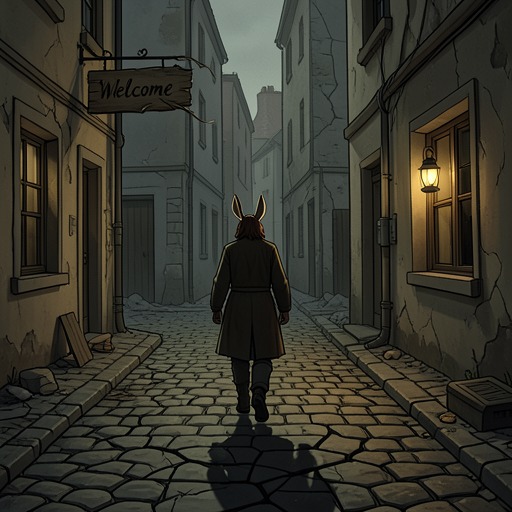
The encounter begins under conditions that strongly favor violence. Broccoli and Amaryllis approach Fort Frogger through marshland while trying to avoid patrols. One patrol consists of four Grenoil skeletons wearing simple armor and carrying badly maintained spears and bucklers; their glowing eyes scan the marshes and pause over ordinary movements in the landscape. A second patrol contains three Grenoil skeletons. The undead are not isolated guards but part of a functioning defensive system.
The fort itself intensifies the danger. Its large wooden doors stand open, although one has been broken away from its massive metal hinges. The courtyard is crowded with undead, mostly Grenoil skeletons, alongside creatures resembling horses with human upper bodies. At the entrance stand two larger skeletons in plate armor, each holding a sword roughly the size of Broccoli Bunch. They are identified as Skeleton Knights, and their presence makes a direct approach appear reckless even before the forces inside the fort are counted.
Broccoli nevertheless decides that reconnaissance should not automatically become combat. After observing the region, the remaining objective is to see inside the fort, but fighting through the entrance would expose both explorers to the many undead within. Broccoli therefore proposes a friendly approach, reasoning that Amaryllis Albatross is strong enough to confront the two knights but that victory at the gate would only create a larger battle in the courtyard. The plan is not based on superior force; it is an attempt to change the terms of contact.
The Diplomatic Entrance
Before approaching, Broccoli uses Cleaning magic on both explorers. The spell strips away the mud and grime that had helped them remain camouflaged in the marsh. Amaryllis reacts with a shiver and an involuntary sound of surprise as the magic passes over her, turning a practical act of preparation into a small display of trust between the expedition partners.
The Skeleton Knights notice Broccoli before the approach is complete, but they do not attack. Broccoli stops a dozen meters away, waves, identifies Broccoli Bunch as a member of the Exploration Guild, and asks to speak with the fort’s leader. The awkward greeting ends with an uncertain attempt at a roar. Rather than closing ranks, the knights turn together and step aside, leaving the path into the courtyard open. Their gesture is ambiguous, but Broccoli interprets it as an invitation and proceeds.
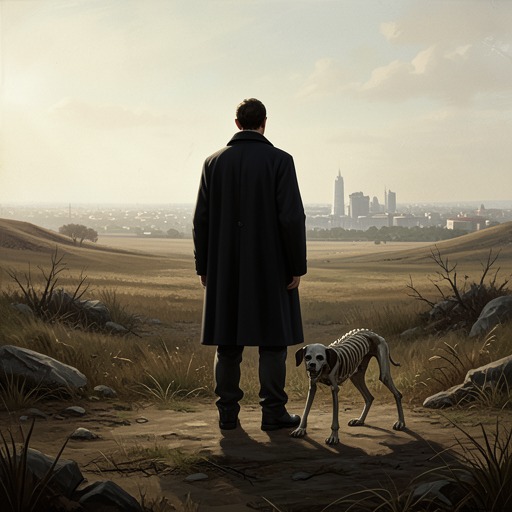
Broccoli then knocks on a building within the fort using a familiar rhythmic pattern. The response is ominous: heavy footsteps approach, accompanied by frantic scratching against the wood. Yet the door opens onto an unexpectedly domestic scene. The resident is a plain, ghoulish-looking man with glowing blue eyes behind spectacles, dressed in a cardigan, sweater vest, and large fluffy loafers. Beside him stands a dog—or what remains of one. The contrast between the fort’s military undead exterior and the host’s almost comically ordinary clothing immediately unsettles the expected division between civilized visitor and monstrous enemy.
The host’s companion is identified as Throat Ripper, a Bone Hound of the Long Slumber. The creature’s name and condition preserve the threat implied by the fortress, but the host describes him as a good dog. Broccoli responds to the rising tension not with a weapon but with an offer of tea. The question interrupts the hostile logic of the scene and creates a social ritual that both sides can enter without first resolving their political or moral differences.
Tea as Truce
The host accepts the offer, provided there is a pot for boiling water. Broccoli has only a kettle in the travel pack and enough equipment for one cup, but the host allows Broccoli and Amaryllis into the fortress. He tells them not to mind Throat Ripper and again characterizes the Bone Hound as harmless in the immediate social setting. The pair enter dark halls and are taken to a lounge with a carpet, chandelier, table, and chair. A skeleton in a frumpy suit is instructed to bring additional chairs, giving the undead household an unmistakably domestic organization.
Broccoli prepares three cups of tea and supplements them with hard bread, strong cheese, and a jar of honey. The food is plain and imperfect, but it turns the meeting into a shared meal rather than an interrogation at the gate. Amaryllis struggles to hold her cup with her talons, Broccoli savors the tea, and the host responds appreciatively. The scene’s hospitality does not erase the fort’s danger; it makes coexistence temporarily visible inside it.
The host asks what brings the visitors to the swampy backwater. Broccoli explains that both explorers belong to the Exploration Guild and are new members sent to map the area around the fort. Broccoli explicitly distinguishes mapping the surrounding region from entering the fort itself. Trampling through someone’s home would be rude, so Broccoli asks whether the exterior can be explored without disturbing the skeletons. This clarification converts the expedition’s official objective into a negotiated boundary: the visitors seek information, but they acknowledge the fort as inhabited space.
When the host asks whether Broccoli objects to the skeletons’ presence, the question exposes the encounter’s central ethical tension. Broccoli treats the undead not as automatically disqualified from social life but as inhabitants whose presence requires interpretation. The resulting exchange prevents the Exploration Guild’s reconnaissance from becoming an unexamined act of intrusion and allows the fort’s people to be approached as subjects rather than obstacles.
Political and Narrative Consequences
The meeting gives Broccoli and Amaryllis access to information that a battle would likely have destroyed or made inaccessible. Fort Frogger is not merely an abandoned stronghold filled with mindless enemies. Its patrols, Skeleton Knights, household staff, host, and Bone Hound indicate a layered undead society capable of surveillance, hospitality, conversation, and territorial negotiation.
The conversation also connects the fort to the history of Deepmarsh and the United Republic of the Trenten Flats. The host explains that the United Republic is the largest nation on the continent and is fiercely expansionist, making it a troublesome neighbor. Decades earlier, it attempted to invade Deepmarsh. Although the invasion force outnumbered the defenders three to one, it was weakened by an inexperienced general, inadequate scouting, green troops, swamp conditions, unfiltered water, and marsh insects. The account complicates any simple claim that Deepmarsh defeated the invasion through military strength alone: the terrain and environment destroyed much of the invading army before resistance could fully decide the outcome.
That history changes the meaning of Fort Frogger’s defensive posture. Its undead patrols and armored gatekeepers belong to a frontier shaped by invasion, suspicion, and competing claims to territory. The fort’s inhabitants are not detached curiosities encountered in a neutral wilderness; they occupy a politically charged borderland where the labels of monster, guardian, resident, and enemy can shift according to who is doing the describing.
Significance of the Encounter
Fort Frogger Encounter is a diplomatic threshold scene in which Broccoli’s strongest resource is not superior combat power but the ability to recognize a social opening. Cleaning magic first removes the mud from the two explorers, symbolically replacing concealment with presentation. Tea then performs the more important cleansing: it clears the immediate encounter of the assumption that undead presence must lead directly to violence. The result is not a permanent peace treaty, but it is a successful suspension of hostility long enough for mutual recognition and information exchange.
The event also establishes Broccoli’s characteristic method of confronting danger. Broccoli acknowledges the skeletons’ strength, refuses to treat reconnaissance as permission for destruction, and uses an ordinary domestic gesture to enter an extraordinary space. Fort Frogger therefore becomes memorable not because its defenses are defeated, but because they are bypassed through manners. Its monsters remain dangerous, its politics remain unresolved, and its history remains marked by invasion; nevertheless, the encounter proves that the boundary between adventurer and undead inhabitant can be crossed without immediately becoming a battlefield.