Gunther
Cinnamon BunGunther is an undead human who lives at Fort Frogger with his resurrected companion, Throat Ripper. Once a well-regarded arts dealer in Cinderrun, he abandoned that life to change his class and restore the friend he had lost. His history makes him more than a local guardian or eccentric necromancer: he embodies the cost of refusing to accept death, while his conduct toward Broccoli Bunch and Amaryllis Albatross reveals an unexpectedly hospitable, observant, and loyal character.
Identity and Setting
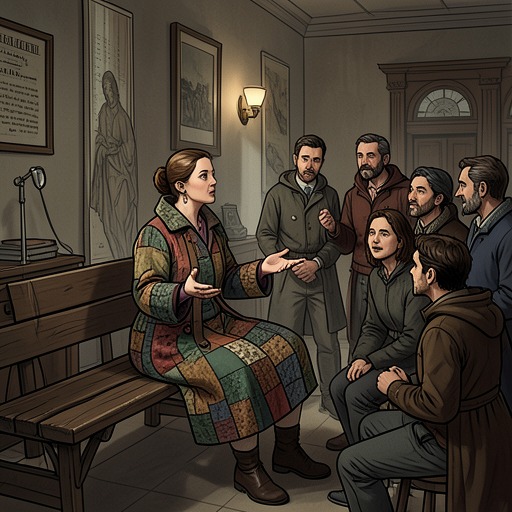
Gunther is introduced as the lordlike figure of Fort Frogger, a fortified estate occupied by undead servants, skeletons, and the enormous Bone Hound of the Long Slumber known as Throat Ripper. His authority is immediately visible in the way the skeleton knights remain stationed at the gate and in the ease with which he directs the undead around him. Yet the fortress is not presented simply as a site of menace. Gunther receives visitors in a lounge, offers hospitality, paints, and escorts guests to the door, placing domestic and artistic practices alongside the death mana and skeletal forces associated with his existence.
His own introduction is deliberately plain. When Broccoli Bunch and Amaryllis ask who he is, he identifies himself as Gunther and says that he has no last name. The absence of a family name contrasts with the scale of his authority and hints at the personal severance behind his current life. He has cut himself off from the social world that once recognized him, but he has not abandoned every form of connection; instead, his life has been reorganized around one exceptionally important bond.
Grief, Class Change, and Throat Ripper
Gunther explains that Throat Ripper is the reason he became what he is. When the dog died, Gunther could not accept the loss, so he undertook a self-imposed quest to correct what he regarded as a cruelty imposed by the world. He gave up his profession as an arts dealer and changed his class, beginning the transformation that allowed him to bring back his one true companion. The decision required him to sacrifice his former livelihood and sever ties with neighbors, family, and the wider community he no longer valued.
The result is not a neutral technical achievement. Gunther’s undeath is a continuing expression of grief and devotion. Throat Ripper is not merely one creature among the skeletons surrounding Fort Frogger; he is the intimate cause of Gunther’s transformation and the companion for whom Gunther rebuilt his entire existence. Their physical interactions retain traces of ordinary affection: Throat Ripper nudges his master, receives a pat on the head, and accompanies him as a trusted partner rather than as an interchangeable servant.
Gunther also describes the social consequences of his choice. Classes associated with undeath are poorly regarded by both superstitious people and those who understand the danger that death mana can pose if it remains in a region too long. In response, Gunther and Throat Ripper travel from place to place, settling in quiet areas for roughly a decade before moving on. They have occupied Fort Frogger for only a year and more, and the surrounding skeletons are gathered partly through Throat Ripper’s knack for digging up remains. Their mobility is therefore both practical and defensive: they seek places where they can exist without provoking the communities that fear them.
Hospitality and Intellectual Curiosity
Despite the hostility directed toward undeath, Gunther treats Broccoli Bunch and Amaryllis as guests rather than intruders. He escorts them from the fort after their reconnaissance and calls their visit a welcome distraction. His welcome is not sentimental in a simple way; he remains dry, reserved, and occasionally uncomfortable when Broccoli responds emotionally to his story. Nevertheless, his willingness to disclose the intimate origin of his condition shows a capacity for trust that his isolated circumstances might otherwise conceal.
Gunther’s artistic identity also survives his class change. He keeps an easel, paints, brushes, glass jars of pigments, and a skeleton assistant carrying the materials. When Amaryllis assumes that painting might involve manipulating emotion or depicting the future, Gunther rejects the idea as preposterous, but he then invites Broccoli and Amaryllis to sit as subjects because he has not had anything new to paint for some time. The scene preserves a link between the respected arts dealer he once was and the undead recluse he has become.
His comments reveal an additional role as an interpreter of forces larger than ordinary knowledge. Gunther warns Amaryllis to set aside her assumptions, particularly around Broccoli, because the world has plans for her. When Broccoli compares those plans to quests, Gunther accepts the comparison. He thus recognizes the significance of the quest structure and of Broccoli’s unusual place within it, even while he remains outside the protagonist’s immediate system of classes and tasks.
Rescue of Amaryllis
Gunther’s most consequential action begins when Broccoli returns to Fort Frogger battered and desperate after Amaryllis has been taken during an attack at a bridge. Broccoli calls for Gunther’s help, and Gunther’s initial unamused expression changes when he sees her condition. He admits that he and Throat Ripper can assist, though he makes clear that the aid will not be free. His response combines practical self-interest with genuine recognition of Broccoli’s crisis.
Gunther refuses to send Throat Ripper into danger with Broccoli alone. He gathers his swiftest skeletons, reasoning that six or more Cervids who have reached or passed the first rank would require a much larger force to hold them back. This decision reveals both his strategic judgment and the importance he places on Throat Ripper: he will assist Broccoli, but he will not risk his best friend without adequate support. The fort’s latent military power becomes visible as Gunther orders Throat Ripper and attendants to retrieve the dog’s armor and dispatches half a dozen Cervid skeletons to prepare for battle.
His preparation is matched by operational clarity. Gunther instructs Broccoli to concentrate on taking Amaryllis and immediately retreating toward the fort or Green Hold, where the kidnappers would not be welcome. He does not turn the rescue into a general campaign; the objective is extraction. Throat Ripper’s transformation from a seemingly silly bone dog into an armored combatant makes the shift from domestic companionship to military action unmistakable. Thick padded armor, crocodile-like scaled hide, a helmet exposing only burning eyes, and bony spikes turn Gunther’s resurrected companion into the spearhead of the rescue effort.
History, Politics, and Narrative Significance
Gunther’s account of the United Republic of the Trenten Flats gives the rescue a historical dimension. He explains that the nation is the largest on the continent and fiercely expansionist. Its attempted invasion of Deepmarsh outnumbered the defending force by three to one, but inexperienced leadership, inadequate scouting, an unseasoned army, swamps, unfiltered water, and insects destroyed much of the invading force. Gunther still finds bodies from that campaign, making political history physically present in the landscape around Fort Frogger.
This knowledge places Gunther between isolated local witness and experienced political observer. He does not simply repeat the victorious version of the conflict; he says the truth is more nuanced, distinguishing military resistance from the environmental conditions that devastated the invasion. His understanding of borders, hostility toward the Cervids, and the lingering remains of war allows Broccoli’s immediate rescue to be read against a broader history of expansion, failed conquest, and contested territory.
Gunther’s characterization also complicates the novel’s boundary between purity and corruption. Broccoli’s Cinnamon Bun class describes her as too pure for the world and charges her with cleansing its impurities, while Gunther’s life is built around undeath, death mana, and recovered bones. Yet the supposedly impure figure behaves with patience, hospitality, artistic discipline, and extraordinary loyalty. He is not reduced to a threat for Broccoli’s cleaning magic to remove. Instead, he becomes an ally whose grief has produced a different kind of moral commitment: the refusal to abandon a friend, even when the world condemns the means by which that friend was restored.