May our wills be the will of the world
Cinnamon Bun“May our wills be the will of the world” is the ritual expression through which a group publicly aligns its individual intentions with the governing order of the world. Spoken together before a shared meal, it initially appears as a gesture of fellowship; later explanations reveal that the same ideal supports a coercive moral system in which dungeons, mana, classes, and the destruction of a Dungeon Core are treated as matters of worldly law.
Communal Use and Immediate Setting
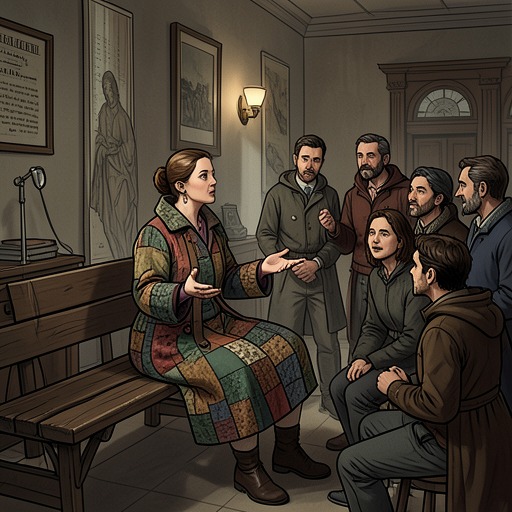
The expression is first heard at a meal around a campfire. After Pierre takes his bowl and joins the others, the group recites the words “May our wills be the will of the world” at more or less the same time, and only then begins eating. The timing makes the phrase a threshold between preparation and participation: food is present, but communal consent comes first. Its collective delivery matters as much as its wording, because the invocation presents shared alignment rather than private belief as the basis of the gathering.
The scene also places the expression beside a small religious difference. Valerie asks whether Broccoli Bunch worships the world tree, and Broccoli Bunch indicates that the answer is no, while hoping that this refusal will not cause trouble. The meal proceeds nonetheless, and the group’s ritual does not require Broccoli Bunch to have already adopted its theology. The phrase therefore functions both as a declaration of communal identity and as an invitation, or pressure, to enter that identity.
The World’s Will as Doctrine
Arianne later gives the expression its institutional meaning when she explains that destroying a Dungeon is “a crime of the highest order.” Her account treats breaking a Dungeon Core as an offense against the world’s will: anyone who breaks a core must in turn be broken because such an act opposes the order that sustains the world. The invocation heard at the meal thus has a legal shadow. What sounded like a blessing becomes the verbal counterpart of punishment and obedience.
Arianne explains that the world requires mana to sustain itself, although life is possible in an area without mana. Such a life is made harder: injuries heal more slowly, and people may die younger and have fewer offspring. Dungeons bring large amounts of clean mana into an area, and that benefit creates the attraction of the dungeon boss. The phrase condenses this ecological and social arrangement into a moral principle: the world’s needs are placed above an individual’s freedom to decide what may be destroyed.
Connection to Classes and the Quest System
The expression also belongs to the same system that governs Broccoli Bunch’s progression. A dungeon boss grants a class, which explains why the expedition group contains three fencers; a lower-level boss near the capital grants the fencing class and is farmed regularly. Class acquisition is therefore not merely personal advancement. It is tied to the existence of dungeons and to a repeated social practice that converts the world’s magical infrastructure into opportunity.
The quest interface gives this doctrine an impersonal, executable form. A translucent menu calls Broccoli Bunch to save the world after announcing that a great evil has set its root in it. When Broccoli Bunch performs a Special Action consistent with the Cinnamon Bun class, the system unlocks the Cleaning skill. Killing three Sentinel Ghosts above Broccoli Bunch’s level grants bonus experience, and later repeated action unlocks the general skill Friendmaking. Each notification turns conduct into measurable progress, making the world’s order appear through rewards, classifications, and instructions rather than through theology alone.
Obedience, Sacrifice, and Narrative Meaning
The tension between the phrase and Broccoli Bunch’s actions becomes clearest after the Evil Root is found. The quest menu reports that Broccoli Bunch is too weak to destroy the Evil Root and instructs Broccoli Bunch to break the Core and let the Root starve. The instruction is presented as a quest update, but it conflicts with the later explanation that breaking a Dungeon Core is an offense of the highest order. The world’s will is therefore not experienced as a single transparent command; it arrives through menus, local custom, religious speech, and rules whose consequences Broccoli Bunch has not yet learned.
After the quest is completed, the system declares, “The world thanks you for your sacrifice!” The congratulatory wording joins reward to sacrifice and makes obedience sound like personal affirmation. Broccoli Bunch responds with exhausted, adrenaline-driven laughter rather than solemn acceptance. That reaction preserves the phrase’s ambiguity. The world may speak through the system, but its approval does not automatically produce understanding, reverence, or emotional agreement.
The expression consequently operates on several levels at once. It is a meal-time benediction, a communal sign of belonging, an ideological statement about mana and Dungeons, and a principle used to justify severe punishment. Its recurrence is echoed by the system’s rewards for cleaning, killing, quest completion, and making friends: individual actions become meaningful when they are recognized as serving an imposed order. Yet Broccoli Bunch’s uncertain response, refusal to claim worship of the world tree, and confusion about class and Dungeon rules keep the phrase from becoming settled doctrine. It names the ideal toward which the world demands that wills bend, while the narrative continues to test whether that demand deserves consent.