Sentinel Ghost
Cinnamon BunThe Sentinel Ghost is the level-one undead presence associated with abandoned Threewells and the Darkwoods. It is first introduced not as a visible monster but as a voice beneath fallen masonry, then revealed as a trapped skeleton before appearing in its more characteristic spectral form. Its repeated attacks make Threewells a haunted frontier rather than merely a deserted settlement, and its destruction becomes one of the earliest mechanisms through which Broccoli Bunch learns that the world’s game-like system rewards survival even when the reward’s language makes that survival sound like murder.
Identity and Appearance
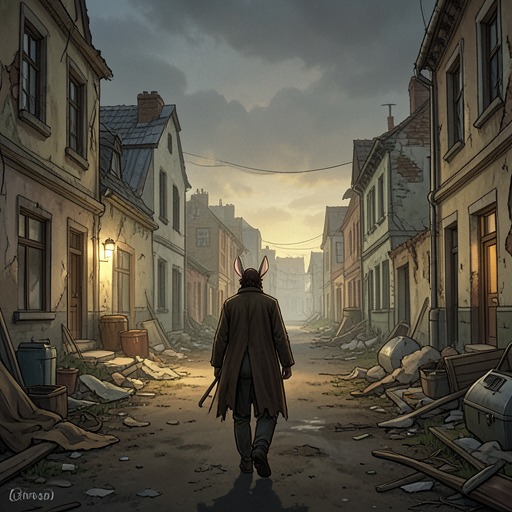
The Sentinel Ghost is presented as an animated guardian or remnant of Threewells, named by the system as the “Sentinel Ghost of Threewells by Darkwood.” The available evidence establishes its level as one and repeatedly links it to the town, but does not explain who created it, whom it once served, or whether every apparition shares one consciousness. What is clear is its spectral physicality: it appears as a floating, hazy person whose clothing moves in an invisible wind, while its presence produces a literal chill rather than merely an impression of fear.
Its face is fixed in indescribable rage. The ghost’s soft white eyes remain locked on Broccoli Bunch as it follows, and its robes trail behind it while it floats a little faster than a walking person. The apparition can phase through solid walls, although doing so slows its movement; a hand and then an arm push through masonry as it pursues Broccoli Bunch through the ruins. These traits make it less a conventional corporeal opponent than a hostile remnant able to turn the town’s walls, passages, and collapsed structures into part of the encounter.
First Encounter in Threewells
The first ghostly threat is preceded by the discovery of a ruined village and a blocked exit. Beneath the rubble of a collapsed archway that once led from a lower room into Threewells, Broccoli Bunch finds a skeleton pinned beneath several stones. Its glowing eyes fix on the newcomer, its head and neck wobble, and its one free arm moves futilely toward him while it makes an inarticulate sound. The scene establishes a material origin for the haunting: Threewells’ supernatural danger is embedded in the physical remains of the settlement, amid rotting papers, signs of fire, ruined offices, and a breached wall revealing rows of beds.
After Broccoli Bunch encounters the floating spectre outside, he responds with an attempt at friendship rather than an attack. The ghost follows in silence, its rage unchanged, and its pursuit continues through the crack in the wall and down the passage. Its ability to pass through the wall turns Broccoli Bunch’s hope that the creature will stop following into a failed escape. The encounter therefore defines the Sentinel Ghost through a sharp contrast between Broccoli Bunch’s social instinct and the apparition’s unanswerable aggression.
The first confrontation ends when the ghost is split apart and reduced to fine white dust. The system declares that Broccoli Bunch has murdered the level-one Sentinel Ghost and grants bonus experience for killing a monster above his level. Broccoli Bunch objects to the word “murdered,” insisting that the act was self-defence and asking where his jury of peers is. The comic protest does not erase the danger of the encounter; instead, it exposes the gap between ordinary moral language and the system’s impersonal classification of combat.
Repetition and Escalation
The Sentinel Ghost is not a singular obstacle that disappears after the first victory. A later notification records another level-one Sentinel Ghost being destroyed, while Broccoli Bunch reflects that it is the third ghost he has killed and the third to answer his friendly request with murder and meanness. The recurrence changes the haunting from an isolated surprise into a pattern governing Threewells: the town repeatedly produces the same hostile response, and Broccoli Bunch begins moving through its main street cautiously, keeping low, going slowly, and peeking through windows for further ghosts.
The decisive group encounter occurs near the church and graveyard, where five ghosts remain. Broccoli Bunch approaches with a cord weighted by his showerhead glyph and a small magic wand, apparently testing whether his suspicion about their behavior is correct. The five heads turn toward him together, and their faces shift into disgusting, disfigured expressions. He again introduces himself as Broccoli Bunch and asks whether they would be his friends, but the ghosts immediately fly toward him with arms and claws outstretched.
The five are eventually destroyed, and the system records that Broccoli Bunch has wiped out five enemies of the same level. The repeated use of the same creature name and level gives the encounter a mechanical rhythm: approach, hostile recognition, combat, notification, and reward. Yet the repetition also carries emotional cost. Broccoli Bunch collapses, cries over the violence, and struggles with the thought that he may have killed his only friend before forcing himself onward because his quest still remains. The ghosts are therefore both recurring combat units and the immediate occasion for grief.
Systemic Function and Consequences
The Sentinel Ghost helps establish the relationship between Broccoli Bunch’s actions and the world’s leveling system. Earlier, cleaning the ruined room as a Special Action aligned with his Cinnamon Bun class and unlocked the Cleaning skill. The ghost battles produce a different kind of progression: the system awards bonus experience for defeating enemies above his level, and after three ghosts are killed, Broccoli Bunch’s Cinnamon Bun class reaches level one with a stamina increase of five. After the five-ghost encounter, repeating a Special Action sufficiently many times unlocks Makeshift Weapon Proficiency. The evidence does not assign that skill solely to ghost killing, but the surrounding progression places the repeated improvised fighting within the broader pattern of actions being converted into abilities.
The system’s notifications make the Sentinel Ghost unusually important as a measure of Broccoli Bunch’s adaptation. It turns an apparently absurd situation—being attacked by ghosts after asking them to become friends—into quantifiable advancement. Later, the existence of a dungeon and the possibility that someone damaged its core become part of Threewells’ larger mystery. Reports describe major mana shifts, suspicion that the dungeon core may have been damaged, and a scout sent toward Dunwich Dungeon; when Broccoli Bunch describes the “evil hole,” Arianne and Leonard Chand’nuit identify it as the entrance to a young dungeon and discuss the mana surge that followed. The Sentinel Ghost is not proven to be caused by that dungeon activity, but its haunting belongs to the same unstable landscape of ruined settlements, disturbed mana, and dangerous remnants.
Narrative Significance
The Sentinel Ghost is the first sustained test of Broccoli Bunch’s ethics under a system that rewards decisive violence. Broccoli Bunch does not begin by treating the apparition as an enemy: he introduces himself, seeks friendship, and only fights after repeated pursuit and attack. The ghost’s refusal of every social opening establishes that his optimism is not enough to make the world safe, while his eventual victories show that kindness and self-preservation cannot always coexist.
Its spectral form also makes Threewells a place where the past remains active without becoming legible. The abandoned town contains collapsed architecture, burned rooms, ruined records, and undead figures whose anger survives even though their history is unavailable. The Sentinel Ghost thus embodies the settlement’s unresolved ruin: it is at once a monster, a remnant, and a repeated system entry. By the time Broccoli Bunch moves onward, the ghosts have supplied experience and new capabilities, but they have also forced him to carry the emotional contradiction of becoming stronger through what the system calls killing.