Skill system
Cinnamon BunThe Skill system is the world’s framework for turning action into capability. It does not limit advancement to combat: cleaning a ruined room, jumping across dangerous terrain, making friends, and confronting major threats can all produce skills, ranks, levels, or other forms of progression. Its decisive importance lies in the way it makes Broccoli Bunch’s distinctive values mechanically legible. The system repeatedly confirms that usefulness, persistence, friendship, and class-aligned action are not merely personal preferences but activities capable of generating power.
Definition and Interface
The Skill system appears through Mister Menu’s floating notifications, which announce quests, rewards, class changes, skill unlocks, and numerical gains. Its first major intervention presents Broccoli with a quest declaring that a great evil has set its root in the world and asking whether she will accept the call to save it. The interface offers explicit choices between acceptance and refusal, making adventure appear as a selectable obligation rather than an unavoidable fate. Broccoli initially suspects that the translucent box cannot be real, but the system’s presence soon becomes an operating fact of her life.
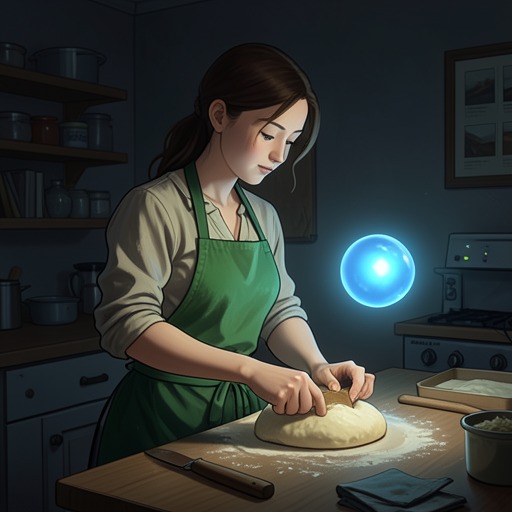
The system also evaluates actions according to class. After Broccoli cleans a confined room in the ruined building, the menu announces that performing a Special Action in line with her class has unlocked Cleaning. The reward is not attached to a conventional heroic deed; it emerges from sweeping floors, removing mould, sorting broken furniture, and arranging a table and chair. This establishes a central principle of the Skill system: advancement depends on what an action means within a class as much as on how dramatic the action appears from outside.
Ranks, Levels, and Points
Skills begin as modest abilities and become more consequential as their ranks rise. Cleaning is initially recorded at Rank F with 100 percent progress, described simply as the ability to clean and as an ability that improves as the skill rises. At lower ranks, Broccoli understands Cleaning and Jumping as enhanced versions of things a person might already do. Jumping at Rank D improves timing, balance, and physical performance, while Cleaning at the same rank makes her a more efficient cleaner, but neither ability yet exceeds ordinary human limits.
Rank C marks a qualitative change. Broccoli later explains that once Cleaning and Jumping reach that rank, they become magical rather than merely assisted. The distinction gives the rank ladder practical meaning: percentage progress measures development, while rank advancement changes the category of what the skill can accomplish. When the menu records Cleaning at Rank C with 100 percent progress, the skill has reached the threshold at which its effects can be treated as genuinely supernatural.
The system separates several kinds of advancement resource. Class Points are used to upgrade a Class Skill, and Broccoli receives one after defeating the first major danger, though she decides not to spend it on Cleaning immediately. Class levels produce broader gains: after three Sentinel Ghosts surrender their existence, the system grants bonus experience for defeating enemies above her level, raises her Cinnamon Bun class to level 1, and adds five stamina. Later, reaching Cinnamon Bun level 4 grants five health and five resilience. These rewards connect distinct kinds of achievement to distinct forms of improvement rather than treating all progress as a single undifferentiated number.
The system also recognizes General Skills. Repeating a Special Action a sufficient number of times unlocks Friendmaking, showing that social behavior can be converted into a formal capability just as cleaning can. Broccoli’s farewell to a departing group is therefore followed by a mechanical confirmation of the friendship-building practice she has been developing. The progression is both comic and consequential: an emotional and ethical habit becomes a skill with a place in the same framework as Jumping and Cleaning.
Advancement, Allocation, and Limits
Skill points are scarce enough to require planning. Amaryllis explains that Broccoli has only so many skill points available before her class evolution, although more will come afterward at a slower rate. Broccoli considers raising Cleaning to Rank A, which would require three levels’ worth of skill points, against the alternatives of improving several other skills or saving points for the next skill that will unlock at level eight. The Skill system therefore produces strategic pressure as well as gratification. Every improvement carries an opportunity cost, and class development depends on deciding which version of the self deserves investment.
The system’s rank thresholds also create a second layer of choice. Amaryllis confirms that skills unlock a secondary function at the disciple rank, while Broccoli learns that her Jumping skill already has enough experience to rank up to journeyman. The terminology gives advancement a social and professional texture: skills do not merely become stronger, but pass through recognized stages of competence. Amaryllis notes that many people would try to remove an inconvenient skill or merge it with another, whereas Broccoli’s unconventional attachment to Jumping is treated as a viable personal strategy even if it is not the usual one.
General Skill Points are rarer and more dangerous than ordinary improvements. Amaryllis explains that killing someone who possesses them allows the killer to take those points. Dungeon core breakers, champions who have performed extraordinary deeds, and people who receive exceptionally rare quests may become targets because of this resource. Such individuals are normally strong enough that killing them is not worth the trouble, but wars between nations can make their points strategically valuable. The Skill system thus turns exceptional achievement into a political liability: power can make its bearer valuable, but it can also place a literal price on that person’s life.
Rewards, Quests, and Consequences
The Skill system links progression to the wider quest structure. It can call Broccoli toward an evil, reward her for defeating enemies, and update an objective when she discovers the Evil Root. Because Broccoli is too weak to destroy the root directly, the quest directs her toward breaking the Dungeon Core and starving the root instead. The instruction transforms a seemingly impossible act of destruction into a constrained alternative, showing that system guidance does not remove danger; it defines the available route through it.
The system’s rewards can arrive at moments of extreme physical and emotional strain. After Broccoli’s health has gradually fallen from the seventies into the low sixties and then stabilized at fifty-nine, she prepares herself before the menu announces Cinnamon Bun level 4, followed by increases to health and resilience. The numerical gains do not erase the danger she has endured, but they give that endurance a concrete consequence. In this way, the interface punctuates hardship with measurable survival.
Its language can also be unsettlingly disproportionate to the human scale of events. After Broccoli completes the dangerous quest involving the Evil Root and Dungeon Core, the menu announces completion and declares that the world thanks her for her sacrifice. Broccoli responds with exhausted, adrenaline-fuelled laughter rather than solemn acceptance. The phrase makes the system sound ceremonial and impersonal at once: a cosmic acknowledgement is delivered through the same notification logic that records skill ranks and class levels.
Narrative and Thematic Function
The Skill system is a gamified model of identity. Broccoli does not merely possess skills; she discovers what kinds of behavior the world is prepared to count. Cleaning becomes a class expression, Jumping becomes magical through persistence, and Friendmaking emerges from repeatedly choosing connection. The system therefore rewards a version of heroism that differs from simple violence. Combat can grant experience, but so can maintenance, movement, and companionship.
At the same time, quantification changes how Broccoli evaluates her choices. A skill displayed as Rank F, Rank D, or Rank C invites comparison, investment, and optimization. A class level produces a visible increase in stamina, health, or resilience, while limited points force Broccoli to calculate future possibilities. The system encourages her to think like a player, yet the available actions remain rooted in the life she is actually trying to lead. Its most revealing pattern is the conversion of moral or practical commitments into progression without making them morally empty: friendship is still a farewell, cleaning is still work, and sacrifice is still frightening even when the menu assigns them value.
The result is a progression system that acts as both power structure and narrative commentator. It confirms Broccoli’s unusual path without making that path effortless, exposes the scarcity and danger attached to exceptional abilities, and turns small repeated actions into durable change. By giving mechanical form to her preference for helping, cleaning, jumping, and making friends before raising a fist, the Skill system makes her character arc visible as a sequence of choices that the world itself has learned to measure.