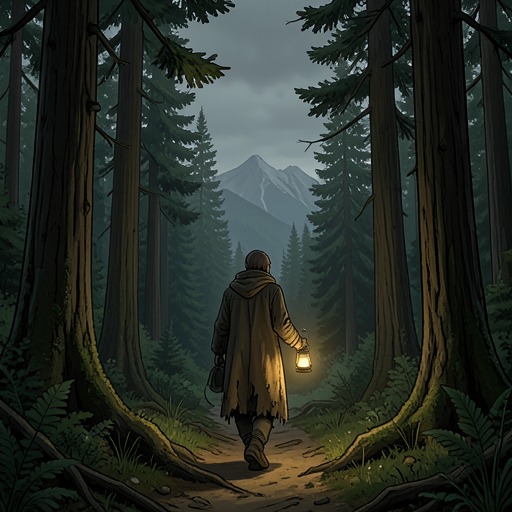
The Road Untravelled
Cinnamon Bun“The Road Untravelled” is both the title of Chapter Seventeen and the name of the neglected route leading away from Threewells. Its decisive significance lies in the contrast between the narrator’s sudden certainty of destination and the landscape’s refusal to offer an easy way forward: the road exists, but nature, time, and years without maintenance have nearly erased it.
A Route Beyond Threewells
The road lies outside the more familiar spaces of Threewells. A few homes once stood near it, accompanied by paths leading into the forest, but those traces have deteriorated even more severely than the roads within the settlement. Their condition makes the route feel less like an ordinary connection between inhabited places than the remnant of a community whose access and purpose have been abandoned.
The narrator does not investigate the nearby houses or side paths, judging that snooping around them would not be worthwhile. This choice keeps the chapter focused on the main route rather than turning the surrounding ruins into a separate mystery. The road’s importance comes from where it leads and from the difficulty of following it, not from any confirmed discovery among the abandoned homes.
Nature Reclaims the Road
The surviving road was once probably compacted dirt covered with cobbles, but that construction has been obscured by neglect. Nature and time have taken their toll, leaving the path torn apart by younger trees, exposed roots, fallen branches, and dense bushes. The description presents deterioration as an active process: the forest has not merely grown beside the road but has broken into it and begun to replace it.
The damage also turns travel into a practical problem. The narrator judges that navigating through the woods would be, if not impossible, then at least very hard. The route therefore retains enough shape to suggest direction while losing enough structure to resist effortless passage. Its incompleteness creates a physical threshold between the known settlement and whatever lies beyond it.
Destination and Uncertainty
Before the chapter begins, the narrator grins because there is now a destination. That moment of satisfaction gives the road a clear narrative function. A destination transforms wandering into an objective, yet the ruined route immediately qualifies that achievement: knowing where to go does not mean that the way remains usable.
The title captures this tension. “The Road Untravelled” is not simply a statement that no one has walked the route recently; it evokes a passage whose former human order has been interrupted and whose future remains uncertain. The narrator has chosen a direction, but the evidence stops before confirming what waits at the end or whether the damaged road can be followed without difficulty.
Narrative Significance
As a chapter title, “The Road Untravelled” marks a transition from the enclosed, deteriorating environment of Threewells toward a broader adventure. The abandoned road carries the consequences of time into the foreground, making the landscape itself an obstacle and a record of disappearance. The nearby ruined homes and forest paths reinforce the same contrast: human routes and settlements persist only as partial traces, while the natural world continues without maintenance or obligation to preserve them.
The passage also leaves the journey deliberately open. It establishes a destination, identifies the road’s likely former construction, and defines the environmental barriers obstructing progress, but it does not resolve the destination’s identity or the traveler’s eventual route through the woods. The chapter’s force comes from that unresolved beginning: a goal has appeared, while the road toward it has almost vanished.