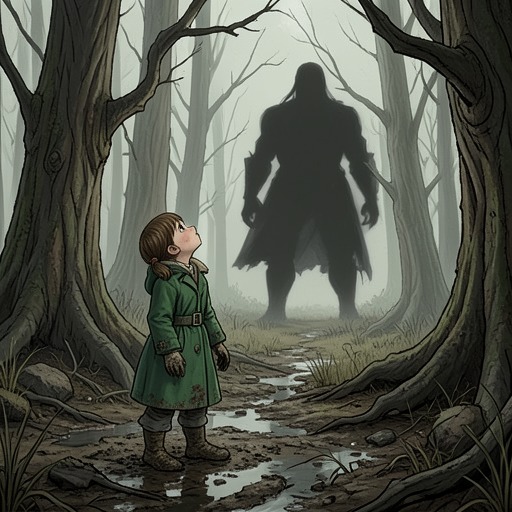
The world thanks you for your sacrifice!
Cinnamon Bun“The world thanks you for your sacrifice!” is a recurring system expression in Broccoli Bunch’s adventure. It first appears as the consequence of accepting a seemingly impossible quest, then returns when the Wonderland Dungeon Core is destroyed. Between those appearances, the same menu-driven world rewards cleaning, combat, cleansing, and friendship with skills, experience, quest updates, and congratulations. The expression therefore does more than mark success: it gives a cheerful, impersonal voice to a world that continually asks Broccoli Bunch to risk himself and then translates the results into progress.
First Appearance and the Call to Adventure
The expression is introduced immediately after Broccoli Bunch accepts the quest announcing that a great evil has set its root in the world. The floating prompt is invisible to everyone else, and its demand appears absurd enough that Broccoli Bunch initially suspects it cannot be real. His parents’ wanderlust makes the decision easy, however; he imagines that they would have pressed the acceptance button repeatedly. When he finally presses “I accept,” the system answers with “Ding! The world thanks you for your sacrifice!” and he falls onto his butt as the classroom disappears.
The wording gives the quest acceptance an ominous aftertaste. Broccoli Bunch has not yet fought, chosen a battlefield, or knowingly surrendered anything. He has only accepted an invitation to adventure, but the system already calls that act a sacrifice. The immediate transformation from a sterile classroom to a living landscape of birdsong, frogs, and wind makes the phrase function as both reward and warning: the world has granted him access to a new reality, while also implying that his ordinary life has been spent as the price.
The Expression Within the System of Rewards
The message belongs to a larger feedback structure that presents Broccoli Bunch’s actions as measurable progress. When he performs a Special Action consistent with his Cinnamon Bun class by clearing a blocked room, the system unlocks the Cleaning skill. After three Sentinel Ghosts of Threewells by Darkwood give up the ghost, it awards bonus experience for killing enemies above his level, and his Cinnamon Bun class reaches level 1 with Stamina increased by five. When Broccoli Bunch repeats a Special Action often enough while parting from an adventuring group, the system unlocks the general skill Friendmaking.
These notices make the world resemble a game interface, but the consequences are physical and ethical rather than merely numerical. Cleaning begins with a broom, shovel, fallen stones, and dead leaves; combat ends with ghosts fading into whitish dust; cleansing Bonesy causes Bonesy, a level-three Skeletal Bard, to pass beyond the veil. In each case, the system compresses a complicated experience into an unmistakable result: a skill, a level, bonus experience, or a congratulatory notice. “The world thanks you for your sacrifice!” is the most revealing version of that compression because it describes risk and loss in the language of achievement.
The expression also appears alongside quest logic that treats Broccoli Bunch’s choices as executable instructions. After he finds the Evil Root and discovers that he is too weak to destroy it directly, the quest menu orders him to break the Core and let the Root starve. The update calls the plan dangerously hazardous, yet the system offers no ethical reflection, only a route toward completion. Its rewards make the world’s values legible: actions become meaningful through successful completion, and danger becomes acceptable when it produces advancement.
Repetition at the Destruction of the Core
The expression returns after Broccoli Bunch destroys the Wonderland Dungeon Core. He collapses, gasping, then begins laughing as adrenaline leaves him lightheaded. The system announces “Quest Complete!” and repeats “The world thanks you for your sacrifice!” before confirming, “Wonderland Dungeon Core Destroyed!” The sequence places the expression between formal completion and irreversible destruction, making it the verbal seal on the end of the quest.
Its repetition changes the phrase’s force. At the beginning, the message accompanies a threshold crossing: Broccoli Bunch leaves the classroom and enters the adventure. At the end, it accompanies the destruction of the dungeon’s Core, a decisive act that completes the stated quest but also closes the world that has shaped much of his early journey. The same sentence thus frames both entry and culmination. It makes the adventure feel governed by a single impersonal logic, one that greets commitment and annihilation with the same bright confirmation.
Broccoli Bunch’s laughter intensifies the ambiguity. The system’s wording is not presented as a solemn memorial, and the scene does not settle whether the message is sincere gratitude, an automatic interface response, or a cruelly inadequate formula. The result is a structural irony: the world claims to thank him for sacrifice at the precise moment when he is too overwhelmed to decide whether he is relieved, horrified, or simply exhausted.
Sacrifice, Death, and Moral Discomfort
Later events give the expression a darker ethical context. During the rescue of Amaryllis, the system announces that Titan and Rex have been killed and grants Broccoli Bunch reduced bonus experience because he was not the primary combatant. Broccoli Bunch interprets the event as killing people and confesses this to Amaryllis. His guilt is not erased by the system’s classification of the combatants as enemies, nor by the experience awarded for the outcome.
Amaryllis rejects his self-condemnation, explaining that the dead were mercenaries who had tried to kidnap her and that removing them was like taking out weeds. She still calls Broccoli Bunch an idiot for compromising himself on her behalf, then hugs him and admits the emotional weight of what he did. The exchange exposes the gap between system judgment and human judgment. The menu can record a kill, calculate a reward, and identify a level difference; it cannot resolve whether the act was justified, whether Broccoli Bunch intended the deaths, or what it costs him to survive them.
The same tension reaches back to Bonesy’s cleansing. Broccoli Bunch uses magic on the skull and causes a ghostly form to emerge, after which the system congratulates him for sending Bonesy beyond the veil and grants bonus experience for cleansing a monster above his level. The technical language treats Bonesy as a monster and the event as advancement, while Broccoli Bunch’s immediate cry of “Bonesy!” preserves the personal shock that the notification cannot contain. The recurring expression consequently gathers meaning through contrast: the world’s thanks are expansive and absolute, while the protagonist’s responses become increasingly personal, uncertain, and burdened.
Narrative Function and Significance
As an expression, “The world thanks you for your sacrifice!” condenses the book’s central conflict between adventure as empowerment and adventure as obligation. The system offers Broccoli Bunch a class, skills, levels, and quests, but every benefit is linked to an action that consumes effort, safety, innocence, companionship, or an entire dungeon. Its gratitude makes sacrifice sound voluntary and productive even when Broccoli Bunch has only partial control over the consequences.
The phrase also gives the unseen world a distinctive voice. “Ding!” and “Quest Complete!” create a rhythm of interruption in which supernatural events are translated into interface language. The notices can celebrate cleaning, friendship, killing, cleansing, and the destruction of a Core through related forms of feedback. This formal sameness is significant because it places ordinary helpfulness and catastrophic violence on the same progression ladder without claiming that Broccoli Bunch experiences them as morally equivalent.
Finally, the expression is a refrain of threshold moments. It appears when Broccoli Bunch accepts the call to adventure and when he completes the mission to destroy the Wonderland Dungeon Core. Between those points, he learns that the system’s rewards are real but not morally sufficient. The world may thank him, and the menu may grant him power, yet responsibility remains with the person who must live through the consequences. The phrase’s apparent warmth therefore becomes its most unsettling feature: it is gratitude without intimacy, judgment without explanation, and a blessing that continually sounds like a reminder of what the adventure demands.