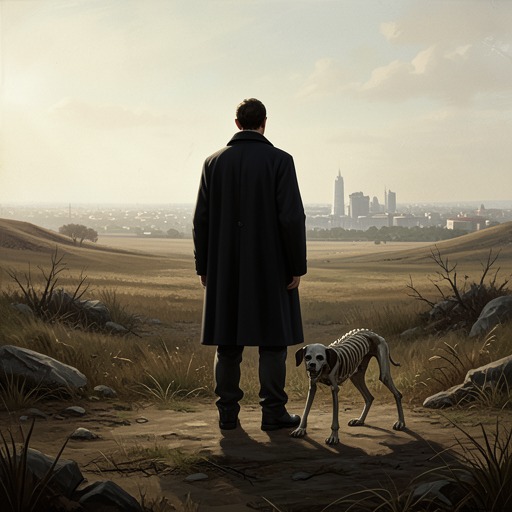
Undead
Cinnamon BunUndead is not merely the absence of life but a persistent state in which bodies, identities, and relationships continue beyond ordinary death. The narrative presents it as a visible and material condition—skeletal patrols, glowing eyes, bone-set bodies, and a resurrected hound—while also showing that undeath carries social consequences. It is feared as both a monster-making force and a source of dangerous mana, yet Gunther’s history gives it an intimate human dimension: for him, undeath is the price of refusing to accept the loss of his one true companion.
Definition and Physical Presence
Undead beings retain enough structure and purpose to act after death, but their bodies no longer conform to ordinary living biology. A patrol encountered in the marsh consists of four grenoil skeletons wearing simple armour and carrying poorly maintained spears and bucklers. Their glowing eyes search the landscape, pausing over birds and swaying trees as though the dead still possess a version of vigilance. They are not inert remains; they move as a group, carry weapons, and perform something resembling a military watch.
Their strength is also anomalous. Amaryllis estimates the skeletons at levels six to eight, a range that would not make them especially formidable among ordinary monsters but makes them powerful for undead. This difference establishes undeath as a distinct category rather than a simple synonym for weakness or decay. The same level of physical capability has a different meaning when embodied by creatures that should not be moving at all.
The narrative repeatedly associates this state with damaged or incomplete bodies. Gunther’s companion is a Bone Hound of the Long Slumber, while Gunther himself is identified as an Undead Human Bone Setter. When the door to Gunther’s estate opens, the first impression is of a plain, cardigan-wearing man with glowing blue eyes behind spectacles, accompanied by a dog that is described as most of a dog. The domestic clothing and almost ordinary setting clash with the visible signs of death, making undeath uncanny precisely because it can coexist with recognizable habits and social forms.
Origins and Conditions
Undead are not treated as common in the regions visited by Broccoli Bunch and Amaryllis. Broccoli recalls seeing them before in an abandoned town, but Amaryllis states that their presence near the fort is abnormal. She explains that undead usually spawn where many bodies accumulate and where certain kinds of unfavourable mana are present. The condition therefore has an environmental dimension: corpses and corrupted magical conditions create circumstances in which death can become active rather than final.
That explanation also clarifies why the marsh encounter raises the possibility of an undead dungeon. The skeletons are not simply isolated remnants wandering without context. Their numbers, organization, and proximity to the fort suggest a larger source that may be producing or sustaining them. Undeath thus functions as evidence of a disturbed region, turning individual monsters into signs of a broader magical and ecological imbalance.
The physical environment makes the boundary between living and undead especially unstable. Broccoli and Amaryllis hide in mud nearly up to their faces while the skeleton patrol passes nearby. The scene places living bodies in a state of near-inert concealment, contrasting their deliberate stillness with the relentless movement of the dead. The mud is unpleasant but survivable; the undead patrol is the true danger. This reversal makes bodily vulnerability a shared condition while preserving the crucial distinction between temporary immersion in decay and permanent existence within it.
Gunther and Throat Ripper
Gunther provides the clearest account of undeath as a chosen response to grief. He explains that Throat Ripper’s death changed him so profoundly that he could not accept it. He therefore began a self-imposed quest to correct what he regarded as a cruelty imposed by the world. Once a well-regarded arts dealer in Cinderrun, Gunther abandoned that life, changed his class, and became the foundation of the person he is now. The transformation enabled him to bring back his one true companion.
The resurrection does not restore a conventional living dog. Throat Ripper is a Bone Hound, a creature whose incompleteness is visible, but the relationship between master and companion remains active and affectionate. Throat Ripper boops Gunther with his head, lies beside him, and receives a pat from his master. These small gestures give the undead body a role beyond horror. The hound is not presented only as evidence of forbidden magic; it is also the surviving form of a friendship that Gunther refused to surrender.
Gunther’s decision required more than a change of occupation. He gave up his former status, severed ties with neighbours, and admitted that he had no friends or family he valued enough to preserve. Undeath consequently becomes linked to deliberate social exile. The world’s response reinforces that exile: classes associated with undeath are poorly regarded either by superstitious people or by those who understand the danger death mana can pose when it remains in a region too long.
Gunther and Throat Ripper respond to this hostility by travelling. They settle in quiet places for roughly a decade before moving on, and they have lived at the fort for a little more than a year. The skeletons around them are unusually easy for Throat Ripper to find because the hound has a knack for digging them up. Their existence is therefore a recurring cycle of attachment and departure: a temporary home, a surrounding population of bones, growing suspicion, and eventual movement before undeath’s magical consequences become intolerable.
Social and Magical Consequences
Undead occupy an unstable position between personhood and monstrosity. Gunther can speak, reason, dress conventionally, maintain an estate, and describe his past, yet his appearance and class place him outside ordinary social acceptance. The prejudice against him is not entirely baseless, because death mana can damage a region if left unchecked, but the narrative keeps that danger beside the personal cost of exclusion. Gunther is both a potential environmental threat and a grieving individual who has built his life around loyalty.
Broccoli’s response complicates the expected moral boundary. After hearing Gunther’s account, Broccoli becomes tearful and expresses sympathy for the sacrifice involved in bringing back a friend. The encounter does not erase the dangers of undeath, but it prevents the condition from being reduced to a purely evil category. Gunther’s story shows that undeath can be pursued through love, even when the resulting magic is feared and socially condemned.
At the same time, Broccoli’s own abilities establish a sharp contrast with undead corruption. The Cinnamon Bun class defines Broccoli as exceptionally pure and oriented toward cleansing the world of impurities. Cleaning magic can produce water and scrub contaminated surfaces, although its spray is weak and consumes mana quickly when first used. Later, while describing combat ability, Broccoli identifies Cleaning magic as useful against undead and related threats. Cleanliness therefore becomes more than domestic maintenance: it is a practical magical counterforce to bodies and regions altered by death.
The contrast is deliberately unstable rather than simple. Broccoli must crawl through foul mud, endure the smell of abominations described as raw sewage, and confront skeletons while relying on a skill whose first application is an ordinary showerhead, mop, and bucket. Undeath is framed through contamination, but cleansing is not an abstract light opposed to darkness; it is labour, exhaustion, water, and the management of filth. The state of undeath gains its force from this material contest over what can remain in the world and what must be removed.
Narrative Significance
Undead expands the story’s system of life beyond a clean opposition between living heroes and dead enemies. The grenoil skeletons demonstrate undeath as organized regional danger, while Gunther and Throat Ripper demonstrate it as an emotional refusal of finality. One manifestation appears as a patrol with weapons; another appears as a quiet domestic partnership. Together they show that the same magical condition can produce threat, stigma, devotion, and displacement.
The state also exposes the limits of classification. Broccoli’s Insight identifies Gunther and Throat Ripper through extraordinary levels and explicit undead designations, yet those labels do not fully explain the beings encountered. The category records what they are mechanically and materially, but Gunther’s history supplies what the label cannot: the grief, choice, sacrifice, and companionship that made his undeath meaningful. In this sense, undeath is both a system state and a contested identity.
Its recurring association with corpses, unfavourable mana, mud, sewage, bones, and cleaning gives the condition a strong boundary-making function. It marks the point where the living world’s discarded matter begins to act back upon that world. The narrative asks readers to recognize the danger of that reversal without assuming that every being caught within it has surrendered every human value. Undead remains frightening because it violates the finality of death, but it is also poignant because, through Gunther and Throat Ripper, that violation can be understood as the shape taken by love after loss.